The sun hung high over the Florida wetlands, casting golden reflections across a vast lake. But this wasn’t an ordinary lake. Beneath the calm water, dozens of large alligators drifted silently, their eyes barely visible above the surface. Warning signs surrounded the shoreline:
DANGER – ALLIGATOR HABITAT. KEEP OUT.
A crowd of hundreds had gathered after hearing about a wealthy businessman named Jonathan Carter. Known for his flashy public challenges, Jonathan loved proving that money could make people attempt impossible things.
Standing on a wooden platform in an expensive navy-blue suit, he raised a microphone.
“Ladies and gentlemen!” he shouted confidently. “Whoever crosses this lake and reaches the other side will receive one million dollars. Cash.”
The crowd erupted in excitement.
“A million dollars?”
“Nobody can survive that!”
“Those alligators will tear anyone apart.”
People whispered nervously while photographers captured every moment.
Jonathan smiled proudly. He knew nobody would accept. The challenge itself was entertainment.
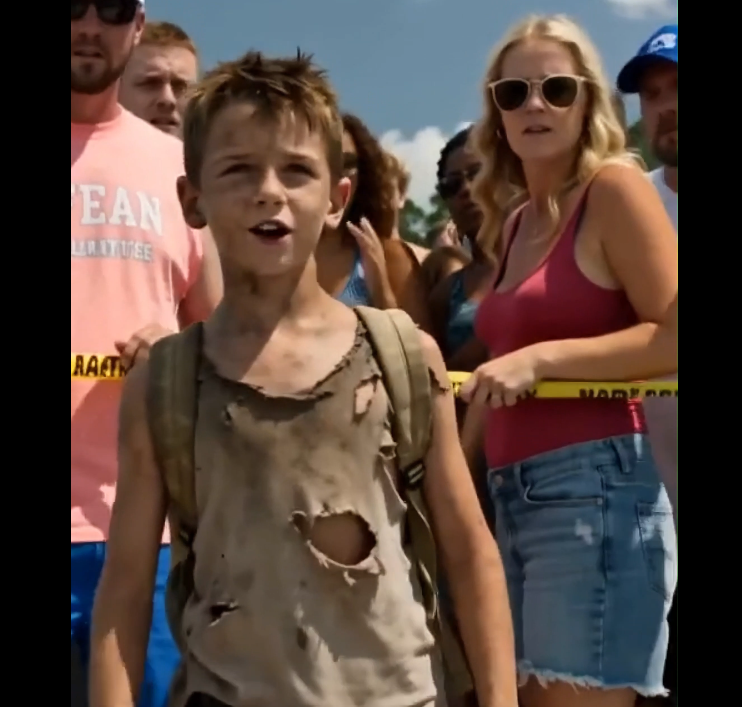
Just then, the crowd slowly parted.
A skinny twelve-year-old boy wearing torn clothes and worn-out shoes stepped forward. His face was dirty, but his eyes were calm and determined.
“My name is Noah,” he said quietly.
Jonathan looked down at him.
“What do you want, kid?”
“I’ll cross the lake.”
For a moment, the entire crowd fell silent.
Then laughter exploded everywhere.
Someone shouted, “Go home before you get eaten!”
Another person laughed.
“Where are your parents?”
Jonathan shook his head.
“Son, are you out of your mind? This isn’t child’s play. Go home.”
Noah looked toward the lake without fear.
“I can do it.”
Jonathan crossed his arms.
“You think you can swim through a lake full of alligators?”
Noah smiled.
“This is my home. These alligators are my friends.”
The crowd laughed even harder.
Jonathan pointed toward the water.
“Fine. Don’t come running back if something bad happens.”
Noah simply nodded.
Nobody knew Noah’s story.
He wasn’t born into wealth.
He had grown up in a tiny abandoned fishing shack hidden deep in the wetlands after losing his parents in a hurricane years earlier. An elderly fisherman named Samuel had found him and raised him with kindness but little money.
Samuel taught Noah everything about the swamp.
“Never fight nature,” Samuel always said.
“Respect it.”
He explained how alligators behaved.
When they hunted.
When they rested.
How sudden movements attracted attention.
How staying calm could prevent unnecessary danger.
Noah had spent years fishing, repairing boats, and observing wildlife.
He never treated the animals like pets.
He simply understood them.
After Samuel passed away, Noah survived alone by catching fish and selling them in nearby towns.
The swamp had become his world.
Back at the lake, Noah removed his torn shoes.
He stepped into the shallow water.
The crowd gasped.
An alligator floated only a few feet away.
Noah stood perfectly still.
The reptile slowly turned away.
He continued walking along a narrow, shallow route near patches of marsh grass that he had quietly studied before stepping in.
The audience watched in complete silence.
Jonathan frowned.
“This can’t be happening.”
Noah moved slowly, never splashing.
He carefully avoided nests and deeper channels where larger alligators gathered.
One enormous alligator surfaced nearby.
The crowd screamed.
Noah stopped moving.
The animal drifted past him without showing aggression.
Minutes felt like hours.
Step by step, Noah continued.
Sweat rolled down Jonathan’s forehead.
News helicopters circled above.
Television reporters spoke excitedly into their cameras.
“I’ve never seen anything like this.”
Halfway across, Noah noticed a frightened dog stranded on a small patch of mud. It had likely wandered too close to the water and become trapped.
The dog whimpered.
Noah hesitated.
He knew rescuing it would make the crossing even riskier.
Without thinking twice, he slowly changed direction.
Using a long fallen branch, he gently guided the frightened dog toward him. He lifted the trembling animal into his arms and continued moving with slow, careful steps.
The crowd watched in disbelief.
“He stopped… to save the dog?”
Some people began crying.
Jonathan stared speechlessly.
Nearly forty minutes after entering the lake, Noah finally reached the opposite shore.
The crowd exploded with cheers.
People clapped so loudly that birds flew from nearby trees.
The rescued dog jumped from Noah’s arms and happily ran toward its grateful owner, who had been searching for it all morning.
News reporters rushed across the bridge to interview Noah.
“How did you survive?”
Noah smiled.
“I respected the animals instead of challenging them.”
“What did you mean when you said they were your friends?”
“They aren’t really my friends,” Noah replied. “They’re wild animals. But if you understand nature instead of trying to dominate it, you can often avoid unnecessary danger.”
His answer quickly spread across television and social media.
Millions praised the humble boy for his wisdom.
Jonathan slowly walked across the pedestrian bridge to meet Noah.
For the first time that day, the wealthy businessman looked embarrassed.
He extended his hand.
“I owe you an apology.”
Noah shook it.
“You kept your promise.”
Jonathan nodded.
“I certainly will.”
In front of the cameras, Jonathan handed Noah a certified check for one million dollars.
The crowd cheered once more.
But Noah surprised everyone again.
He smiled politely.
“I don’t need a mansion.”
Jonathan looked confused.
“You don’t?”
“No.”
“What will you do with the money?”
Noah looked toward the wetlands where he had spent his childhood.
“I’ll build a home for children who have nowhere to go.”
The crowd became silent.
“And I’ll create a wildlife education center,” Noah continued. “People fear animals because they don’t understand them. If children learn to respect nature, both people and wildlife can stay safer.”
Jonathan felt tears forming in his eyes.
The crowd gave Noah a standing ovation.
One year later, the abandoned fishing shack was gone.
In its place stood the Samuel Nature and Children’s Center.
Homeless children received food, education, and a safe place to sleep.
Experienced wildlife experts taught visitors how to safely live alongside Florida’s unique ecosystems.
Warning signs reminded everyone that alligators were wild animals deserving respect and distance.
Jonathan became one of the center’s biggest donors.
Every year, he returned to visit Noah.
“You taught me something,” Jonathan admitted during one visit.
“I thought courage meant risking your life.”
Noah smiled.
“Courage isn’t ignoring danger.”
“What is it then?”
“It’s understanding the danger, respecting it, and making wise choices.”
Jonathan nodded thoughtfully.
“I’ll never forget that.”
As the sun set over the peaceful wetlands, dozens of alligators floated quietly in the distance, just as they always had.
They weren’t monsters.
They weren’t pets.
They were simply wild creatures living in their own home.
And the boy who once said, “These alligators are my friends,” had really meant something much deeper.
Home isn’t about owning a place.
It’s about understanding it.
Sometimes the greatest strength isn’t being fearless.
It’s showing respect—for nature, for life, and for every creature that shares the world with us.
That was worth far more than a million dollars.