The automatic doors of Mercy General slid open with a tired hiss, letting in the late afternoon light and a woman who looked as if she had been walking through years instead of miles.
She was small, wrapped in a faded blue shawl despite the warmth outside, gray hair tucked neatly under a scarf. In her hand she held a folder — old, bent at the corners, thick with papers — and she paused just inside the lobby as if gathering courage. Hospitals have a way of making even the strong feel fragile. For her, the place felt like a mountain.
The emergency lobby was loud. Phones ringing. A child crying. A television murmuring health tips no one listened to. Behind the reception desk stood Nurse Kelly Harrow — efficient, overworked, and in a very bad mood. Her shift had doubled after two no-shows. Her coffee had gone cold three hours ago. Compassion had been replaced by irritation.
The older woman stepped forward slowly.
“Ma’am,” she said softly, voice trembling, “I need help. I was told to come today. My chest — it hurts when I breathe.”
Kelly didn’t look up at first. Fingers kept typing.
“ID and insurance.”
“I… I have papers,” the woman said, sliding the worn folder forward with both hands.
Kelly sighed loudly, opened it, flipped once, then twice. Her expression hardened.
“This is old authorization. Expired program. You’re not in our active coverage network.”
“I was told—” the woman began.
Kelly cut her off and finally looked straight at her — not with curiosity, not with care — but with annoyance sharpened by fatigue and prejudice she didn’t even bother to hide.
“We don’t treat you guys here — now go away, shhuuu!”
Her hand flicked toward the exit like she was waving off a fly.
The words landed like a slap. Conversations nearby stopped mid-sentence. A man in a wheelchair looked up. A mother pulled her child closer. The older woman froze, lips parted, eyes glassy — not angry, just wounded in a way that suggested this was not the first time.
“I… I walked two buses,” she whispered.
Kelly turned back to her screen.
“Then take two back.”
Silence stretched — tight and ugly.
From across the lobby, a voice cut through it.
“What is going on here?”
Dr. Daniel Mercer walked toward the desk with long, controlled steps. Mid-50s, silver at the temples, reputation carved from decades of trauma medicine and zero tolerance for nonsense. He had the rare ability to make a room quieter just by entering it.
Kelly straightened slightly but kept her defensive tone. “Expired coverage case. Not eligible. I’m clearing the line.”
Dr. Mercer didn’t look at Kelly first.
He looked at the older woman.
And his expression changed — not to surprise, but recognition.
He stepped closer. Softer voice now. “Ma’am… are you in pain right now?”
She nodded once, unsure whether she was allowed to answer.
He turned to Kelly.
“My office. Now.”
“Doctor, I was just—”
“Now.”
No raised voice. Worse — calm authority.
Kelly followed, heat rising in her face. The lobby buzz resumed behind them like sound returning after a power cut.
Inside the office, Mercer closed the door firmly. Not slammed — sealed.
Kelly crossed her arms. “With respect, we can’t treat every—”
He dropped the worn folder onto his desk. It hit with weight.
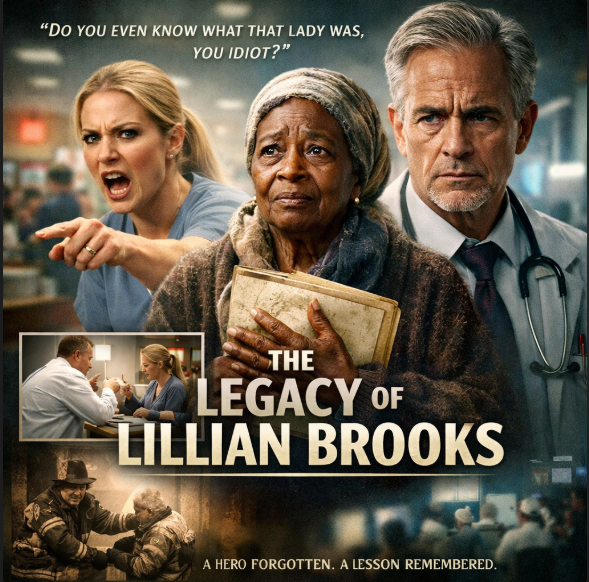
“Do you even know what that lady was, you idiot?”
Kelly blinked. “What?”
“Was,” he repeated sharply. “Past tense — because people like you make sure heroes don’t stay visible long enough to be remembered.”
She stared, confused and defensive. “I checked the system. She’s not covered.”
“You checked billing,” Mercer said. “You didn’t check history.”
He opened the folder carefully — reverently — and turned it toward her.
Inside were photographs. Old newspaper clippings. A certificate with a state seal. A medal citation.
Kelly leaned forward despite herself.
“That,” Mercer said, tapping the page, “is Lillian Brooks.”
Silence.
Kelly read aloud in disbelief. “State Civilian Valor Award… 1998… hospital evacuation… fire rescue…”
Mercer’s jaw tightened.
“She pulled seven patients out of a burning rehab wing when the staff froze. No gear. No training. Just courage. Third-degree burns on her arms. Lost partial lung function from smoke damage.”
Kelly swallowed.
Mercer continued, voice lower now — angrier for being controlled.
“I was a resident here when they brought her in. She refused pain medication until every patient she dragged out was accounted for.”
Kelly’s posture shifted. Defensive walls cracking.
“I… didn’t know.”
“That’s the point,” Mercer snapped. “You didn’t ask. You judged.”
He took a breath, steadied himself.
“She comes every year around this date. Lung scarring complications. We flagged her file decades ago for priority intake regardless of coverage status. It’s in the legacy system — not billing — medical honors registry.”
Kelly sat down slowly.
“I told her to leave,” she said quietly.
“Yes,” Mercer replied. “You did.”
The words hung there — heavy, final.
Outside, Lillian Brooks had taken a seat near the wall, hands folded over the folder that was no longer in her possession. She looked smaller sitting down. Invisible again. People passed — some glancing, none stopping.
Then Mercer returned.
He crouched slightly so he was eye level — not towering, not distant.
“Ms. Brooks,” he said gently, “we’re taking you in right now.”
She searched his face, uncertain.
“I’m sorry for how you were spoken to,” he added. “That should never have happened here.”
Her voice was thin but steady. “Hospitals are busy places. I understand.”
“No,” he said quietly. “You forgive too easily.”
A transport nurse arrived with a wheelchair. This one spoke kindly. Used her name. Moved slowly.
As they rolled away, Mercer stood watching — not like a doctor tracking a patient, but like a soldier saluting another.
Behind him, Kelly had come back into the lobby.
Her eyes found the empty space where Lillian had been standing earlier.
Shame is a strange teacher — harsh, but effective.
The rest of the shift felt different. Every patient looked more human. Every file felt heavier.
Three hours later, Mercer found Kelly outside Imaging, waiting with a cup of fresh coffee she hadn’t touched.
“How is she?” Kelly asked quietly.
“Stable. Treatable. Painful — but manageable.”
Kelly nodded. Then: “May I apologize?”
Mercer studied her — measuring sincerity, not words.
“Yes,” he said. “But not to erase your guilt. To acknowledge her dignity.”
They walked in together.
Lillian lay propped up, oxygen line in place, eyes open and alert.
Kelly stepped forward — no desk between them now.
“Ms. Brooks… I spoke to you cruelly. I made an assumption instead of offering care. I was wrong. I am sorry.”
No excuses. No explanations. Just truth.
Lillian watched her for a long moment — the way older people do when they’ve learned that apologies are easy and change is rare.
Then she smiled faintly.
“Then do better for the next frightened person,” she said. “That will be enough.”
Kelly’s eyes filled unexpectedly.
Mercer looked away — giving them privacy without leaving.
On her way out that night, Kelly stopped at the hospital history wall — something she had walked past a thousand times without seeing.
There was a photo newly cleaned and re-framed that evening.
Lillian Brooks — Civilian Hero — Patient Advocate by Action
Kelly stood there a long time.
Hospitals save lives every day.
But sometimes — if you’re lucky — a life walks back in and saves the hospital.