
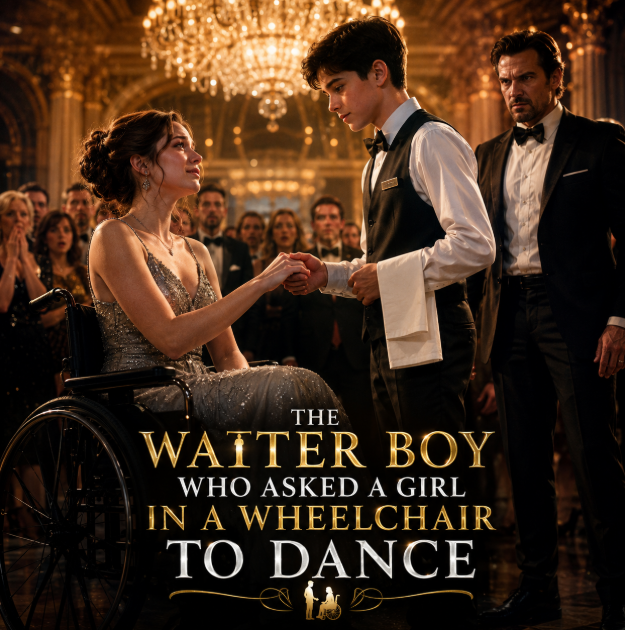
The grand ballroom of the Grand Crescent Hotel shimmered beneath enormous crystal chandeliers. Soft golden lights reflected across polished marble floors while a live orchestra filled the room with elegant music.
Wealthy business leaders, celebrities, and politicians mingled in designer suits and sparkling gowns. It was the city’s most prestigious charity gala, where every detail spoke of luxury.
Near the center of the ballroom, however, sat someone who wasn’t smiling.
Twenty-five-year-old Emily Carter sat quietly in a wheelchair beside a large window overlooking the city skyline. She wore a breathtaking silver evening gown, but the sparkle of the dress couldn’t hide the sadness in her eyes.
Couples danced gracefully across the floor while laughter echoed around the hall. Emily watched them with a gentle smile that lasted only a moment before fading.
Three years earlier, a devastating car accident had changed her life forever. Doctors had told her that the damage to her spine was severe. They believed she would never walk again.
Since then, she had stopped attending social events. Tonight’s gala was the first public appearance she had made in months, only because her father had insisted.
Her father, Richard Carter, was one of the richest businessmen in America.
He loved his daughter deeply, but after spending millions on surgeries, specialists, and experimental treatments without success, he had become overprotective. He trusted almost no one around her.
Across the ballroom, thirteen-year-old Noah quietly carried a tray of sparkling water between tables.
Unlike the other hotel staff, Noah wasn’t working to earn extra spending money.
He was helping his widowed mother, who worked two jobs to support them. During weekends and special events, Noah volunteered at the hotel to help his mother and save money for school.
He noticed Emily sitting alone.
While everyone else admired the decorations or enjoyed expensive meals, Noah noticed something different.
He noticed loneliness.
After placing down his tray, he walked toward her with a warm smile.
“Will you dance with me?” he asked politely.
Emily looked up in surprise.
For the first time that evening, someone had spoken to her without pity.
A tear rolled down her cheek.
“Don’t you see?” she whispered. “I can’t walk.”
Instead of looking embarrassed, Noah smiled even brighter.
“Don’t worry,” he said confidently. “I can make you walk again.”
Emily blinked.
She wasn’t offended.
She was simply confused.
Before she could answer, an angry voice echoed through the ballroom.
“Stay away from my daughter!”
Richard Carter hurried toward them, his face red with anger.
Guests immediately stopped talking.
The orchestra slowly fell silent.
Hundreds of eyes turned toward the small waiter boy standing beside the wheelchair.
Richard stepped between Noah and Emily.
“What kind of cruel joke is this?” he demanded.
“My daughter has suffered enough.”
Noah remained calm.
“I wasn’t joking, sir.”
Richard pointed toward the exit.
“Go back to serving tables before I have security remove you.”
Hotel employees nervously watched from a distance.
Most expected the frightened teenager to apologize and run away.
Instead, Noah quietly reached into his pocket.
Everyone assumed he was pulling out a phone.
Instead, he unfolded a small, worn notebook.
Its pages were filled with handwritten sketches of muscles, nerves, balance exercises, and rehabilitation techniques.
Richard frowned.
“What is that?”
“My dad’s notebook.”
Richard crossed his arms impatiently.
“And who was your father?”
“A physical therapist.”
The ballroom remained silent.
Noah looked down at the notebook.
“My dad spent twenty years helping patients who were told they’d never walk again.”
Emily listened carefully.
“He believed that some people stopped trying because everyone around them had already accepted defeat.”
Richard’s expression softened only slightly.
“My father passed away last year,” Noah continued.
“But before he died, he told me something I’ll never forget.”
He smiled gently.
“‘Never tell someone what they can’t become. Help them discover what they still can.'”
Emily felt another tear fall.
Noah carefully opened the notebook to one particular page.
“There are no miracles in here,” he said.
“No magic.”
“Only hope, patience, and thousands of tiny steps.”
Richard sighed.
“We’ve already tried everything.”
“Have you?” Noah asked respectfully.
Richard hesitated.
Noah continued.
“Or did every doctor focus on what your daughter had lost instead of what she still had?”
Those words lingered in the silent ballroom.
Emily slowly looked at her own legs.
She hadn’t tried physical therapy in almost a year.
Every failed treatment had convinced her there was no point anymore.
Noah knelt beside her wheelchair.
“I’m not saying you’ll stand tonight.”
“I’m saying… don’t let the world decide your future before you do.”
The room was completely still.
Even the orchestra members watched quietly.
Richard looked at the notebook again.
Its pages were old.
Corners were folded.
Some pages contained coffee stains.
This wasn’t something a boy had invented to impress people.
It was years of knowledge left behind by someone who had dedicated his life to helping others.
For the first time, Richard’s anger disappeared.
He looked at Emily.
“What do you want?”
Emily took a deep breath.
“I want to try again.”
Richard closed his eyes.
For years, he had been protecting her from disappointment.
Perhaps he had also been protecting her from hope.
The following Monday, Richard contacted one of the country’s best rehabilitation centers.
Not because Noah promised a miracle.
But because Noah reminded them that giving up was the only guarantee of failure.
Months passed.
Rehabilitation was exhausting.
Some days Emily celebrated tiny improvements.
Other days she cried in frustration.
Noah visited whenever he could.
He never acted like a hero.
Sometimes he simply sat beside her and encouraged her to keep going.
Weeks became months.
Then one morning, something happened.
Emily stood.
Only for four seconds.
But she stood.
Doctors applauded.
Therapists smiled.
Emily cried.
Richard cried harder than anyone.
Recovery continued.
A few weeks later she managed six steps using parallel bars.
Then ten.
Then twenty.
Nearly a year after the charity gala, the Grand Crescent Hotel hosted the same annual event.
Guests filled the ballroom once again.
The orchestra played the same opening melody.
Richard stood on stage holding a microphone.
“Ladies and gentlemen,” he announced, “last year I believed money could solve every problem.”
“I was wrong.”
“The greatest gift my daughter received wasn’t expensive treatment.”
“It was hope.”
The crowd applauded.
Then everyone turned toward the ballroom entrance.
Emily walked inside.
Not perfectly.
Not without effort.
But on her own.
Thunderous applause filled the hall.
Many guests wiped away tears.
Emily walked across the dance floor until she reached Noah.
He was once again wearing a waiter’s uniform.
She smiled.
“A year ago,” she said softly, “you asked me to dance.”
Noah laughed.
“I remember.”
Emily held out her hand.
“My turn to ask.”
The orchestra began playing.
Slowly, carefully, the two stepped onto the dance floor.
Noah matched every step to her pace.
No one noticed the imperfections.
They only saw courage.
The ballroom erupted in applause.
Richard watched proudly from the side of the room.
He had never imagined that the most valuable person he would meet that year wouldn’t be a billionaire, a celebrity, or a politician.
It would be a thirteen-year-old waiter who refused to let hope disappear.
As the dance ended, the audience rose to their feet for a standing ovation.
But just as everyone believed the story was over, the hotel’s elderly owner walked onto the stage.
He smiled at Noah.
“I’ve waited a long time for this moment.”
The audience looked confused.
The owner continued.
“Many years ago, Noah’s father saved my wife after doctors had lost hope. Since then, I promised that if his family ever needed help, I would always be there.”
He turned toward Noah.
“Your mother has worked at this hotel for years without telling anyone who she was.”
The old man handed Noah a sealed envelope.
Inside was a full scholarship to one of the nation’s finest medical schools, guaranteed for the future, along with financial support for his family until he graduated.
The ballroom erupted into applause once again.
Richard smiled.
“It seems,” he said, “the boy who gave my daughter hope has just been given the chance to bring hope to thousands more.”
Noah looked up at the chandelier-filled ceiling, silently thanking the father who had left behind more than a notebook.
He had left behind a legacy.
And that legacy had changed every life in the ballroom.