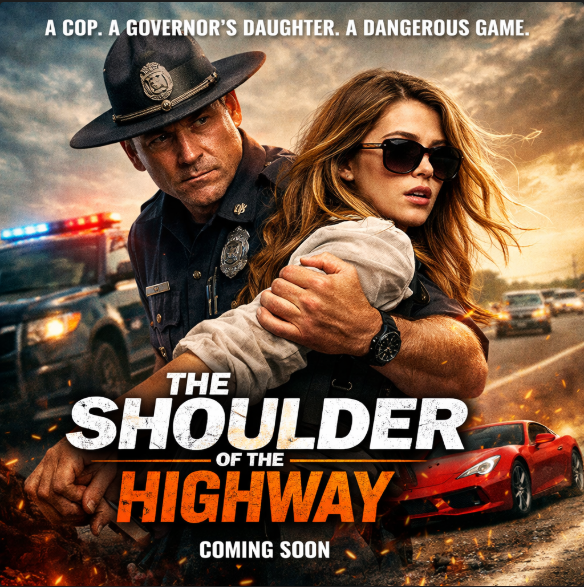
The sun was bright and sharp over Route 47, the kind of afternoon where heat shimmered above the asphalt and every chrome surface flashed like a mirror. Traffic was steady but fast — commuters, truckers, weekend travelers. And then there was the red sports car slicing through lanes like it owned the road.
Officer Daniel Reeves noticed it instantly.
He’d been highway patrol for twelve years. You develop an instinct — not for speed alone, but for attitude. The car wasn’t just fast; it was careless. No signals. Hard cuts between vehicles. A near miss with a delivery van.
He flipped on his lights.
The red car hesitated, accelerated, then finally drifted onto the shoulder with a reluctant jerk.
Reeves stepped out of his cruiser, adjusted his hat, and approached calmly. Body cam on. Dash cam recording. Standard procedure. His boots crunched gravel as trucks thundered past.
Inside the sports car sat a young woman in oversized sunglasses, perfectly styled hair, and a look of deep annoyance — like being stopped was a personal insult.
He leaned slightly toward the window.
“Driver’s license, please.”
She didn’t reach for anything. Didn’t even blink. Just slowly turned her head and looked him up and down.
“Do you know who my father is, you idiot?”
Reeves had heard versions of that line maybe fifty times. Usually from drunk college kids or spoiled trust-fund types. The words didn’t bother him. The tone did.
He kept his voice level. “License and registration.”
She smirked. “You really want to lose your job today?”
Behind the arrogance, he noticed something else — tension in her jaw, a faint tremor in her fingers resting on the steering wheel. Not fear. Nerves.
“Step out of the vehicle,” he said.
“No.”
That made it simple.
He opened the door, unbuckled her belt, and guided her out with firm, controlled force — trained restraint, nothing rough. She gasped in outrage.
“Call your dad,” Reeves said evenly. “Let’s see what he can do.”
Traffic roared past. Her confidence flickered — just for half a second.
Then the black SUV convoy arrived.
Two of them. Government plates.
They stopped behind the cruiser.
Reeves didn’t turn around. Didn’t need to. He heard the doors open. Measured footsteps.
A man in a navy suit approached, holding a badge wallet — not police. Federal.
“Officer,” the man said quietly, “I’m Special Agent Cole. We need a word.”
Reeves kept hold of the girl’s arm. “She was driving reckless.”
“I know,” Cole said. “That’s why we’re here.”
The girl shot Cole a furious look. “You were supposed to stay back.”
Cole ignored her. Looked at Reeves. “Her father is Governor Whitaker.”
Reeves shrugged slightly. “Good for him.”
Cole leaned closer, voice lower. “And she’s in the middle of an active federal operation.”
That landed.
Reeves studied the girl again — not spoiled now, but coiled. Alert. Watching every passing vehicle.
“What kind of operation?” Reeves asked.
Cole answered with a question. “Did you notice the gray pickup that exited right after you lit her up?”
Reeves replayed the moment in his mind. Yes. Sudden exit. Fast.
“Smuggling case,” Cole said. “She’s been running controlled contact to get inside their network. You stopping her wasn’t planned — but it may have saved her life.”
The girl pulled her arm free. “I had it handled.”
“You were about to get boxed in by their scout vehicle,” Cole replied calmly.
Reeves frowned. “Then why the attitude?”
She met his eyes. The arrogance dropped like a mask.
“Because if they think I get special treatment,” she said quietly, “I’m dead.”
That changed the air.
Cole exhaled. “We’re improvising now. Officer Reeves — we could use your help.”
“Doing what?”
“Making this stop look real.”
Reeves almost smiled. “That part I can do.”
They staged the scene.
Ticket written. Stern lecture delivered — loudly enough for any distant observers. The girl — whose real name turned out to be Lena Whitaker — played along, furious and humiliated.
Cole’s team slipped trackers into her vehicle frame while pretending to argue jurisdiction.
Then Reeves leaned in close and murmured, too soft for cameras:
“If this goes bad, you floor it north. Mile marker 212. There’s a service road dip — they can’t box you there.”
She studied him — reassessing.
“Why help me?” she asked.
“Because reckless drivers are my job,” he said. “Dead undercover assets are paperwork.”
A ghost of a smile touched her lips.
She drove off — slower this time.
Two hours later, Reeves’ shift should have ended.
Instead, he sat in an unmarked unit beside Agent Cole, watching drone feed on a tablet. The gray pickup had met with two cargo vans at an abandoned quarry.
Weapons trafficking. Bigger than expected.
Lena’s sports car rolled in.
“You sent her alone?” Reeves asked.
“She insisted,” Cole said. “She’s the only one they trust.”
On screen, men approached her car.
One opened her trunk.
Cole frowned. “That’s not protocol.”
The tablet feed glitched.
Signal jammed.
Cole swore. “They’re onto us.”
Reeves started the engine. “Location?”
“Eight miles.”
They drove.
The quarry exploded with motion when they arrived — vans starting, men shouting. Lena’s car blocked between vehicles.
Gunfire cracked — distant but real.
Reeves didn’t wait for orders. He used his cruiser like a battering ram, slamming into a van trying to pin her driver door. Metal screamed. The path opened.
“Drive!” he shouted.
She did — launching through dust and gravel.
Federal units swarmed in seconds later.
It was over in four minutes.
At the debrief, Cole reviewed body cam footage.
“You broke three pursuit guidelines,” the agent said.
“Only three?” Reeves asked.
Cole closed the folder. “You also prevented a federal witness from being executed.”
“Balances out,” Reeves said.
Lena entered the room — no sunglasses now, no attitude armor. Just tired eyes and a small bruise on her wrist.
“You didn’t have to come,” she said.
“Yeah,” Reeves replied. “I did.”
She hesitated. “I owe you an apology.”
“For the ‘idiot’ part?”
“For the act,” she said. “Not the word.”
He laughed once. “Fair.”
Cole slid a paper across the table — commendation notice.
Reeves didn’t touch it. “Just doing the job.”
Lena studied him a moment. “Most people see the governor’s daughter. You saw a bad driver.”
“You were a bad driver.”
She smiled. First real one.
Three months later, Reeves got a letter.
Not official. Handwritten.
Operation closed. Network dismantled. No leaks. No headlines — by design. Dad says thank you. I say it louder. — Lena
Inside was a photo: the red sports car — obeying a speed limit sign — with a sticky note on the dash that read:
LICENSE — CHECKED.
He pinned it to his locker.
Satisfying enough.