The playground was loud with the sound of summer—squeaking swings, sneakers scraping concrete, kids laughing like the world had never taught them how to hate.
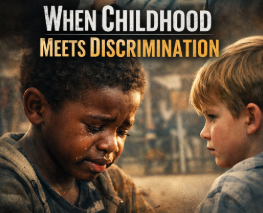
On the far side, two boys sat cross-legged near a faded hopscotch grid. One was Black, small for his age, wearing clothes that had clearly lived a few childhoods before him.
The other was White, bright sneakers still clean, hair neatly trimmed. They were both six. They were both smiling.
They didn’t know anything about politics or prejudice. They knew toy cars. They knew who could make the loudest engine noise. They knew how to laugh until milk came out of their noses.
For ten perfect minutes, nothing else mattered.
Then a shadow fell across them.
The White boy’s mother appeared like a storm breaking the sky. Her heels clicked fast, sharp, angry. She grabbed her son’s wrist and yanked him up so hard the toy car skidded across the pavement.
“What do you think you’re doing?” she shouted.
The boys froze.
Her eyes locked onto the Black child like he’d committed a crime by breathing the same air. “Stay away from my son,” she snapped. “Don’t you ever come near him again.”
The playground went quiet in that way only cruelty can manage.
The Black boy blinked, confused. He didn’t understand the words fully, but he understood the tone. He felt the heat rise in his face, the sting behind his eyes. His hands trembled as he reached for the toy car, then stopped. He didn’t touch it. He stood up instead, chest tight, throat burning.
“I—I was just—” he started.
“Go,” she barked. “Go before I call someone.”
The White boy tried to speak. “Mom, we were—”
“I said now.”
She dragged him away, her grip firm, her jaw tighter. The boy looked back once, helpless, before disappearing behind the slide.
The Black child stayed where he was.
Tears fell—slow at first, then fast. His shoulders shook as the world he thought was safe suddenly made no sense. He didn’t know what he’d done wrong. He only knew it hurt. Bad.
From the benches nearby, a few adults looked away. A few pretended they hadn’t heard. Silence spread like permission.
Then footsteps approached—steady, controlled.
His mother.
She had been watching from a distance, groceries at her feet, heart pounding so hard she felt it in her ears. She knelt beside her son and pulled him into her chest. His sobs soaked her shirt.
“It’s okay,” she whispered, though it wasn’t. “I’ve got you.”
She stood and turned toward the woman who had already decided her child was a problem.
“What you just did,” the Black mother said, her voice low and calm, “will cost you.”
The White mother scoffed. “Excuse me?”
“You humiliated a child,” she continued. “You taught hate where there was none. And one day, when consequences come knocking—don’t blame us.”
A few parents shifted uncomfortably. Someone cleared their throat. No one stepped in.
The White mother rolled her eyes. “I’m protecting my son.”
“No,” the Black mother said softly. “You’re poisoning him.”
She took her son’s hand and walked away, each step heavy with a promise she didn’t want to make but couldn’t ignore.
That night, the Black boy didn’t sleep. Every time he closed his eyes, he saw the woman’s face, heard her voice telling him to stay away, to disappear. His mother sat beside his bed and held his hand until dawn.
“This world isn’t always kind,” she told him. “But you didn’t do anything wrong.”
“Why didn’t she like me?” he asked.
His mother swallowed. “Because some people are taught fear instead of love.”
The question stayed with him long after childhood faded.
Years passed.
The playground was repainted. New swings replaced the old. But the memory didn’t fade—it hardened.
The Black boy grew into a young man who studied harder than anyone expected. He learned laws, history, systems—how power worked, how it failed, and who it crushed when no one was watching. He volunteered. He spoke. He listened. And every time someone said, “It’s not that serious,” he remembered how serious it felt at six years old.
Meanwhile, the White boy grew up too. His life was easier in ways he didn’t notice. Doors opened. Teachers assumed the best. When he messed up, someone always explained it away. But something nagged at him—a picture in his head of a boy crying on a playground and the way his mother’s hand had tightened around his wrist.
He never forgot that look.
Their paths crossed again one afternoon years later, in a place neither expected.
A courthouse.
The Black man stood in a tailored suit, calm and composed, representing a family who claimed discrimination at a local school. The White man sat in the gallery, eyes widening as recognition hit him like a punch to the chest.
The lawyer spoke clearly, confidently. His words carried weight. He wasn’t angry. He didn’t need to be. Truth did the work for him.
The case was about a child told he didn’t belong.
The judge listened. The room was quiet.
When the ruling came down, it was decisive.
Accountability.
Outside the courthouse, the White man waited, heart racing. When the lawyer emerged, he stepped forward.
“I don’t know if you remember me,” he said. “But we played together once. When we were kids.”
The lawyer studied his face, then nodded slowly. “I remember.”
“I’m sorry,” the White man said, voice breaking. “I didn’t stop her.”
The lawyer looked at him for a long moment. “You were a kid,” he said. “But now you’re not.”
He turned to leave.
“Wait,” the man said. “What can I do?”
The lawyer paused. “Teach better than you were taught.”
The story made the news.
Not the playground incident—that never had. But the lawsuit. The ruling. The message.
Comment sections exploded. Some denied it. Some minimized it. Some got angry that anyone dared to talk about race at all. But many listened. Many remembered moments they’d brushed off, moments that suddenly looked different under the light.
The Black mother watched the coverage from her living room, her son beside her. She squeezed his hand.
“You did good,” she said.
He smiled. “You did.”
Across town, the White mother sat alone, television muted, watching headlines scroll by. She saw her reflection in the dark screen and looked away. Consequences had arrived quietly, without yelling, without drama. They always did.
Racism doesn’t start with slurs or laws or violence.
It starts with a moment.
A sentence.
A choice.
It starts when adults teach children who is “safe” and who is “other.” It grows when silence protects cruelty. And it survives when people insist it isn’t real because it makes them uncomfortable.
But it can end the same way it begins.
With a choice.
Because those boys were never enemies.
They were taught to be.
And that lesson—whether we pass it on or break it—will always cost something.
The only question is who pays.