The Door They Didn’t Want Opened
The first kick didn’t break the door.
It only made the house shudder—like it was alive and trying to hold its breath.
Red and blue lights flooded the quiet suburban street, bouncing off cracked windows and abandoned cars. Neighbors watched from behind curtains, phones half-raised, afraid to record, afraid not to. This house had always been wrong. Everyone felt it. No lights at night. No trash pickup. No voices. No adults ever seen coming or going.
Just silence.
And now, that silence was surrounded by guns, badges, and men who didn’t flinch easily.
“Police! Open the door now!” Sergeant Daniel Reeves shouted, his voice sharp and controlled. “This is your final warning!”
No response.
Reeves exchanged a look with Officer Martinez. Both men had done this long enough to recognize it—the heavy stillness, the kind that meant something inside didn’t want to be found.
“Breach,” Reeves ordered.
The second kick landed hard.
The door cracked, split at the frame, then collapsed inward with a violent snap. Dust and splinters filled the air as officers surged inside, weapons raised, flashlights cutting through darkness.
“Clear left.”
“Clear right.”
“Kitchen empty.”
The house smelled wrong. Not rot. Not garbage.
Something worse.
Cold. Damp. Human.
The living room was bare—no couch, no TV, no pictures. Just stained carpet and scratch marks along the walls, like furniture had been dragged away repeatedly. The windows were sealed shut with wooden planks from the inside.
“Who lives here?” Martinez muttered.
Reeves didn’t answer. His eyes locked onto the hallway.
“Back rooms,” he said. “Slow.”
They moved down the narrow hall, boots crunching on broken glass. One door led to an empty bedroom. No bed. No closet. Just chains bolted into the floor.
Another door revealed a bathroom with no mirror, no soap, no towels. The sink had been removed entirely.
“Jesus…” someone whispered.
Then they reached the last door.
It was already open.
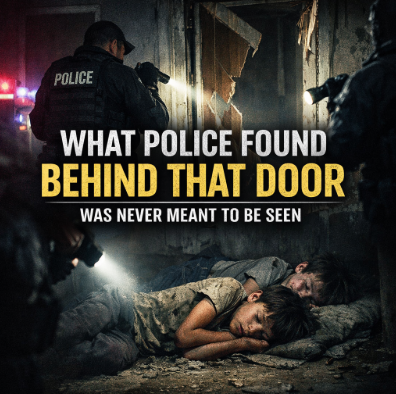
The flashlight beam swept across the floor—and stopped.
Two small shapes lay there, curled together on a thin, filthy blanket.
Children.
Boys.
No older than ten.
For a moment, no one spoke. Not because they didn’t know what to say—but because every instinct in their bodies screamed that whatever they were looking at was only the beginning.
The boys were painfully thin, ribs visible beneath torn, oversized shirts. Their arms were marked with bruises—some yellowed with age, others dark and fresh. One boy’s lip was split. The other had a healing cut near his eyebrow. Their hair was matted, dirty, unevenly cut like someone had hacked at it with dull scissors.
They weren’t pretending to sleep.
They were exhausted.
Reeves lowered his weapon slowly.
“Hey,” he said, kneeling, his voice dropping into something gentler. “Hey, buddy. Wake up.”
The older boy’s eyes fluttered open first.
They weren’t confused.
They were terrified.
He bolted upright, scrambling backward until his back hit the wall. His arms shot out in front of his face, defensive, instinctive—like he was used to being hit for waking up at the wrong time.
“Please,” the boy whispered. “We didn’t do anything.”
Reeves felt something twist in his chest.
“You’re not in trouble,” he said quickly. “You hear me? You’re safe now.”
The younger boy woke next, clutching his brother’s shirt with shaking hands. He didn’t cry. He didn’t speak. He just stared at the guns, the badges, the lights.
Martinez turned away, jaw clenched. He’d seen gang houses. Meth labs. Homicides.
This was worse.
“EMS, we need medics now,” Reeves said into his radio. “Two juveniles. Severe malnutrition. Signs of abuse.”
As officers spread through the rest of the house, Reeves noticed something else—numbers written faintly on the wall behind the boys. Erased. Rewritten. Erased again.
Dates.
Dozens of them.
Some circled. Some crossed out.
“What are these?” Reeves asked gently, pointing.
The older boy shook his head violently. “Don’t look at those.”
“Why?”
“Because if you look,” the boy said, his voice barely audible, “they come back.”
Reeves froze.
“Who comes back?”
The boy swallowed. His eyes flicked to the hallway. To the door. To the darkness beyond.
“The men.”
Before Reeves could ask more, one of the officers called out from the living room.
“Sergeant… you need to see this.”
They found it hidden beneath loose floorboards.
Not drugs. Not money.
Files.
Folders stacked neatly, wrapped in plastic. Each one labeled with a number. Inside were photographs. Medical charts. Consent forms.
Names crossed out in black ink.
A seal stamped at the bottom of each page: PRIVATE RESEARCH INITIATIVE.
Reeves felt his blood run cold.
“These aren’t adoption papers,” Martinez said quietly, flipping through a file. “They’re… evaluations.”
“Evaluations for what?”
Martinez didn’t answer immediately. He turned one page.
“Pain tolerance.”
“Sleep deprivation response.”
“Nutritional threshold.”
Reeves slammed the folder shut.
“Where are the adults?” he demanded.
No one had an answer.
The house had no food. No personal belongings. No evidence anyone lived there—except the boys.
And the files.
When the paramedics arrived, the younger boy clung to Reeves’ arm as they tried to lift him.
“No hospitals,” the boy whispered frantically. “They’ll find us.”
Reeves crouched beside him. “Who will?”
The boy shook his head, tears finally spilling over. “The people who paid for us.”
That was when Reeves knew.
This wasn’t a single crime.
It wasn’t even a single house.
It was a system.
Outside, as the boys were loaded into ambulances, a black SUV rolled slowly past the police perimeter. Its windows were tinted. Its plates were temporary.
It didn’t stop.
But someone inside was watching.
And somewhere far beyond that quiet street, phones were already ringing.
Because the door that broke tonight wasn’t supposed to.
And the people behind this conspiracy were about to do whatever it took to make sure it was the last one.
End of Part 1
👉 In the next chapter, the boys start talking—and what they reveal forces police to confront something far bigger than they’re prepared for.
Part 2: The Names That Shouldn’t Exist
The hospital room was too bright for boys who had spent most of their lives in darkness.
The fluorescent lights hummed softly above them, steady and harmless, but both boys flinched every time someone entered. Machines beeped. Curtains rustled. Shoes squeaked on linoleum floors. Normal sounds—yet each one made their shoulders tense.
The older boy sat upright in the bed, knees pulled to his chest. A thin blanket barely covered him. His chart clipped at the foot of the bed read UNKNOWN MALE – APPROX. 10 YRS.
The younger boy slept fitfully in the next bed, a tube taped gently to his arm delivering fluids his body had been denied for years.
Sergeant Daniel Reeves stood just outside the door, arms crossed, staring through the glass.
“You gonna sit down?” Officer Martinez asked quietly, handing him a coffee he hadn’t touched.
Reeves shook his head. “If I sit, it becomes real.”
Martinez sighed. “It is real.”
Inside the room, a child psychologist spoke softly to the older boy. She had introduced herself three times already. He still didn’t trust her.
“What’s your name?” she asked gently.
The boy hesitated.
Reeves leaned closer to the glass.
Finally, the boy whispered, “They told us names were dangerous.”
“Why?” the psychologist asked.
“Because names make you easier to replace.”
Reeves closed his eyes.
After nearly an hour, the boy agreed to talk—but only if the police stayed. Only if the door stayed open. Only if no one wrote anything down while he spoke.
They pulled up chairs.
Reeves knelt so his eyes were level with the boy’s.
“My name’s Daniel,” he said. “What do you want me to call you?”
The boy thought for a long moment. Then he said, “We used numbers. I was Seven.”
“And your brother?”
“Four.”
Reeves swallowed. “Do you have real names?”
Seven nodded slowly. “We used to. Before the house.”
“Tell me about before.”
Seven’s eyes drifted to the ceiling. “Before… there was a lady. She smiled a lot. She said we were going to help people. She said we were special.”
“How old were you?”
“I think… six.”
The psychologist leaned forward. “Was she your mother?”
Seven shook his head. “She worked for them.”
“Who is them?” Reeves asked.
Seven’s fingers clenched the blanket. “The ones who paid.”
The words sat heavy in the air.
“They brought us to the house,” Seven continued. “They said it was temporary. They said if we were good, we’d get to go home.”
“Did you?” Martinez asked quietly.
Seven didn’t answer.
“They tested us,” he said instead. “Food first. Then no food. Sleep. No sleep. Cold floors. Hot rooms.”
Reeves felt heat rise behind his eyes.
“They’d write things down,” Seven said. “Sometimes they’d argue. Sometimes they’d smile.”
“And the bruises?” Reeves asked.
Seven’s voice dropped. “Those were punishments. Or practice.”
“Practice for what?”
Seven looked at him. Really looked at him.
“To see how long it takes before someone breaks.”
The younger boy stirred in his bed, whimpering in his sleep.
Seven reached over instinctively, touching his brother’s arm.
“They told us it was important,” Seven went on. “That important people needed the results.”
“Doctors?” the psychologist asked.
“Some,” Seven said. “Some wore white coats. Some wore suits. Some wore badges that weren’t police.”
Reeves’ jaw tightened.
“What about the dates on the wall?” Martinez asked.
Seven flinched. “Those were selection days.”
“Selection for what?”
Seven swallowed hard. “When kids disappeared.”
The room went silent.
“Disappeared how?” Reeves asked.
“They’d take one,” Seven said. “Put them in the van. Say they were ‘approved.’”
“And then?”
Seven’s eyes filled with tears. “They never came back.”
Reeves felt something inside him crack.
“How many?” he asked.
Seven stared at his hands. “Too many.”
Down the hall, agents from Child Protective Services whispered urgently. Detectives photographed evidence recovered from the house. The files had already been scanned and flagged.
Within an hour, federal officials arrived.
Not local.
Not state.
Federal.
Reeves didn’t like how fast they showed up.
Two men in dark suits requested access to the boys. Their badges were real—but unfamiliar.
“Who tipped you off?” Reeves asked.
One of the men smiled thinly. “We monitor sensitive cases.”
Reeves stepped in front of the door. “These kids just came out of hell. You’ll wait.”
The man’s smile faded. “Sergeant, this investigation is bigger than your department.”
“That’s what worries me,” Reeves replied.
That night, Reeves couldn’t sleep.
He sat in his car outside the hospital, scrolling through internal databases. The seal on the files—PRIVATE RESEARCH INITIATIVE—was vague by design. No address. No executive names. Just shell companies stacked on shell companies.
But one thing kept repeating.
Funding transfers.
Legal authorizations.
Waivers signed under the guise of experimental youth care programs.
It was all paper-clean.
Too clean.
At 2:17 a.m., his phone buzzed.
Unknown number.
He hesitated—then answered.
“You opened the wrong door,” a man said calmly.
Reeves straightened. “Who is this?”
“A courtesy call,” the voice replied. “Stand down. Let federal partners handle this.”
“I am law enforcement.”
The man chuckled softly. “You’re local.”
The line went dead.
Reeves stared at the phone, heart pounding.
Inside the hospital, Seven jolted awake, gasping.
“They know,” he whispered.
The psychologist hurried to him. “Who knows?”
“They always know,” Seven said, trembling. “When someone talks. When someone asks questions.”
“Who?” she pressed.
Seven shook his head violently. “Please. Don’t make us move again.”
That was when the power flickered.
Just once.
Lights dimmed—then returned.
But Reeves saw it.
Security monitors rebooting.
Doors unlocking, then locking again.
A nurse ran down the hall. “We’ve got an issue with the system.”
Reeves stood up.
Something was happening.
And whatever had been done to those boys—it wasn’t finished.
Somewhere, far from the hospital, a conference room filled with men and women who never used their real names.
A screen showed a still image from a police bodycam.
Two boys on a floor.
One labeled SUBJECT SEVEN – NONCOMPLIANT.
Another line appeared beneath it.
PROTOCOL BREACH CONFIRMED.
A voice spoke calmly.
“Prepare retrieval.”
Back at the hospital, Seven clutched Reeves’ hand.
“They’re coming,” he whispered.
“For who?” Reeves asked.
Seven looked up at him, eyes hollow with certainty.
“For us.”
End of Part 2
👉 Part 3 will reveal who’s really behind the program—and how far they’re willing to go to erase the truth.
Part 3: What Police Found Behind That Door Was Never Meant to Be Seen