
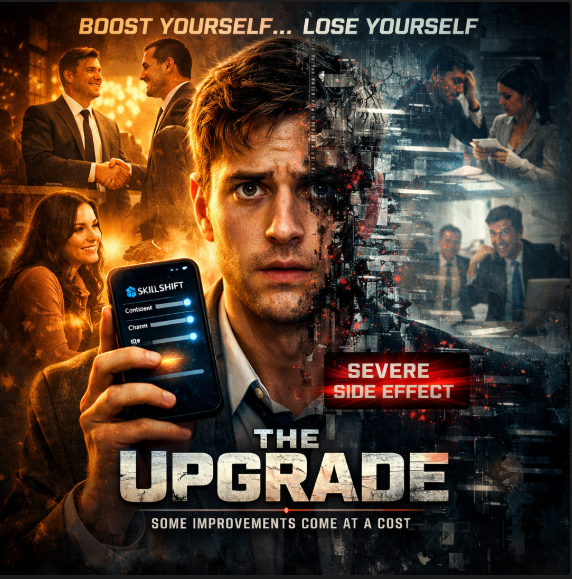
Ethan Cole never thought his life was bad — just painfully average.
At twenty-nine, he worked as a junior analyst at a mid-sized marketing firm in Chicago. He wore the same two blazers in rotation, drank burnt office coffee, and spoke only when asked in meetings. He wasn’t ignored — he was overlooked. There’s a difference, and he felt it every day.
His dating life was worse. Conversations with women felt like job interviews where he was underqualified. He rehearsed jokes in his head and forgot them when it mattered. Confidence, charm, presence — other men seemed born with these settings turned on. Ethan felt like his sliders were stuck at low.
One Thursday night, unable to sleep, he was scrolling through a tech forum full of experimental apps and beta tools. Between posts about productivity hacks and AI schedulers, a strange thread caught his eye.
“SkillShift — adjust your real-world abilities.”
He almost laughed — until he saw the comments.
Not many. Just a handful.
“This is not normal.”
“How is this even possible?”
“Use carefully.”
There was a download link. No company name. No description. Just a black icon with a white slider symbol.
“Why not,” Ethan muttered, and installed it.
The app opened without a login. No permissions requested. Just a clean interface with five sliders:
Confidence
Charisma
Cognitive Speed
Negotiation
Social Awareness
Each was set around 35–45%.
He smirked. “Accurate.”
At the bottom was a message:
Adjust responsibly. Changes apply immediately.
“Sure,” he whispered. “And I’m the President.”
He dragged Confidence to 80%.
The screen pulsed once.
A strange sensation hit him — not pain, not pleasure — like a mental fog lifting. His posture straightened without effort. His breathing deepened. His thoughts felt… aligned.
He stood up.
Walked to the mirror.
Same face — but the hesitation behind the eyes was gone.
He laughed once — sharply. Naturally.
“Okay,” he said slowly. “That’s new.”
The next morning proved it wasn’t placebo.
At the coffee shop, instead of mumbling his order, he spoke clearly, smiled, made eye contact. The barista smiled back — not politely, but genuinely. They talked. Easily. No script in his head. No panic buffer.
At work, during the morning meeting, something unthinkable happened.
He interrupted.
Not rudely — precisely.
“Actually, that metric is misleading,” Ethan said calmly. “If we segment by acquisition channel, the drop disappears.”
The room turned.
His manager blinked. “Show me.”
He did. Smoothly. No shaking hands. No racing pulse.
After the meeting, two coworkers stopped by his desk to ask questions — not small talk, real questions. Respect questions.
By lunch, he had raised Charisma to 75%.
By Friday, Negotiation was at 70%.
Results stacked fast.
Conversations flowed. Humor landed. He read emotional cues like subtitles. He wasn’t becoming someone else — he was becoming the version of himself he always tried to fake.
The first date came easily. Then another. Then options.
Women leaned in when he spoke. Silence no longer scared him — it worked for him.
Two weeks later, he led a client pitch when the senior manager got sick. He didn’t just survive — he dominated the room. The client signed.
Promotion followed within a month.
Salary up 28%.
Corner desk.
People now described him with words like sharp, magnetic, natural leader.
SkillShift became his secret weapon.
But he noticed something strange.
The sliders never stayed where he set them.
Every morning, small drops.
Confidence: 80 → 74
Charisma: 75 → 69
He assumed it was usage decay — like a battery.
So he adjusted them back up.
Then the warnings appeared.
Small red text at the bottom:
System compensation active.
He tapped it.
No explanation.
He ignored it.
Until the first glitch.
During a presentation, mid-sentence, a simple word vanished from his mind. Not a complex term — a basic one.
“Market… trend… direction… the… the…” he stalled.
The room waited.
The word growth would not come.
He recovered — barely — but sweat pooled under his collar.
That night he checked the app.
New hidden sliders had appeared.
Emotional Stability — 62%
Memory Recall — 71%
Empathy — 68%
He never added those.
They were decreasing.
A cold feeling crept into his stomach.
He searched the forum thread again.
Gone.
Deleted.
No archive.
No mirror links.
He posted asking about SkillShift.
No one replied.
He should have stopped using it then.
He didn’t.
Because the gains were real — and addictive.
He told himself he’d stabilize things later. Just one more boost cycle. One more upgrade push.
He raised Cognitive Speed to 90% before a high-stakes negotiation.
He won the deal.
He also forgot his neighbor’s name — someone he’d known for three years.
The losses accelerated after that.
Sleep became shallow. Faces felt familiar without context. Emotional reactions dulled — like watching life through glass.
Dates became performances instead of experiences.
Charm worked — but connection didn’t.
One woman — Lila — noticed.
“You say all the right things,” she told him quietly over dinner. “But it feels like you’re not… here.”
“I’m right here,” he smiled smoothly.
She shook her head. “No. You’re optimized.”
He laughed it off.
But the word stuck.
Optimized.
Three days later, he couldn’t remember his childhood dog’s name.
He sat frozen on his couch, phone in hand, heart pounding.
He opened SkillShift.
A new banner flashed across the top:
Balancing exchange nearing threshold.
“What exchange?” he whispered.
He dragged every enhanced slider back down.
Nothing changed.
They snapped back to boosted levels.
Locked.
He tried uninstalling.
The icon vanished.
The effects didn’t.
In the mirror, he still looked composed — but his eyes were empty-calculating now, not warm. Efficient, not alive.
At work, he performed brilliantly — and felt nothing.
Applause registered as data.
Praise registered as noise.
He went back to the app forum using deep search tools.
Finally found a cached quote from the deleted thread:
“It doesn’t add skill. It reallocates brain resources.”
His chest tightened.
Reallocates.
He wasn’t gaining abilities.
He was cannibalizing himself.
Trading memory for confidence. Trading empathy for persuasion. Trading emotional depth for cognitive speed.
He opened the app again.
One final locked panel had appeared.
Core Personality — 52%
Dropping live.
“Stop,” he said aloud. “Stop.”
No button.
Only text:
Optimization completes at 30%. Permanent state follows.
He panicked for the first time in weeks — real panic — raw and messy. It felt unfamiliar.
Good.
Human.
He searched his phone for the install file. Found it buried in temp storage. Opened metadata.
There — a developer contact hash.
He traced it through a code registry.
A name surfaced: Dr. Adrian Voss — cognitive systems researcher — project shut down after ethics violations.
There was an old university lab address.
He drove there at midnight.
The building was dark except one floor.
He went up.
A single office lit.
Inside — an older man, tired eyes, not surprised to see him.
“SkillShift user?” the man asked.
Ethan nodded.
“How bad?”
“Half of me is gone,” Ethan said.
Dr. Voss gestured him in. “Sit. Quickly.”
“Fix it.”
“Can’t fully,” Voss replied. “The system runs a zero-sum neural reallocation model. Enhancement requires subtraction.”
“Then reverse it.”
“Possible,” he said, “but painful — and you’ll lose the artificial gains.”
“I don’t care.”
Voss studied him. “Good. That means you’re still above forty percent.”
The reversal process wasn’t a machine.
It was deprivation.
No slider boosts. No optimization behaviors. No performance pushing. No manipulation. Forced cognitive rest. Emotional re-engagement. Memory reconstruction exercises.
“It will feel like becoming weaker,” Voss warned. “Because you are — temporarily.”
“I’d rather be real,” Ethan said.
The recovery took weeks.
Confidence dropped first — sharply. Conversations stumbled again. Charm vanished. Negotiations felt clumsy.
But memories returned.
His dog’s name.
His mother’s laugh.
Lila’s expression at dinner.
He called her — honestly this time — and didn’t try to impress her. Just spoke.
They met again.
“You’re different,” she said.
“I know,” he replied. “I’m slower.”
She smiled. “You’re warmer.”
Months later, Ethan was no superstar — but he was solid. Respected. Present. Human.
Sometimes he missed the upgraded version.
But he never missed the emptiness.
On an old backup phone, the SkillShift icon still exists — black, silent, waiting.
He keeps it as a reminder.
Some upgrades don’t improve you.
They replace you.