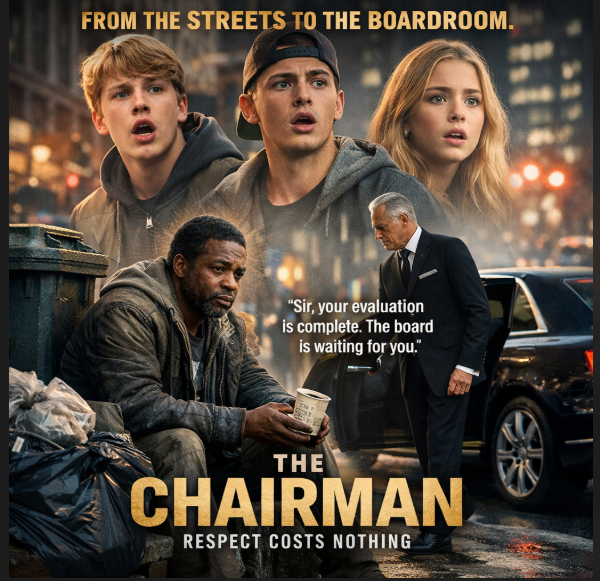
The first thing people noticed about him was the smell of smoke and city dust — not because it was strong, but because it felt like it belonged to him, like part of the pavement itself. He sat beside a green metal garbage bin on West 42nd Street, back against the wall, a paper cup resting near his shoe. His beard was uneven, his jacket faded, his eyes half-lowered like he had trained them not to expect anything from anyone.
Most people passed the way city people do — quick glance, quick judgment, quick forget.
His name, though nobody there knew it, was Marcus Reed.
At 2:12 PM, a group of teenagers turned the corner — loud, polished, expensive. Clean sneakers, branded hoodies, loud confidence. The kind that comes from never having missed a meal or a safety net. One of them was recording everything for a livestream, narrating nonsense to invisible viewers.
“City vibes, baby — raw and real,” the boy with the phone said, spinning the camera.
They saw Marcus.
They slowed.
Targets are rarely chosen for logic — only for vulnerability.
“Yo,” one laughed, stepping closer. “Bro lives here.”
Another kicked the garbage bin lightly so it rattled. “Prime real estate.”
Marcus didn’t react. He kept looking at the pavement.
“Say something,” the boy with the phone said, angling the camera inches from Marcus’s face. “Tell the internet how you messed up your life.”
A couple pedestrians hesitated, then walked on. Nobody wants trouble that isn’t theirs.
Marcus lifted his eyes once. Calm. Studying. Not wounded — measuring.
“Yeah,” another teen said, grinning. “This is where you people end up. No grind, no brain, no future.”
The livestream comments began flying — laughing emojis, fire emojis, insults, applause. Cruelty always finds an audience.
Marcus spoke quietly.
“Respect costs nothing.”
They burst out laughing.
“Motivational speaker!” one mocked. “From the trash can stage!”
The kid with the camera leaned closer. “You deserve this life, man. Choices, right?”
Marcus held his gaze for exactly three seconds. Not angry. Not ashamed.
Just patient.
Then he looked away again.
At 2:14 PM, a long black sedan rolled around the corner and stopped at the curb beside them.
Not flashy — precise. Silent engine. Mirror-polished paint. The kind of car that didn’t need attention because it commanded it.
The teens noticed immediately. Everyone does.
The rear window tint was dark as ink. The license plate was custom, but subtle. The doors didn’t unlock with a chirp — they clicked with authority.
The driver stepped out first — navy suit, earpiece, posture like a soldier. Then the rear passenger door opened.
A butler emerged — older, immaculate, gloved hands, silver hair combed straight back. He didn’t look confused. He looked exactly where he intended to be.
He walked past the teenagers without acknowledging them.
Straight to Marcus.
And bowed slightly.
“Sir,” he said, voice formal and steady, “your field evaluation is complete. The board is assembled and awaiting your return.”
The livestream kept recording — but nobody spoke.
Marcus didn’t move immediately. He looked up at the butler as if confirming a time he already knew.
“Traffic?” Marcus asked calmly.
“Cleared,” the butler replied. “Helicopter is on standby.”
One teen laughed nervously. “Yo — what is this, a prank show?”
No one answered him.
The butler opened the car door and stepped aside.
“Whenever you’re ready, Mr. Chairman.”
The title landed like a dropped plate.
Marcus placed his hands on his knees and stood — not like a weak man rising, but like someone unfolding. His posture changed first. Then his expression. Then, somehow, the air around him.
He removed the worn jacket.
Underneath was a tailored charcoal shirt — wrinkled, but expensive. A steel watch hidden under the sleeve caught the light.
The boy holding the phone slowly lowered it.
Marcus picked up the paper cup, folded it, and placed it neatly on top of the garbage bin lid.
Orderly. Intentional.
He turned to the teenagers.
No anger. No speech. Just a calm, direct look — the kind that makes noise feel childish.
Then he stepped into the car.
The door closed with a soft, final sound.
The sedan pulled away.
Silence hung in its exhaust trail.
“What… was that?” one teen whispered.
The livestream chat exploded.
Fake. Scripted. Actor. Setup. No way. Who is he??
The answer arrived twelve minutes later.
Across the city, in a glass tower overlooking the river, executives sat around a long table — uneasy, waiting. A digital screen displayed a paused live feed: the teenagers mocking Marcus beside the garbage bin.
The doors opened.
Marcus entered — freshly cleaned, hair combed back, wearing a navy suit now. Same eyes. Same calm.
Everyone stood.
“Good afternoon,” he said.
This was Marcus Reed — founder and majority owner of Reed Urban Systems — a company that managed sanitation, transit contracts, and public infrastructure projects across three states. Net worth: 2.4 billion dollars.
But that wasn’t why he ran the test.
He took his seat at the head of the table.
“Well?” said a board member carefully.
Marcus pressed a remote. The street footage played — multiple camera angles. The insults. The laughter. The bystanders walking away.
“Field empathy audit,” Marcus said. “Quarterly exercise.”
A woman across the table exhaled. “And the result?”
Marcus paused the frame on the teenagers’ faces.
“Unfiltered behavior when status appears low,” he said. “No incentives. No consequences. Pure character.”
A board member frowned. “They’re just kids.”
Marcus shook his head slightly. “They’re future voters, managers, officers, supervisors. Culture doesn’t appear later — it appears early.”
He switched screens.
Facial recognition profiles appeared — names, schools, family businesses.
Several board members leaned forward — surprised.
Marcus continued, “Two of them applied last month for our youth leadership scholarship.”
The room shifted.
“Applications denied,” Marcus said.
No one argued.
“Now,” he added, “show camera three.”
A new angle appeared — a street cleaner in an orange vest who had quietly stepped between the teens and Marcus for a moment, pretending to adjust the bin — not confrontational, but protective.
Marcus smiled slightly.
“That man gets promoted.”
The operations director blinked. “He works for a subcontractor.”
“He works for us now.”
The meeting moved on — contracts, budgets, expansions — but the tone had changed. Decisions felt less abstract.
Because the street had spoken.
Meanwhile, back on West 42nd Street, the teenagers sat on the steps replaying the clip over and over.
“It’s edited,” one insisted weakly.
But the butler’s voice. The bow. The title.
Mr. Chairman.
Their follower count had doubled — but the comments had turned. Not laughing now. Judging.
Funny how fast the spotlight rotates.
One of them checked the scholarship portal that evening.
Application status: Rejected.
No reason listed.
Across the city, Marcus stood at his penthouse window watching the sunset reflect off traffic lines. The butler approached quietly.
“Sir, shall I schedule the next audit?”
Marcus nodded once.
“Yes,” he said. “Different neighborhood.”
“Same disguise?”
Marcus thought for a moment.
“No,” he said. “This time — janitor.”
The city below kept moving — unaware it was being tested.