The Man She Judged on a Flight Turned Out to Be a Hero
The cabin lights inside Flight 782 glowed softly as passengers settled into their seats. The low, steady hum of the engines blended with quiet conversations, the rustling of carry-on bags, and the distant click of overhead bins closing. It was an ordinary evening flight from Chicago to New York—another routine journey for people chasing meetings, memories, or simply the comfort of home.
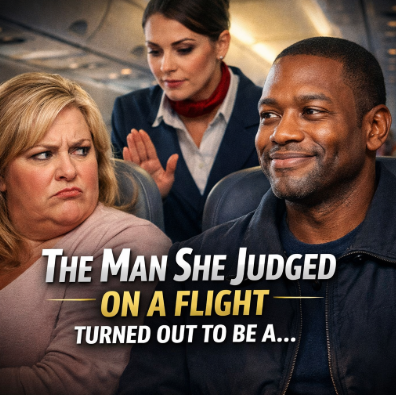
In seat 14A, a Black man in his late thirties sat calmly by the window. He wore a simple navy jacket, dark jeans, and polished shoes that showed quiet attention to detail. His posture was relaxed, his expression peaceful, as if the chaos of the world rarely reached him. Resting on his lap was a worn leather notebook, its edges softened by years of use.
He looked like someone who carried stories.
A few moments later, a white woman in her mid-forties approached the aisle seat beside him. She was noticeably uncomfortable even before she sat down—adjusting her handbag, frowning at the tight space, sighing loudly as if the seat itself had offended her.
When she finally lowered herself into 14B, her irritation only grew.
She glanced sideways.
Her eyes lingered on the man beside her—his skin color, his quiet confidence, the calm way he simply existed without asking permission.
Something in her expression hardened.
She shifted in her seat dramatically, exhaling with exaggerated frustration. Within seconds, she pressed the call button above her head.
The soft ding sounded far louder than necessary.
Nearby passengers turned slightly, sensing tension before a single word was spoken.
A flight attendant arrived quickly, professional and composed, her warm smile practiced through years of handling every kind of traveler imaginable.
“Yes, ma’am? How can I help you?”
The woman leaned closer, but her whisper carried sharp edges.
“Please move him from my side,” she said, anger slipping through every syllable. “I can’t even breathe sitting next to him.”
The words landed heavily in the narrow space between rows.
A few nearby passengers froze. One man lowered his phone. A young college student across the aisle looked down, suddenly very interested in her shoes.
The flight attendant’s smile faded—not into anger, but into calm firmness shaped by dignity.
“Calm down, ma’am,” she said evenly. “You’re making a scene.”
The woman scoffed, clearly expecting agreement, not resistance.
Meanwhile, the man by the window hadn’t moved.
Not a single defensive word.
Not a sigh.
Not even a frown.
Instead, he slowly lifted his eyes from the notebook resting in his hands.
And he smiled.
It wasn’t a mocking smile.
Not angry.
Not wounded.
Just… peaceful.
The kind of smile that comes from someone who has already survived far worse than rude strangers on airplanes.
The quiet confidence in that small expression unsettled the woman more than any argument could have.
She turned away sharply, muttering under her breath.
The flight attendant hesitated, then spoke gently to the man.
“Sir, would you mind waiting just a moment?”
He nodded politely. “Of course.”
She walked toward the front of the cabin.
Minutes passed.
The tension lingered like static in the air.
Passengers pretended not to notice, but everyone felt it.
Then something unexpected happened.
The flight attendant returned—this time accompanied by the lead purser and a man in a dark suit wearing an airline executive badge.
The suited man looked directly at the seated passenger by the window.
His face changed instantly—from professional neutrality to clear respect.
“Dr. Marcus Ellington?” he asked.
The quiet man nodded once. “Yes.”
The woman beside him stiffened.
The executive smiled warmly.
“Sir, we’re deeply honored to have you on board. On behalf of the airline, we’d like to upgrade you to first class. Your work with the Children’s Trauma Recovery Foundation has inspired millions, and it would be our privilege to make your flight more comfortable.”
Silence swept across the cabin.
The woman’s breath caught in her throat.
Passengers who had ignored the scene moments earlier now stared openly.
The name sounded familiar.
Very familiar.
Because Dr. Marcus Ellington wasn’t just anyone.
He was the renowned surgeon who had pioneered a breakthrough procedure saving abused and injured children—kids other hospitals had given up on.
The man featured on national news.
The recipient of humanitarian awards.
The voice behind legislation protecting vulnerable families.
A man whose life was built on compassion.
And he had been sitting quietly… in economy… without a word.
All eyes turned to him.
Marcus closed his notebook slowly.
For a moment, it seemed obvious he would accept the upgrade. Anyone would.
But instead, he glanced sideways—toward the woman who had wanted him gone.
Her face had drained of color.
Embarrassment trembled across her expression.
Regret arrived too late.
Marcus looked back at the executive and spoke softly.
“Thank you. That’s very kind.”
He paused.
“But I’d prefer to stay right here.”
Confusion flickered across the executive’s face.
“Are you sure, sir?”
Marcus nodded.
“Yes. I’m exactly where I need to be.”
The meaning of his words hung gently in the air.
Not harsh.
Not proud.
Just true.
The executive respected the answer, offering a small bow of the head before stepping away.
The cabin slowly returned to motion—but nothing felt the same.
The woman beside him swallowed hard, struggling to find words strong enough to undo what she had said.
“I… I didn’t know,” she whispered.
Marcus’s expression remained calm.
“I know,” he replied gently.
Tears gathered in her eyes—quiet, ashamed tears no one applauded.
“I’m sorry.”
It was a fragile apology.
Late.
But real.
Marcus studied her for a moment—not with judgment, but with understanding shaped by years of seeing broken people try to heal.
Then he gave a small nod.
“Kindness doesn’t need permission,” he said softly.
“It just needs a moment.”
The woman covered her mouth, emotion finally breaking through pride.
Outside the window, clouds drifted like silent witnesses to something larger than a single flight.
For the rest of the journey, no harsh words were spoken.
Only quiet.
And reflection.
When the plane landed in New York, passengers stood slowly, collecting bags and unspoken thoughts.
Some glanced again at Marcus—seeing him differently now.
Not because of fame.
But because of grace.
As he stepped into the aisle, the woman touched his sleeve gently.
“Thank you… for staying,” she said.
Marcus offered one last peaceful smile.
“Sometimes,” he answered,
“the lesson isn’t for the person who speaks…
but for the person who learns.”
Then he walked forward into the bright airport lights—just another traveler in a crowded world.
Yet behind him, something invisible had changed.
Because one quiet moment of dignity
had spoken louder
than anger ever could.