
The Price of Hope
Emily didn’t remember standing up.
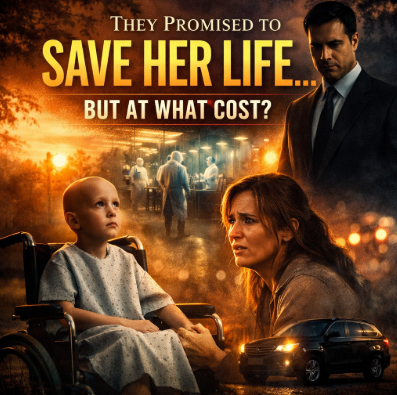
One moment she was kneeling in front of Lily, her hands cupping her daughter’s fragile cheeks, and the next she was on her feet, chest tight, lungs refusing to work properly. The world narrowed to a single, unbearable question pounding in her head.
What if this is the only chance?
The man in the black suit waited patiently, as if time itself bent around him. His hand remained extended, steady, confident. He wasn’t rushing. He wasn’t pushing.
He didn’t need to.
“Who are you?” Emily demanded, her voice hoarse. “You don’t just walk into a park and promise cures. Who do you work for?”
The man finally answered. “A private research division. Funded independently. We specialize in advanced regenerative medicine.”
Emily laughed again, but this time it sounded broken. “That’s not an answer.”
“It’s the only one I can give here,” he said. “Details come later. If you agree.”
“And if I don’t?”
His eyes flicked briefly to Lily. “Then life continues as it has.”
Emily felt the weight of those words crush her.
Life as it had been meant hospital hallways that smelled like bleach and fear. It meant doctors who avoided eye contact when they talked about timelines instead of futures. It meant Lily waking up crying at night because her bones hurt and she didn’t understand why.
It meant watching her child fade in inches.
Lily reached for her mother’s hand. Her fingers were cold.
“Mom,” she whispered. “Please don’t be mad.”
Emily looked down at her, at the brave little face that had endured more pain than most adults ever would.
“I’m not mad,” Emily said, choking on the words. “I’m scared.”
Lily nodded. “Me too.”
The man spoke again. “We’re not asking for blind trust. You’ll be informed of the risks. You’ll sign consent. This is not… illegal.”
That word—not illegal—hung in the air, heavy with implication.
Emily stared at him. “And the secrecy?”
“For her safety,” he replied smoothly. “And ours.”
Emily closed her eyes.
She thought of Lily’s room at home. The stuffed animals arranged just right. The growth chart on the wall that hadn’t changed in months. The medical bills stacked neatly in a drawer she pretended not to open anymore.
She thought of all the times she’d promised Lily things would be okay—without knowing if it was true.
When she opened her eyes, Lily was watching her, waiting.
“I don’t want to die,” Lily said simply.
That was it.
Emily broke.
She pulled Lily into her arms, careful not to hurt her, and held her like she was afraid the wind might steal her away. Her tears soaked into the thin hospital gown.
“Okay,” Emily whispered. “Okay.”
The man nodded once.
They didn’t go far.
A black SUV waited just beyond the park’s edge, engine already running. The windows were tinted so dark Emily couldn’t see inside. The door opened silently.
Emily hesitated.
“You said she comes with you,” she said. “What about me?”
The man met her gaze. “You can’t come inside the facility.”
Emily’s heart dropped. “What?”
“But,” he added, “you can say goodbye.”
That word felt like a blade.
Emily knelt again, pressing her forehead to Lily’s. “I’ll be right here,” she lied. “I’ll be waiting.”
Lily smiled weakly. “I know.”
The man helped lift the wheelchair into the vehicle with practiced ease. Lily didn’t cry. She didn’t resist. She waved as the door closed.
Emily stood frozen as the SUV pulled away.
Only when it disappeared down the road did she realize she was screaming.
The facility didn’t have a name.
At least, not one Lily ever saw.
It was bright and quiet, filled with glass walls and white corridors that seemed to stretch forever. Everyone wore badges with numbers instead of names. The doctors smiled, but their smiles were careful—measured.
Lily was given a room. A real bed. Clean sheets. Machines that hummed softly instead of beeping angrily.
They explained things to her in gentle terms.
Special medicine.
A chance to help your body learn how to heal itself.
You’re very special.
The treatments were different.
No harsh chemicals. No endless nausea. Instead, there were injections that burned briefly, followed by warmth that spread through her veins like sunlight.
At night, Lily dreamed.
She dreamed of running.
Days passed.
Then weeks.
Emily wasn’t allowed to visit, but she received updates—brief, carefully worded messages sent through secure channels.
Progress is promising.
Vital signs improving.
Cellular response exceeds expectations.
Emily read them over and over, clinging to every word like proof that she hadn’t made a terrible mistake.
And then, one morning, her phone rang.
The number was blocked.
“She’s responding better than anticipated,” the man said. “You should know that.”
Emily collapsed into a chair. “Can I see her?”
There was a pause.
“Soon,” he replied.
Lily felt stronger.
Her appetite returned. Her color improved. One morning, she woke up and realized something strange.
She wasn’t tired.
Not the bone-deep exhaustion she’d lived with for so long. Not the heaviness that made even smiling feel like work.
When the nurse helped her sit up, Lily laughed.
“I feel funny,” she said.
The nurse smiled. “That’s your body remembering how to be a body.”
Weeks later, Lily stood.
Her legs shook, but they held.
By the third month, fine strands of hair began to appear on her head, soft as baby feathers.
The doctors watched closely. Took notes. Whispered behind glass walls.
They weren’t just treating Lily anymore.
They were learning from her.
Emily finally saw her again six months later.
Lily walked into the room.
Emily didn’t recognize her at first—not until Lily smiled.
“Mom,” she said.
Emily fell to her knees.
She laughed and cried and held her daughter so tightly the doctors had to gently intervene. Lily was warm. Solid. Alive.
“She’s in remission,” the man explained quietly. “Beyond what conventional medicine predicted.”
Emily looked at him, joy and suspicion tangled together. “What did you do to her?”
He didn’t answer.
They went home.
Life returned—slowly, carefully. Lily went back to school. She learned to ride a bike. She grew.
But some things were different.
Lily healed faster than other children. Bruises vanished overnight. Fevers never came. She could run longer. Think faster.
Sometimes, Emily caught her staring at her hands like they didn’t quite belong to her.
Years passed.
One evening, when Lily was sixteen, there was a knock at the door.
Emily knew before she opened it.
The man in the black suit stood there, unchanged by time.
“We’re ready,” he said.
Emily’s chest tightened. “Ready for what?”
“For her,” he replied, glancing past her. “Others are sick now. Others need hope.”
Lily stepped forward.
She was tall now. Strong. Her eyes calm and steady.
She looked at her mother.
Emily saw it then—the truth she’d avoided for years.
The cure had never been free.
Lily took her mother’s hand. “It’s okay, Mom,” she said gently. “I know why they saved me.”
The man extended his hand once more.
This time, Lily took it without hesitation.
As the door closed behind them, Emily finally understood:
Lily hadn’t escaped the experiment.
She had become it.
And somewhere out there, other parents would soon be standing in a park, facing the same impossible choice—
never knowing the real question wasn’t will she recover or get trapped?
It was—
What will she become if she survives?
— THE END

One thought on “Part 2: They Promised to Save Her Life… But at What Cost?”