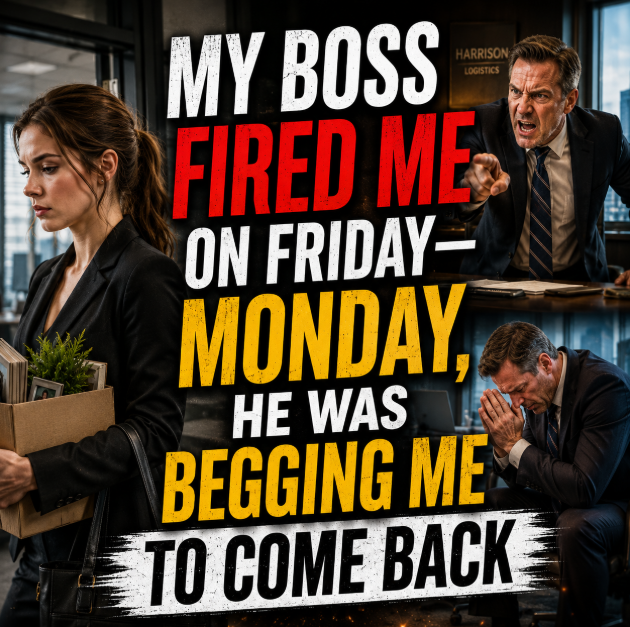
The moment my boss pointed at the door, I knew my life was about to change.
“You’re fired! Don’t show your face here again!”
His voice echoed across the office floor. Every employee stopped typing. Heads turned. The room fell silent.
I stood there holding a folder against my chest, trying not to cry.
“Sure, sir,” I said calmly. “But you’ll regret this decision soon.”
His face turned red.
“You think you’re special?” he shouted.
Then he slammed his hand on his desk so hard that a coffee mug tipped over.
“Get out!”
I nodded, grabbed my purse, and walked out.
No one said a word.
Not even my coworkers.
I was just another employee being thrown away.
Or so they thought.
My name is Emily Carter. I was twenty-five years old, and for the last three years, I had worked at Harrison Logistics, a rapidly growing shipping company in Chicago.
Officially, I was an operations assistant.
Unofficially?
I was the person holding the entire company together.
My boss, Richard Harrison, loved taking credit for everything.
Whenever a project succeeded, he claimed it was his leadership.
Whenever something went wrong, he blamed his employees.
For three years I watched him climb higher while the people doing the real work stayed invisible.
I didn’t complain.
I just kept working.
What Richard never realized was that I had built almost every system the company relied on.
I created the tracking spreadsheets.
I designed the inventory automation process.
I organized supplier databases.
I managed emergency contacts.
I even trained most of the department managers.
Whenever a problem appeared, they came to me.
And every time, I fixed it.
But Richard never noticed.
Or maybe he didn’t care.
The trouble started on Thursday afternoon.
One of our biggest clients was preparing a multi-million-dollar shipment.
Everything had to be perfect.
While reviewing reports, I discovered a serious error.
The company was about to send thousands of products to the wrong distribution center.
If the shipment left, the mistake would cost hundreds of thousands of dollars.
I immediately informed Richard.
He barely looked up from his phone.
“You’re overreacting.”
“No, sir,” I said. “I’ve checked it three times.”
“It’s fine.”
“It isn’t.”
His eyes narrowed.
“Are you questioning my judgment?”
“I’m trying to prevent a disaster.”
The office grew quiet.
Richard hated being challenged.
Especially by someone younger.
Especially by a woman.
He stood up.
“If you know so much, maybe you should run the company.”
Several employees looked away.
I knew this wasn’t going anywhere.
So I returned to my desk.
I sent an email documenting the issue and attached evidence.
Then I went home.
Friday morning was chaos.
The shipment error had become impossible to ignore.
Multiple managers were asking questions.
Instead of admitting he was wrong, Richard decided to find someone to blame.
Guess who he chose?
At noon he called me into his office.
The conversation lasted less than two minutes.
He accused me of creating confusion.
He claimed I was undermining leadership.
Then he fired me.
Just like that.
Three years of loyalty erased in seconds.
By Friday evening I was sitting in my apartment eating takeout noodles and wondering how I would pay rent next month.
I felt angry.
Humiliated.
Scared.
But mostly relieved.
Because deep down, I knew something Richard didn’t.
I knew exactly how dependent the company had become on me.
Monday morning arrived.
I woke up later than usual.
No alarm.
No emails.
No meetings.
It felt strange.
Around 9:30 a.m., my phone rang.
Richard.
I ignored it.
A minute later he called again.
And again.
And again.
By lunchtime I had fourteen missed calls.
Then a text arrived.
“Emily. Please call me. Urgent.”
I stared at the screen.
For the first time in years, I smiled.
Something was wrong.
Very wrong.
An hour later my former coworker Sarah called.
“Emily,” she said breathlessly. “You won’t believe what’s happening.”
“What happened?”
“The system crashed.”
I sat up.
“What system?”
“All of them.”
My smile widened.
The inventory tracking system.
The supplier database.
The automated shipping schedules.
The reporting dashboards.
Everything.
See, before leaving on Friday, I had followed company policy.
I removed my personal access credentials from every system I had created.
The systems themselves remained.
But nobody knew how to operate them.
Nobody except me.
For years Richard had ignored my requests to hire support staff.
He refused documentation budgets.
He rejected training programs.
Why spend money when Emily could handle everything?
Now Emily was gone.
And so was the knowledge.
By Monday afternoon, operations were collapsing.
Shipments were delayed.
Managers were panicking.
Clients were demanding answers.
One customer threatened to cancel a contract worth nearly five million dollars.
Richard was desperate.
At 3:00 p.m., my doorbell rang.
I opened the door.
There stood Richard.
The same man who had fired me three days earlier.
But now he looked completely different.
His suit was wrinkled.
Dark circles sat under his eyes.
And for the first time ever, he looked nervous.
“Emily.”
I folded my arms.
“Can I help you?”
He cleared his throat.
“We need to talk.”
I stepped outside.
He glanced around awkwardly.
Then something happened I never expected.
Richard Harrison apologized.
Not a fake corporate apology.
A real one.
“I made a mistake.”
I raised an eyebrow.
“That’s new.”
He sighed.
“The company is struggling.”
“Really?”
“Emily…”
“No, tell me more.”
His shoulders dropped.
“We need you back.”
There it was.
The sentence I had been waiting to hear.
“We?”
“The company.”
I almost laughed.
Three days ago he had treated me like I was worthless.
Now suddenly I was essential.
“What exactly are you asking?”
He swallowed.
“I want you to return.”
“As an operations assistant?”
His face tightened.
“No.”
I waited.
“We want you to become Operations Director.”
For a moment I thought I had misheard him.
Operations Director was three levels above my old position.
The role came with a six-figure salary.
A private office.
Management authority.
And direct access to the executive board.
The offer stunned me.
But then I remembered Friday.
The humiliation.
The disrespect.
The years of being overlooked.
I took a deep breath.
“Why would I come back?”
Richard hesitated.
Because for once, he didn’t have an answer.
The truth was obvious.
They didn’t value me.
They valued what I could do for them.
And those weren’t the same thing.
That evening I received another surprise.
A competing logistics company contacted me.
One of their executives had heard about my situation through industry connections.
They offered me an interview.
The next morning I attended.
By Wednesday they made an offer.
It was even better than Richard’s.
Higher salary.
Remote flexibility.
Leadership opportunities.
Most importantly?
Respect.
Real respect.
Thursday afternoon Richard called again.
“Have you made a decision?”
“Yes.”
“And?”
I smiled.
“I’m not coming back.”
Silence.
Then a quiet sigh.
“I understand.”
“No, Richard.”
“What?”
“You finally do.”
For years he believed employees were replaceable.
That loyalty could be demanded.
That talent would always stay.
Now he understood the truth.
People don’t leave companies.
They leave bad leaders.
I accepted the new position that same day.
Six months later, my career was thriving.
The new company doubled its revenue.
My team loved working together.
And every morning I woke up excited to go to work.
As for Harrison Logistics?
Several major clients left.
The company survived, but it never fully recovered.
Sometimes I think about that Friday afternoon.
The anger.
The embarrassment.
The fear.
At the time, being fired felt like the worst thing that could happen.
It wasn’t.
It was the best thing that ever happened to me.
Because the door Richard slammed shut forced me to walk toward a better future.
And in the end, the person who regretted his decision wasn’t me.
It was the man who made it.