The rain had stopped an hour ago, but the streets of downtown Baltimore still looked wet and restless.
Puddles reflected neon signs. Tires hissed across the pavement. Somewhere in the distance, police sirens echoed through the city like a warning nobody listened to anymore.
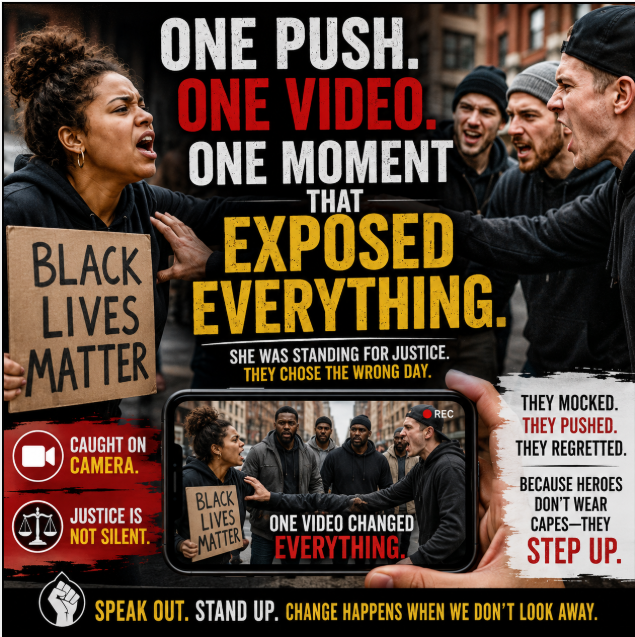
Twenty-six-year-old Danielle Brooks adjusted the hood of her black sweatshirt and stared at the cardboard sign in her hands.
The words were simple.
BLACK LIVES MATTER
Nothing violent. Nothing hateful.
Just four words.
But in America, sometimes four words were enough to make strangers hate you.
Danielle swallowed hard.
Her best friend had begged her not to come alone.
“You saw what happened last month,” she’d warned. “People are angry right now.”
But Danielle was angry too.
Angry at headlines. Angry at funerals. Angry at watching videos of grieving mothers while politicians argued on television like human lives were debate topics.
Most of all, she was tired of silence.
So she stepped onto the sidewalk near Franklin Street and lifted the sign above her head.
“Black lives matter!” she shouted.
A few pedestrians glanced over.
Most ignored her.
That hurt more than she expected.
People had mastered the art of pretending not to see uncomfortable things. It was easier than choosing sides.
Danielle kept walking.
“Black lives matter!”
A truck passing by honked loudly. She couldn’t tell whether it was support or mockery.
A man exiting a coffee shop muttered something under his breath and shook his head.
Still, she kept going.
The cold wind stung her cheeks, but her voice grew louder with every chant.
She didn’t notice the group of men at first.
Four of them stood outside a convenience store smoking cigarettes and laughing over something on a phone. Mid-twenties maybe. Loud. The kind of men who took up more space than necessary.
One of them spotted her sign and nudged his friend.
“Yo,” he laughed. “Check this out.”
Danielle looked straight ahead.
Experience had taught her that eye contact could invite trouble.
“BLACK LIVES MATTER!” she shouted again.
The tallest guy smirked.
“Oh wow,” he mocked loudly. “Another activist.”
His friends laughed.
Danielle’s stomach tightened, but she kept moving.
Then came the comment.
“So tell me,” another guy yelled, “one of them your boyfriend or something?”
The group burst into laughter again.
Danielle stopped walking.
Not because she wanted to argue.
Because humiliation has a strange way of freezing people for half a second.
She slowly turned toward them.
“That’s not funny,” she said firmly.
The tallest guy shrugged dramatically.
“We’re joking. Relax.”
Another added, “Freedom of speech, right?”
Danielle could feel people nearby watching now.
A couple standing at a bus stop looked uncomfortable. An older man glanced over before quickly pretending to check his phone.
Nobody moved.
Nobody spoke.
The men noticed that too.
Bullies always did.
The tallest one stepped closer.
“What?” he said. “You can protest in public, but we can’t talk?”
Danielle tightened her grip on the sign.
“You don’t need to harass me,” she replied.
“Oh, harass?” he laughed. “That’s harassment now?”
She turned away, deciding it wasn’t worth it.
That should have been the end of it.
But ego rarely lets men walk away quietly.
A rough hand slammed into her shoulder from behind.
Danielle stumbled hard, nearly falling onto the wet sidewalk.
Her sign bent sharply in the middle.
For one terrifying second, her mind went blank.
Then adrenaline hit like electricity.
She spun around.
“Don’t touch me!” she yelled.
The men laughed louder than before.
“Look at her acting like a victim,” one sneered.
Danielle’s heart pounded violently.
This wasn’t a debate anymore.
This wasn’t politics.
This was fear.
Real fear.
The tallest guy moved closer again, invading her space deliberately.
“You wanna scream on the streets,” he said coldly, “people are gonna react.”
Danielle looked around desperately.
Cars passed.
People watched.
No one stepped in.
The realization cut deep.
Everyone claimed they cared online. Everyone reposted quotes and hashtags. But when ugly moments happened in real life, silence suddenly became very popular.
Danielle took a slow step backward.
Then another.
Her chest tightened.
She hated the feeling crawling through her body—the feeling of becoming small.
Then a voice exploded from across the street.
“HEY!”
The entire sidewalk turned.
Four Black men were jogging toward them from the opposite corner.
Their expressions were deadly serious.
One of them—a tall man wearing a gray hoodie—stepped forward immediately.
“Back away from her,” he said sharply.
The bullies stiffened.
The tallest one scoffed. “Mind your business.”
The man in the gray hoodie didn’t blink.
“It became my business when you touched her.”
Danielle felt the energy shift instantly.
The laughter disappeared.
The confidence faded from the harassers’ faces.
Because suddenly they weren’t surrounding someone vulnerable anymore.
Now they were being watched.
One of the other men stepped beside the guy in the hoodie.
“You really pushing women over signs now?” he asked disgustedly.
Another shook his head.
“That’s weak.”
The bully who shoved Danielle tried to recover his pride.
“She’s overreacting.”
“Did you touch her or not?” the man in the hoodie asked calmly.
Silence.
That silence answered everything.
More pedestrians had stopped now.
Phones came out.
Somebody across the street was recording.
The bully noticed.
His jaw tightened.
“Whatever,” he muttered. “This is stupid.”
“Yeah,” one of the Black men replied coldly. “It is.”
For a moment, Danielle thought a fight might break out anyway. The tension sat thick in the air like gasoline waiting for a spark.
Then one of the harassers grabbed his friend’s arm.
“Forget it,” he whispered. “Let’s go.”
One by one, they backed away.
No more jokes.
No more laughing.
Just bruised egos and angry stares.
Danielle finally exhaled.
She hadn’t realized she’d been holding her breath.
The man in the gray hoodie turned toward her.
“You okay?”
She nodded quickly, though her hands were trembling uncontrollably.
“Thank you,” she said quietly.
He glanced at the bent sign in her hands.
“You shouldn’t have had to deal with that alone.”
Danielle looked around at the crowd beginning to disperse.
“Apparently I did.”
The man gave a bitter smile.
“That’s America sometimes.”
Before leaving, he pointed toward the convenience store.
A teenager stood near the entrance holding his phone up.
Still recording.
“Trust me,” the man said. “They picked the wrong day to act stupid.”
Danielle didn’t fully understand what he meant until later that night.
At 11:14 p.m., the video appeared online.
By midnight, it had over two million views.
The caption read:
“Woman harassed for peaceful protest. Watch who steps in.”
Danielle stared at the screen in disbelief.
The footage was crystal clear.
The mocking comments.
The shove.
Her stumbling backward.
The exact moment the four men intervened.
The internet exploded instantly.
Celebrities reposted it.
Activists shared it.
News pages uploaded slowed-down versions with dramatic music.
The comments section became a battlefield.
Some called Danielle brave.
Others claimed she was “asking for attention.”
But the biggest shock came the next morning.
One of the men in the video had been identified.
Then another.
Internet detectives moved fast.
One worked at a car dealership.
Another was reportedly studying criminal justice at a local college.
Irony spread through social media like wildfire.
By afternoon, both had been suspended.
Danielle sat frozen in her apartment while interviews flooded in from local news stations.
She ignored most of them.
The attention made her uncomfortable.
Because people online weren’t seeing her as human anymore.
She had become content.
A symbol.
An argument.
Still, one clip from the video haunted everyone who watched it.
Not the shove.
Not the yelling.
The silence.
Dozens of people had watched the harassment happen before anyone intervened.
That part angered people the most.
Three days later, the story became national news.
Legal analysts debated whether the shove qualified as assault.
Political commentators turned it into another screaming match.
Everyone wanted ownership of the moment.
But Danielle remembered something simpler.
Fear.
Isolation.
And the sound of footsteps crossing the street toward her when nobody else moved.
A week later, she returned to Franklin Street.
Same sidewalk.
Same cold air.
But this time she wasn’t alone.
Hundreds of people stood beside her holding signs.
Black.
White.
Asian.
Latino.
Young and old.
The crowd stretched across the block.
Danielle looked around in disbelief.
Then she lifted her sign once more.
“Black lives matter!”
This time, hundreds of voices shouted it back.
And somewhere in the crowd, a camera recorded everything again.
But this video felt different.
Not fear.
Not humiliation.
Hope.