The wind cut through downtown Chicago like it had something personal against the living.
It was late October, the kind of cold that arrived early and stayed longer than welcome. The streets outside Miller’s Diner glowed under yellow streetlights, reflections stretching across rain-soaked pavement.
On the corner, beneath a flickering bus stop sign, sat a man most people didn’t see anymore.
His name was Daniel Brooks.
Three years ago, Daniel wore pressed suits and commuted to an office overlooking Lake Michigan. He had a corner desk, a coffee mug that read World’s Okayest Accountant, and a savings account that felt secure.
Then came the layoffs.
Then the hospital bills when his wife got sick.
Then the funeral.
After that, everything blurred.
Savings disappeared. The apartment went next. Pride followed shortly after.
And now, Daniel counted change in a torn jacket pocket while sitting on cold concrete, trying to ignore the way people avoided eye contact as they passed.
He wasn’t asking for money tonight.
He didn’t have the energy.
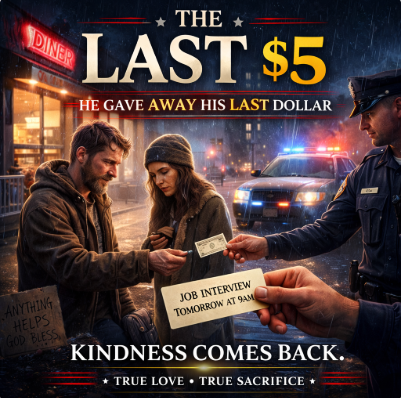
In his pocket, folded carefully like it mattered, was a single five-dollar bill.
His last five dollars.
He had been saving it for coffee and something warm from the diner. Just enough to get through another night.
The diner door opened with a jingle.
A young woman stepped out, holding a toddler against her chest. She couldn’t have been older than twenty-five. Her hair was pulled back in a messy bun, exhaustion carved into her face deeper than makeup could hide.
The little boy clung to her hoodie, small fingers gripping tight.
Daniel looked away at first. He wasn’t proud of being seen like this.
But then he heard it.
“Mommy, I’m hungry.”
The boy’s voice was small. Not whining. Not demanding.
Just honest.
The woman swallowed hard. “I know, baby. I know.”
She glanced back at the diner window, at the people inside eating burgers and fries under warm lights. She checked her purse, rummaging frantically.
Nothing.
She closed it slowly, blinking back tears she refused to let fall.
Daniel felt something twist in his chest.
Hunger wasn’t new to him.
But hearing it in a child’s voice hit differently.
The woman turned to leave, pulling her son closer to shield him from the wind.
Daniel stood up.
His knees protested. His body had grown used to sitting still for long stretches.
“Ma’am,” he called gently.
She stiffened.
There’s a certain caution people carry when strangers call out on dark streets.
“Yes?” she asked carefully.
Daniel walked closer but kept distance, hands visible.
He pulled the folded bill from his pocket.
“It’s all I’ve got,” he said quietly. “But you look hungrier than me.”
Her eyes widened. “I can’t take that.”
“You can,” he replied softly. “Please.”
She hesitated, pride and desperation wrestling across her face.
“My name’s Sarah,” she said, as if introductions made it more acceptable.
“Daniel.”
The boy looked up at him with wide eyes.
Daniel crouched slightly to meet his gaze.
“What’s your name, champ?”
“Eli.”
Daniel smiled faintly.
He held out the five-dollar bill.
After a long moment, Sarah accepted it, her fingers trembling.
“Thank you,” she whispered. “You don’t even know us.”
Daniel shrugged lightly. “Someone once told me kindness doesn’t need a resume.”
She managed a small, broken smile.
That’s when headlights flashed behind them.
A police cruiser rolled slowly to the curb.
Daniel’s stomach dropped.
He had been asked to move along more times than he could count. Sometimes politely. Sometimes not.
The cruiser door opened.
Officer Marcus Hale stepped out.
Tall. Solid. Calm eyes that noticed everything.
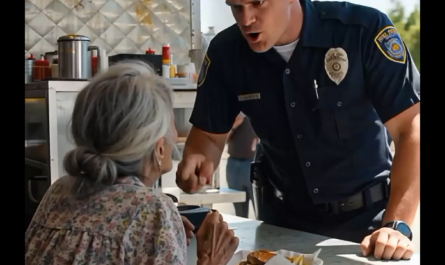
He surveyed the scene: homeless man, young mother, cash exchanging hands.
“Everything alright here?” he asked evenly.
Sarah stiffened. “Yes, officer.”
Daniel instinctively stepped back, hands raised slightly.
“I wasn’t bothering anyone,” he said quickly.
Officer Hale looked at Daniel’s worn shoes, his thin jacket, then at the five-dollar bill in Sarah’s hand.
“Sir,” Hale said, “did you just give her money?”
Daniel nodded slowly. “Yes, sir.”
“Why?”
Daniel hesitated. It felt strange explaining something that should’ve been obvious.
“Because her kid’s hungry.”
Silence hung between them, thick as the cold air.
Officer Hale studied him carefully.
“You live around here?” Hale asked.
Daniel gave a half-smile. “Depends what you mean by live.”
Sarah stepped forward. “Officer, he helped us.”
Hale looked from her to Daniel again.
“Stay right here,” Hale said.
Daniel’s heart sank.
He had heard those words before.
The officer walked back to his cruiser.
Daniel braced himself.
Maybe a citation. Maybe a warning. Maybe nothing good.
Sarah turned to him. “I’m so sorry.”
Daniel shook his head. “It’s okay. You should go feed him.”
She didn’t move.
Inside the cruiser, Officer Hale picked up his radio—then paused.
Instead, he reached into his wallet.
After a moment, he stepped back out.
Daniel straightened, preparing himself.
Hale walked toward him slowly.
Then, without a word, he extended a small white card.
Daniel blinked.
“What’s this?”
“A friend of mine runs a construction company,” Hale said. “They’re hiring laborers. Show up at 9 AM tomorrow.”
Daniel stared at the card.
“Why?” he asked quietly.
Hale’s jaw tightened slightly.
“Because three years ago,” Hale said, “a stranger paid for my groceries when my account overdrafted. I was too proud to ask for help.”
He nodded toward Sarah and Eli.
“You reminded me.”
Daniel’s throat tightened.
“I don’t have an address,” he admitted.
Hale pulled out another card. “Local shelter. Tell them I sent you. They’ll give you a bed tonight.”
Sarah wiped tears from her eyes.
“You see?” she whispered to Daniel. “Kindness.”
Daniel looked down at the five-dollar bill now gone from his hand.
He had expected to go to sleep hungry.
Instead, he was holding something heavier.
Hope.
The next morning, Daniel stood outside Harrison Construction, freshly showered from the shelter, wearing donated clothes that didn’t quite fit.
He almost didn’t go in.
Pride is stubborn even when it’s starving.
But he stepped forward.
The receptionist glanced up.
“Can I help you?”
Daniel placed the card on the desk.
“Officer Hale sent me.”
An hour later, he was filling out paperwork.
It wasn’t glamorous work. It wasn’t spreadsheets or offices with lake views.
But it was work.
Weeks passed.
Daniel showed up early. Stayed late. Listened more than he talked.
The foreman noticed.
“You’ve done this before?” he asked one afternoon.
Daniel nodded. “Different field. But numbers are numbers.”
The foreman laughed. “We could use someone who understands those.”
By winter, Daniel wasn’t just hauling materials.
He was helping with budgeting.
By spring, he had his own small apartment again.
Nothing fancy.
But it had heat.
And a door that locked.
One afternoon, while walking past Miller’s Diner, Daniel stopped.
The bus stop looked the same.
The streetlights. The corner.
But he wasn’t the same.
Inside the diner, he spotted Sarah and Eli at a booth.
Eli was laughing over a plate of pancakes.
Daniel stepped inside.
Sarah looked up—and recognition flashed across her face.
“Daniel?”
He smiled. “Hey.”
She stood quickly. “You look—”
“Different?” he finished.
She nodded, smiling.
“I got the job,” he said simply.
Tears filled her eyes again.
Eli grinned. “Mom says you’re a hero.”
Daniel laughed softly. “No, buddy. Just hungry that night.”
Sarah shook her head. “No. You were something else.”
Daniel glanced around the diner, then back at her.
“Actually,” he said, pulling out his wallet, “I think it’s my turn to buy dinner.”
She started to protest.
He gently placed a twenty on the table.
“Please,” he said.
As he walked back out into the Chicago evening, the wind didn’t feel as sharp.
The corner didn’t feel as lonely.
And somewhere inside him, something long broken had finally begun to mend.
That night, Daniel placed a framed five-dollar bill on his kitchen counter.
Not the same one.
But close enough.
A reminder.
That sometimes the smallest amount can carry the biggest weight.
And sometimes, the last five dollars you have…
Is the beginning of everything coming back.