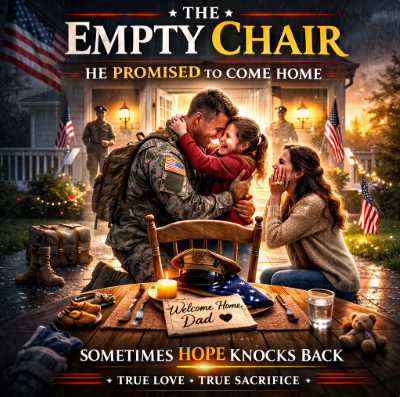
For two hundred and fourteen days, the chair at the head of the table had remained empty.
No one said the number out loud.
But the silence in the house knew it well.
The chair was wooden, slightly uneven on one leg, the kind that creaked when someone leaned back too far.
It had once been the loudest seat in the room—filled with laughter, terrible jokes, and stories that stretched longer than dinner itself.
Now it simply waited.
And every night, Emily Carter, seven years old and missing her front tooth, set a plate in front of it anyway.
Because hope, to a child, is not logical.
It is routine.
Outside their small home in Dayton, Ohio, autumn had begun to fold the world into colder colors.
Leaves gathered along the sidewalk like forgotten letters.
The sky dimmed earlier each evening, as if daylight itself were tired.
Inside, the kitchen clock ticked too loudly.
Sarah Carter stood at the stove, stirring soup that had already been done for several minutes.
She stirred because stopping meant thinking.
And thinking meant remembering phone calls that never came.
The Army had used careful words.
Missing.
Ongoing search.
Uncertain status.
Words designed to keep hope alive just long enough to hurt.
She had memorized every syllable.
“Mom?” Emily’s small voice floated from the table.
Sarah kept stirring. “Yes, sweetheart?”
A pause.
The kind filled with bravery children borrow from somewhere adults forget.
“Should I still set Dad’s plate?”
The spoon stopped mid-circle.
For a moment, the only sound in the room was the clock…
tick… tick… tick…
Hope is dangerous when it’s fragile.
But taking it away from a child feels worse.
“Yes,” Sarah said softly.
“Always.”
Emily smiled with quiet relief and placed the plate carefully in front of the empty chair.
Beside it, she set her father’s folded Army cap, the fabric still carrying the faint scent of aftershave and airplane terminals.
She treated the space like someone might arrive any second.
Because in her world, people who promise to come home… do.
They began dinner.
Two voices.
Three plates.
One absence sitting heavier than anything on the table.
Halfway through the meal, the lights flickered.
Once.
Twice.
Then darkness swallowed the kitchen.
Emily gasped.
Sarah’s heart jumped for reasons that had nothing to do with electricity.
Outside, rain began suddenly, tapping against the windows like hurried fingers.
Thunder rolled low across the sky.
Then—
A car door slammed in the distance.
Sarah froze.
No visitors came this late.
Not anymore.
Headlights brushed briefly across the living-room wall… then vanished.
Emily’s voice dropped to a whisper.
“Mom… someone’s here.”
Sarah’s pulse thundered in her ears.
Because military families learn certain sounds the way others learn lullabies.
Footsteps on wet pavement.
A pause at the porch.
Then—
Knock.
Knock.
Knock.
Three slow, measured knocks.
Professional.
Respectful.
Final.
Her breath disappeared.
Every nightmare she had avoided for 214 days suddenly stood on the other side of the door.
Emily slid off her chair.
“Is it Daddy?”
Sarah couldn’t answer.
Her legs moved without permission, carrying her toward the hallway.
Each step felt like walking through water.
Through memory.
Through the life that existed before this moment.
She reached the door.
Her hand trembled on the handle.
Behind her, Emily whispered,
“Mom… why are you crying?”
Only then did Sarah realize tears were already falling.
She opened the door.
Two U.S. Army soldiers stood beneath the porch light, rain streaking down perfectly pressed uniforms.
Caps held against their chests.
Faces carefully composed into something between strength and sorrow.
The world tilted sideways.
One soldier began softly,
“Ma’am…”
But Sarah barely heard him.
Because grief had already arrived early, unpacking itself inside her ribs.
Emily peeked around her mother’s arm.
“Where’s my dad?” she asked.
The soldiers exchanged a glance.
Not the glance of people bringing death—
but something stranger.
Confusion.
Relief.
Disbelief.
The younger soldier cleared his throat.
“Ma’am… there’s been an update.”
Sarah blinked slowly.
“I don’t understand.”
The older soldier spoke gently.
“Your husband was reported missing after an explosion three days ago.
Search teams continued looking.”
A long pause.
Rain softened around them.
Emily’s fingers tightened in Sarah’s sweater.
“Tonight… he was found.”
Silence expanded across the porch.
“Found?” Sarah whispered, afraid the word might break if spoken louder.
The soldier nodded once.
“Alive.”
Time stopped.
Not dramatically.
Not loudly.
Just… completely.
Emily’s breath caught.
Sarah’s knees nearly gave way.
From the darkness beyond the porch light—
Footsteps approached.
Slow.
Uneven.
Real.
A shadow moved forward.
Then into the light.
Wet uniform.
Mud on the sleeves.
A healing cut along his temple.
But unmistakably—
David Carter.
Emily screamed first.
“DADDY!”
She ran into the rain, colliding into him with all the force seven years of love could carry.
He dropped instantly to his knees, arms wrapping around her like the world might steal her again.
Sarah couldn’t move.
Couldn’t trust her eyes.
He looked up at her, voice rough but warm.
“I told you,” he said.
“I’d come home.”
Inside, the kitchen lights flickered back to life as they stepped through the doorway.
The table was still waiting.
Three plates.
Steam barely rising from forgotten soup.
The empty chair… empty no more.
David stared at it, emotion breaking through the soldier he tried to remain.
“You kept my seat,” he whispered.
Sarah nodded, tears falling freely now.
“Every night.”
He pulled out the chair and sat down slowly, as if afraid the moment might disappear.
Emily climbed into his lap, refusing to let go.
For the first time in 214 days—
Dinner felt like dinner again.
Later that night, after Emily fell asleep curled between them on the couch, the house finally grew quiet in a peaceful way.
Not empty.
Not waiting.
Just… whole.
Sarah traced the scar near David’s temple.
“We thought we lost you.”
He covered her hand gently.
“I thought so too,” he admitted.
A silence passed—soft this time.
“But something kept me going,” he said.
“What?” she whispered.
He glanced toward the kitchen.
At the chair.
The plate.
The light still on above the stove.
“You kept a place for me,” he said.
“And somehow… I could feel it.”
Her tears returned, but they were warm now.
Not grief.
Not fear.
Relief.
Outside, the storm cleared.
Clouds parted quietly, revealing a sky full of steady, patient stars.
Inside the small Ohio home, three heartbeats slept under one blanket—
safe, together, finally finished waiting.
And at the head of the table,
the chair no longer held silence.
It held home.
Sometimes the knock brings loss.
Sometimes… it brings life back through the door.