The bell above the diner door rang like it always did — small, metallic, forgettable. But for the people inside Rusty Mile Diner, that evening would not be forgettable at all.
Rain tapped softly on the windows. Neon lights flickered outside. The dinner rush had just slowed, leaving behind the smell of grilled meat, coffee, and fried onions hanging in the air.
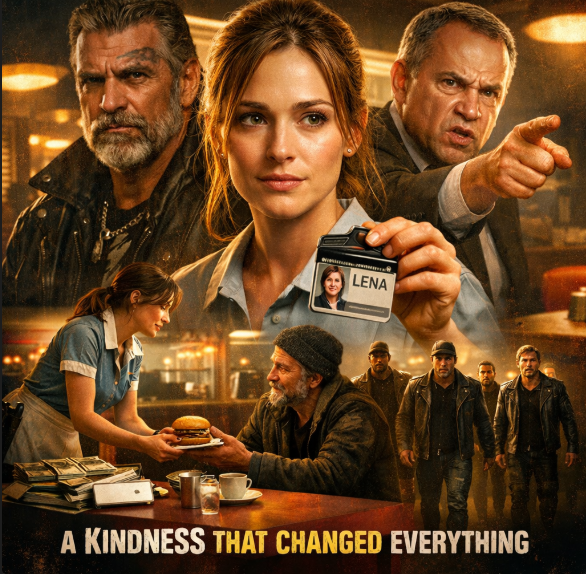
Lena adjusted her name badge and tucked a loose strand of hair behind her ear. She was known among customers as “the smiling waitress.” Not because her life was easy — but because she chose kindness like a habit.
At table 7 sat a thin, worn-out man in a torn jacket. His beard was uneven, hands shaking slightly — not from cold, but from hunger. He had been staring at the menu for ten minutes without turning the page.
Lena walked over gently.
“Can I get you something, sir?”
He looked embarrassed. “Just… water is fine.”
She knew that tone. She’d heard it before.
“Kitchen made an extra burger by mistake,” she said softly. “Would be a shame to waste it.”
His eyes lifted — confused first, then grateful. She placed the plate in front of him like it was something sacred.
His fingers trembled before touching it.
“Thank you,” he whispered.
From across the counter, Manager Doyle saw everything.
Doyle was a numbers man. Waste sheets. Margins. Inventory counts. Compassion was not on his spreadsheet.
He marched over.
“Where did that burger come from?” he barked.
Lena kept her voice steady. “It was extra.”
“No, it wasn’t.”
The diner grew quiet.
Doyle slammed his palm on the table so hard the ketchup bottle rattled.
“You don’t give away store property. You don’t play charity with my inventory.”
“It’s one burger,” she said quietly.
“It’s theft.”
The homeless man froze mid-bite.
Customers watched — forks suspended, coffee cups paused halfway.
“You’re fired,” Doyle snapped. “Badge off. Apron off. Now.”
The words landed like glass shattering.
Lena swallowed. Her lips trembled — but she didn’t beg. Didn’t argue. She slowly removed her badge.
It slipped from her fingers and hit the tile floor with a small plastic click that somehow sounded very loud.
The diner felt colder.
Then came the sound of chairs dragging.
In the back corner booth sat six bikers — leather jackets, road-worn faces, silent until now. Regulars. Always polite. Always tipped well. Spoke little.
They stood together.
Boots heavy. Movement deliberate.
Every head turned.
The tallest one — gray in his beard, scar across his brow — stepped forward. His voice was calm, almost gentle.
“This world needs cleaning.”
Doyle scoffed. “Sit down and eat your food.”
The biker didn’t raise his voice. “You just fired kindness and defended a spreadsheet.”
“Private property,” Doyle snapped. “Not your business.”
The biker leader walked closer, stopping just short of the counter. Close enough that Doyle could see the faded military tattoo on his neck.
“Everything decent is my business.”
Tension stretched tight like wire.
Lena stepped in quickly. “Please — don’t make this worse. It’s okay. I’ll go.”
But something unexpected happened.
Table 3 — an old couple — stood up.
“She served us when we couldn’t pay last winter,” the woman said.
A truck driver near the window raised his hand.
“She packed me free coffee the night my rig broke down.”
A nurse spoke up.
“She paid for a kid’s meal when that single dad came short.”
Voices layered. One after another. Stories poured out like rain finally breaking from clouds.
Doyle looked around — stunned. He hadn’t known. Hadn’t cared to know.
The biker leader leaned on the counter. “Looks like your best employee isn’t on your payroll anymore.”
Doyle turned red. “All of you — out. I’ll call the police.”
“Already called someone better,” said one biker quietly.
The door opened.
Not with drama — but authority.
A woman in a dark coat stepped in, shaking rain from her umbrella. Sharp posture. Sharp eyes. She looked around once and walked straight to the counter.
“Mr. Doyle,” she said.
His anger deflated instantly. “Ma’am — I didn’t know you were—”
“I own the building,” she replied calmly.
Silence.
She turned to Lena. “Are you the waitress who gave away the burger?”
Lena nodded slowly. “Yes, ma’am.”
“Why?”
“He was hungry.”
“Did you log it?”
“No, ma’am.”
“Did you lie about it?”
“No.”
The owner smiled faintly.
“Good.”
Doyle blinked. “Good?”
She faced him. “You’ve had three customer complaints this quarter about rudeness. Two staff resignations. Shrinking repeat traffic.”
He tried to speak — failed.
She pointed to Lena’s badge on the floor.
“Pick it up.”
Doyle bent automatically — then realized she wasn’t talking to him.
She meant Lena.
“Effective immediately,” the owner said, “you’re rehired — with a raise.”
Lena stared. “What?”
The owner continued: “And he’s fired.”
Doyle’s mouth opened. Nothing came out.
The diner breathed again.
The homeless man at table 7 stood up slowly. He wiped his mouth, then reached into his jacket pocket.
He placed a business card on the counter.
“I wasn’t always homeless,” he said gently. “Lost everything after medical debt. I run a nonprofit now — just got funded again last month. Was deciding where to place our city meal contract.”
He looked at Lena.
“Decision made.”
The biker gang laughed — warm, approving.
One of them tossed a thick envelope onto the counter. “We eat here every week. Consider this three months prepaid for anyone who can’t afford a meal.”
The truck driver added cash. Then the nurse. Then the old couple.
Within minutes, a pile formed.
Not charity.
Respect.
Lena cried now — not from humiliation, but release.
The biker leader picked up her badge and handed it to her like a medal.
“Keep feeding people,” he said. “You’re dangerous — in the right way.”
Rain slowed outside. Neon stopped flickering. The diner felt different — like the air had been cleaned.
The owner turned to Lena. “One more thing.”
“Yes?”
“You’re training the new manager.”
Lena laughed through tears. “I’ve never managed anything.”
The biker leader grinned. “You managed humanity just fine.”
The bell above the door rang again as customers returned to their meals — but now they tasted better.
Because sometimes justice doesn’t arrive with sirens.
Sometimes it walks in wearing muddy boots, tired smiles, and hungry hearts — and leaves a place better than it found it.
And table 7?
It never went empty again.