Part 2: When the Courtroom Froze
The courthouse doors never reopened that day.
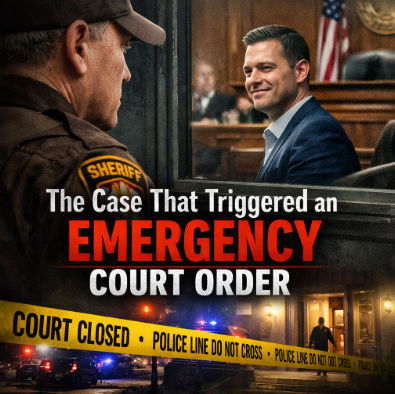
By sunset, yellow police tape wrapped the entire east entrance of the Cook County Courthouse, and news vans crowded the street like vultures. Helicopters hovered overhead.
Social media had already decided what happened—half the country believed an innocent man had nearly been convicted, the other half believed a wealthy defendant had almost slipped away.
Inside, the judge sat alone in chambers, staring at the same four words over and over again:
Wrong defendant. Check the scar.
Emergency Court Order
At 6:42 p.m., an emergency court order was issued.
The verdict was officially suspended. The jury was dismissed indefinitely under strict confidentiality instructions. Marcus Hale was not released—but he wasn’t convicted either.
He was moved to a holding room under armed supervision.
For the first time since the trial began, he looked afraid.
His attorney, one of the most expensive criminal defense lawyers in Illinois, paced the hallway while speaking rapidly into his phone.
“This is a disaster,” he whispered. “No, worse. This is grounds for a civil rights lawsuit if they don’t handle this correctly.”
Inside the holding room, Marcus finally broke his silence.
“This was supposed to be over,” he muttered. “They had nothing.”
No one responded.
The Medical Record That Changed Everything
Rachel Monroe’s statement triggered a sealed review of hospital intake logs from the night of the accident.
What investigators found made prosecutors go pale.
At 1:17 a.m., less than forty minutes after Elaine Porter was killed, an unidentified man had arrived at a private ER in North Chicago with a bleeding neck wound. He’d paid in cash. No insurance claim. No ID.
The injury was consistent with airbag deployment.
Rachel had stitched the wound herself.
And then—against hospital protocol—the man had walked out before police were notified.
The intake name was fake.
But the security footage wasn’t.
The face was clear.
And it wasn’t Marcus Hale.
The Man in the Photo
The image was enhanced, cleaned, and run through multiple databases.
It took twelve hours.
At 8:03 a.m. the next morning, a name appeared on the screen.
Jonathan Cross.
Former private contractor. Prior arrests sealed. No active warrants. And one critical detail buried deep in an old military medical file:
Scar—left side of neck. Combat injury.
Crowe stared at the file.
“So he let another man take the fall,” he said quietly.
The prosecutor shook her head.
“No,” she said. “He let us do it for him.”
Marcus Hale’s Counterattack
By noon, Marcus Hale’s legal team went on the offensive.
They filed a motion for immediate release, citing unlawful detention, prosecutorial negligence, and emotional distress. By 3 p.m., they added something worse:
A $45 million civil lawsuit against the state for false prosecution.
The filing named everyone—police, prosecutors, hospital administrators, and the court itself.
The media exploded.
Headlines screamed:
“Wrong Man on Trial?”
“Scar Nearly Frees Killer”
“Courtroom Chaos in Illinois”
Marcus gave a single statement through his attorney:
“I trusted the system. The system failed me.”
But in private, Marcus wasn’t celebrating.
Because he knew something no one else did.
Jonathan Cross wasn’t finished.
The Insurance Trail
Investigators followed the money.
Two months after the hit-and-run, Marcus Hale had received a private insurance settlement for vehicle damage he’d never reported. The claim had been processed quietly through an offshore subsidiary.
The payout: $180,000.
Too clean. Too fast.
The policyholder on the document wasn’t Marcus.
It was Jonathan Cross—using a shell company Marcus owned.
The pieces finally aligned.
Marcus hadn’t been the driver.
But he hadn’t been innocent either.
The Arrest That Didn’t Happen
Police tracked Jonathan Cross to a rented condo near Lake Michigan.
They moved in quietly.
Too quietly.
The place was empty.
Bedsheets gone. Laptop wiped. No fingerprints.
Only one thing remained on the kitchen counter:
A folded newspaper.
The headline circled in red ink:
“COURT HALTS VERDICT AFTER LAST-SECOND TIP.”
Under it, three words were written:
You were late.
Rachel’s Guilt
Rachel Monroe resigned from her hospital job two days later.
She couldn’t sleep. Couldn’t eat.
In a recorded deposition, she admitted everything.
“I knew something felt wrong that night,” she said, voice shaking. “But I told myself it wasn’t my responsibility.”
Her attorney gently pushed a box of tissues toward her.
“The court will consider your cooperation,” he said. “But understand—civil liability is still possible.”
Rachel nodded.
“I deserve that,” she whispered.
The Second Courtroom
Two weeks later, a different courtroom filled with a different tension.
This wasn’t a criminal trial.
It was a civil hearing.
Marcus Hale sat at the plaintiff’s table now, dressed in gray. Calm again. Controlled.
The judge read from the bench.
“The state acknowledges procedural failure. However, evidence now suggests the plaintiff may have knowingly benefited from said failure.”
Marcus’s attorney stiffened.
The judge continued.
“This court will not authorize a settlement until criminal liability is fully resolved.”
Marcus’s jaw clenched.
For the first time, the shield of money cracked.
The Phone Call
That night, Marcus received a call from an unknown number.
He didn’t answer.
The voicemail came anyway.
“You should’ve taken the deal,” Jonathan Cross said calmly. “Now everyone’s watching.”
Marcus deleted the message—but not before hearing the faint background noise.
Waves.
The Final Move
At 4:18 a.m., federal agents received a tip.
Jonathan Cross had been spotted boarding a private boat near Traverse City, Michigan.
This time, they didn’t wait.
The arrest was quiet. No chase. No speech.
As agents cuffed him, Cross smiled.
“You’re still too late,” he said. “The damage is done.”
The Truth Comes Out
Cross’s confession came with conditions.
Immunity negotiations. Asset forfeiture. Cooperation clauses.
He told them everything.
The hit-and-run hadn’t been an accident.
Elaine Porter had witnessed something she shouldn’t have.
Cross had panicked.
Marcus had helped cover it up.
Not out of loyalty.
Out of profit.
The Aftermath
The criminal trial was rescheduled.
This time, with the right defendant.
Marcus Hale’s lawsuit collapsed within days.
Instead, he faced charges of obstruction, fraud, conspiracy, and insurance manipulation.
Rachel Monroe testified again—this time publicly.
The judge issued a final statement that echoed through legal journals nationwide:
“Justice delayed nearly became justice denied. The system survived—but only because someone chose to speak.”
Marcus Hale lost everything.
Jonathan Cross lost his freedom.
Rachel lost her peace.
And the court gained a reminder it would never forget.
One scar.
One whisper.
One verdict stopped just in time.