The officer decided she didn’t belong the moment he saw her.
It wasn’t anything she did. She wasn’t running. She wasn’t shouting. She wasn’t breaking the law. She was simply walking—steady, confident, unbothered—down Jefferson Avenue just as the sun dipped behind the buildings and the city shifted into its evening rhythm.
Traffic hummed. Neon signs flickered awake. Somewhere down the block, music spilled out of an open car window. It was an ordinary American street on an ordinary night.
And yet, to him, she stood out.
A well-dressed Black woman in a tailored blazer, heels clicking softly against the sidewalk, phone in one hand, leather handbag resting against her hip. She walked like someone who knew where she was going. Like someone who belonged.
That, more than anything else, unsettled him.
He stepped forward, positioning himself directly in her path.
“Hey,” he said, voice sharp, practiced. “You’re under arrest.”
The words hit the air like a crack of thunder.
She stopped.
Not abruptly. Not fearfully. Slowly—deliberately—as if she wanted to make it clear that she wasn’t running, wasn’t resisting, wasn’t doing anything wrong.
“For what?” she asked.
Her voice was calm. Almost curious.
That wasn’t the reaction he expected.
He glanced her up and down again, as if looking harder might reveal the crime he’d already decided she’d committed. Expensive clothes. Clean appearance. Calm posture.
Confidence.
He leaned closer, lowering his voice, the way authority figures sometimes do when they think power lives in proximity.
“For existing where you don’t belong,” he said. “Now put your hands behind your back.”
The street seemed to quiet.
A couple waiting at the bus stop stopped talking. A man walking his dog slowed down. Someone across the street raised their phone—not openly filming, but not hiding it either.
In America, moments like this carried weight. Everyone knew it. Everyone felt it.
She didn’t move her hands.
Instead, she looked directly at him.
“Say that again,” she said.
He shifted, irritation creeping into his expression. “Don’t play games with me. You’re being detained.”
Detained.
That word had followed her people for generations. Detained for walking. Detained for driving. Detained for existing too loudly, too proudly, too freely.
She felt a familiar tightening in her chest—not fear, but anger. Controlled. Focused.
She thought of the names she’d seen plastered across news headlines. Thought of body-cam footage cut short. Thought of explanations that never explained anything at all.
Officer felt threatened.
Suspect failed to comply.
Tragic outcome.
“You don’t know anything about me,” she said.
He scoffed. “I know enough.”
That was the problem.
She reached into her jacket.
His posture stiffened instantly.
“Don’t,” he snapped, his hand moving toward his belt. “Keep your hands where I can see them.”
The tension thickened, stretching like a wire pulled too tight.
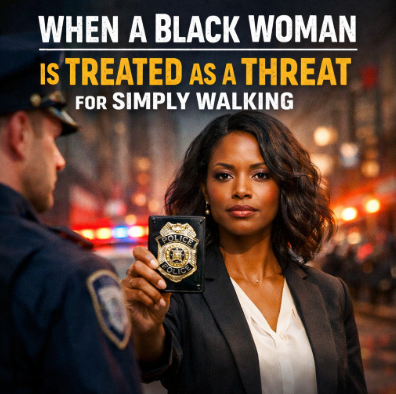
Slowly—carefully—she pulled out a badge.
Gold. Official. Heavy with meaning.
She held it up between them, letting the streetlight reflect off its surface.
The officer froze.
His confidence collapsed in real time. The color drained from his face. His hand dropped away from his belt.
For a moment, the entire world seemed to pause.
Then the city exhaled.
Traffic noise returned. Someone whispered, “Oh my God.” A phone camera tilted higher, now openly recording.
She clipped the badge back where it belonged and met his eyes.
“Are you done?” she asked.
He stammered. “I—I didn’t realize—”
“No,” she said, cutting him off. “You didn’t ask.”
The words landed harder than any shout could have.
She straightened her jacket, voice firm, controlled, professional.
“Good,” she continued. “Because you messed up big this time.”
The conference room at the precinct smelled like burnt coffee, stale air, and unease.
Internal Affairs sat along one side of the long table, folders neatly stacked, faces serious. Across from them sat a civil rights attorney, her tablet open, fingers poised, body language calm but unyielding.
The officer sat alone in the middle.
He hadn’t slept.
His badge felt heavier than it ever had before.
The footage played on the screen.
Clear audio. Clear visuals. No missing context. No blurred angles.
“For existing where you don’t belong.”
The room went silent.
The attorney didn’t raise her voice. She didn’t need to.
“This isn’t a misunderstanding,” she said. “This is racial profiling. This is an abuse of authority. And this is exactly why trust between law enforcement and Black communities continues to erode.”
No one argued.
They couldn’t.
The woman from Jefferson Avenue stood near the wall, arms crossed, expression unreadable. She wasn’t here as a suspect. She wasn’t even here as a victim.
She was here as a witness.
And as a fellow officer.
“You didn’t stop me because I broke the law,” she said finally, her voice steady but heavy with truth. “You stopped me because you decided I didn’t belong.”
She paused.
“That assumption has gotten people killed.”
The words hung in the air like smoke.
Black Lives Matter wasn’t a chant in this room. It wasn’t a protest sign or a trending topic.
It was evidence.
It was policy failure.
It was a pattern.
She continued, “Every time an officer acts on bias instead of facts, they don’t just endanger civilians—they endanger this badge.”
She gestured toward his chest.
“And they dishonor every officer who actually does the job right.”
No one interrupted her.
Outside the precinct, the story spread faster than anyone expected.
Local news picked it up first. Then national outlets. Headlines focused on the footage, the words, the moment everything changed.
Social media did what it always did—amplified, debated, polarized.
Some called her brave.
Some called her lucky.
Others accused her of embarrassing the department.
She didn’t read the comments.
She didn’t need to.
What mattered was the conversation that followed.
Community leaders organized forums. Activists demanded accountability. Parents asked difficult questions. Officers—quietly, privately—admitted they’d seen similar behavior and said nothing.
The department announced policy reviews. Mandatory bias training. Expanded body-cam audits. New disciplinary guidelines.
None of it felt like justice.
But it felt like movement.
And movement mattered.
Weeks later, she walked down Jefferson Avenue again.
Same street. Same buildings. Same cracked sidewalks.
Different energy.
People passed her without suspicion. Without fear. Without assumption.
She stopped briefly at the exact spot where it had happened. The memory surfaced—not as trauma, but as clarity.
She had never been out of place.
The problem was never her presence.
It was the belief that someone like her needed permission to exist.
She continued walking, heels echoing softly into the evening, blending back into the rhythm of the city.
And somewhere, someone watching the footage for the first time understood something uncomfortable, something necessary:
Black lives don’t need justification.
They need respect.