THE BLUE GOWNS
The land was dead.
Not empty—dead.
The kind of dead that felt intentional.
Cracked earth stretched for miles in every direction, like the ground had been punished until it split. No roads. No buildings. No power lines. Just heat, dust, and silence so heavy it pressed against the ears.
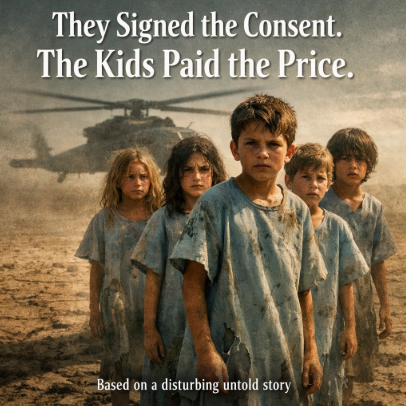
Five children walked across it.
They were too young to be alone here. Ten to twelve years old, at most. Their feet were bare or wrapped in scraps of fabric. Their skin was sunburned, lips cracked. Each of them wore the same thing: light blue hospital gowns, torn, filthy, and flapping in the wind like surrender flags.
They walked close together, shoulders almost touching, as if distance itself was dangerous.
The oldest boy—thin, sharp-eyed, moving like he’d learned fear early—kept checking the sky. His name was Lucas, though none of them said names anymore. Names felt loud. Names felt traceable.
“Move fast,” he whispered, voice dry and tight. “We have to get out of this place.”
The youngest girl stumbled, nearly falling. Another kid caught her arm before she hit the ground. No one complained. Complaining wasted energy.
They didn’t know where they were.
They only knew where they weren’t.
And that mattered more.
A distant whup-whup-whup rolled across the sky.
At first, it blended with the wind.
Then it didn’t.
Lucas froze.
The sound grew louder. Faster. Mechanical. Angry.
A helicopter.
The kids looked up at the same time, panic moving through them like electricity.
“No,” one of them whispered. “No, no, no—”
The helicopter cut across the sky, black against the sun, its shadow crawling over the ground like a living thing.
“They found us,” someone cried.
“Run!”
They scattered, feet slapping against cracked earth, dust exploding into the air as the helicopter circled once… then disappeared beyond the horizon.
The silence that followed was worse.
Hours earlier, the world had looked very different.
White walls. Beeping machines. Cold air that smelled like disinfectant and fear.
Lucas remembered that part too clearly.
He remembered waking up with wires stuck to his chest, an IV in his arm, and a plastic bracelet around his wrist with a number instead of a name. He remembered trying to ask where his mother was—and being told to lie still.
He remembered doctors who didn’t make eye contact.
They wore badges from a private medical contractor, not a hospital. He noticed things like that. His mom had once worked in insurance claims. She’d taught him how to read fine print before she disappeared.
The place had been called a research facility. That’s what the forms said.
But it wasn’t a hospital.
Hospitals let parents visit.
Hospitals didn’t lock doors from the outside.
Hospitals didn’t require armed security in the hallways.
Lucas had overheard conversations when staff thought he was asleep.
“—liability exposure—”
“—federal immunity under emergency authorization—”
“—if the trial leaks, the lawsuits alone would—”
Trial.
That word stuck.
They weren’t patients.
They were test subjects.
The escape hadn’t been planned.
That was the terrifying part.
It happened because something went wrong.
Alarms screamed one night. Red lights flooded the hallways. Doors slammed shut automatically. Somewhere, someone was yelling about a containment breach.
Lucas had been awake already, counting ceiling tiles like he always did when panic crept in. He watched a nurse swipe her badge at the door—once, twice—and curse when it didn’t open.
That’s when the power flickered.
Just for a second.
Just long enough.
The magnetic lock released with a soft click.
Lucas didn’t think. He moved.
He ripped the IV from his arm, ignoring the pain, and shoved the door open. Blood dripped onto the floor, bright against sterile white.
Other doors were opening too.
Kids spilling into the hallway, barefoot, confused, terrified.
Someone screamed.
Someone else cried for their dad.
A security guard ran past without looking at them.
That was when Lucas knew.
No one was coming to save them.
So he grabbed the nearest kid—an older girl with dark hair and hollow eyes—and said the only thing that made sense.
“Run.”
Back in the wasteland, the kids hid behind a shallow ridge, gasping for breath.
The helicopter didn’t return. Not yet.
The smallest girl—Maya—was crying silently, shoulders shaking. Her gown was ripped at the back, exposing bruises that looked too precise to be accidental.
“They’ll bring us back,” she whispered. “They always do.”
“No,” Lucas said quickly, more sharply than he meant to. “They won’t.”
“How do you know?” another boy asked.
Lucas didn’t answer.
Because the truth was worse.
He knew because if they were caught, they wouldn’t be brought back.
They’d be erased.
Facilities like that didn’t exist on paper the way normal hospitals did. They were shielded by emergency powers, classified funding, and layers of legal protection. If a child died inside one, it became a non-event, buried under settlement clauses and confidentiality agreements.
No police report.
No missing persons alert.
No wrongful death lawsuit.
Just silence.
Lucas had heard a doctor say it once, casually, like discussing weather.
“Legally,” the man said, “they’re already dead.”
The sun dipped lower, heat easing slightly but danger growing.
“We can’t stay here,” the dark-haired girl said. “They’ll search again.”
“They already are,” Lucas replied.
He pointed to the sky. Thin white lines cut across the blue—contrails.
Planes.
Surveillance.
This wasn’t a rescue operation. It was a retrieval.
The kids began walking again, slower now, conserving energy. Every step hurt. Hunger gnawed at them like an animal.
Maya looked up at Lucas. “Why us?”
He didn’t want to answer.
Because he knew that too.
They were chosen because no one would fight hard enough to get them back.
Kids from unstable homes. Kids whose parents had signed medical consent forms they didn’t fully understand. Kids whose insurance coverage came with loopholes wide enough to hide crimes in.
High-risk. Low-cost.
Perfect.
They walked until the sky turned orange.
That’s when they saw it.
A road.
Not close. Not safe-looking. But real.
Asphalt cutting through the wasteland like a scar.
Hope hurt more than fear.
“Cars mean people,” someone said.
“People mean help.”
“Or police,” another kid whispered.
Lucas stared at the road.
Police meant reports.
Reports meant questions.
Questions meant attention.
And attention was the last thing the people chasing them wanted.
“Listen,” Lucas said, gathering them close. “If we reach that road, everything changes. Good or bad.”
Maya grabbed his hand. “I don’t want to go back.”
“You won’t,” he said, though he wasn’t sure how he could promise that.
Above them, far away but unmistakable, the sound of helicopter blades returned.
Closer this time.
Lucas swallowed.
They ran toward the road as the sky darkened, unaware that somewhere, in a climate-controlled office thousands of miles away, a legal team was already preparing damage-control statements, insurance risk assessments, and preemptive settlement offers.
Because the worst-case scenario wasn’t that the children escaped.
It was that someone believed them.
And that was a risk no amount of money could easily erase.
PART 2: THE ROAD DOESN’T SAVE YOU
The road looked closer than it was.
That was the cruel trick of it.
Every step toward the cracked asphalt felt like progress, but the helicopter’s shadow kept stretching ahead of them, reminding Lucas that speed didn’t matter when someone else owned the sky.
“Don’t stop,” he said, voice hoarse. “Whatever happens—don’t stop.”
They ran until their lungs burned and their legs shook. When they finally reached the edge of the road, the asphalt felt unreal beneath their feet—smooth, solid, human. A thin white line ran down the center like a promise.
Headlights appeared in the distance.
A car.
Maya squeezed Lucas’s hand so tightly it hurt. “Lucas… please.”
He hesitated for half a second.
Then he stepped into the road and raised both arms.
The car slowed, tires crunching against gravel. It was an older sedan, dusty, with a cracked windshield and a dented hood. The driver—a man in his forties, baseball cap pulled low—rolled down his window.
“What the hell—” His words died when he saw them. The gowns. The bruises. The fear.
“Please,” Lucas said, forcing his voice to stay steady. “We need help.”
The man swallowed. “Where are your parents?”
No one answered.
The helicopter roared overhead, low enough that dust exploded around them. The car rocked slightly from the downdraft.
The man’s eyes widened.
“Get in,” he said quickly. “Now.”
They didn’t hesitate.
The kids piled into the back seat and trunk space, bodies overlapping, knees jammed into ribs. The man slammed the gas and the car shot forward just as the helicopter circled again.
For a brief, dangerous moment, hope surged.
Then the sirens started.
Ten minutes later, the sedan was boxed in.
Two black SUVs cut them off from the front. Another slammed on the brakes behind them. No police markings. No flashing lights. Just dark windows and engines idling with quiet authority.
The driver cursed under his breath.
Men stepped out.
They wore plain clothes, but their posture screamed training. One held up a badge—too fast to read. Another rested a hand casually on his jacket, where a weapon was clearly hidden.
The driver’s door opened.
“Sir,” one of the men said calmly, “you’ve interfered with a federal recovery operation.”
The word recovery hit Lucas harder than any threat.
“They’re kids,” the driver snapped. “They need a hospital.”
“This is about medical care,” the man replied smoothly. “You’ve been misinformed.”
Lucas pushed himself between the others. “You’re lying.”
The man finally looked at him directly.
Cold. Evaluating.
“Son,” he said, “you don’t exist.”
That was when everything collapsed.
They were separated within minutes.
No handcuffs. No shouting. Just practiced efficiency.
Lucas was pulled toward one SUV. Maya screamed his name as another agent dragged her away. The dark-haired girl tried to fight back and was injected in the neck before she could land a punch.
The driver shouted something about lawyers and civil rights.
An agent handed him a card.
A law firm’s card.
“Someone will be contacting you about compensation,” the agent said. “For your inconvenience.”
The driver stared at it. “This is kidnapping.”
The agent leaned closer. “This is liability management.”
The doors slammed shut.
Darkness.
Lucas woke up in a room that felt too clean.
Not white—off-white. Soft lighting. No windows.
A man sat across from him at a small table. Expensive suit. Silver hair. Calm smile that never reached his eyes.
“Hello, Lucas,” the man said.
Lucas stiffened. “How do you know my name?”
The man folded his hands. “Because your mother signed a consent agreement that included identity disclosure clauses.”
Lucas’s chest tightened.
“My mother is dead,” he said.
The man nodded sympathetically. “Yes. Very unfortunate. Her insurance claim was… complicated.”
Lucas clenched his fists. “Where are the others?”
“Safe,” the man replied. “Sedated. Evaluated.”
“Liar.”
The man sighed. “You’re intelligent. That’s why you were selected. High cognitive response, low genetic redundancy.”
Lucas didn’t fully understand the words.
But he understood the tone.
They hadn’t chosen him to save him.
They’d chosen him to use him.
“You can’t do this,” Lucas said. “People will find out.”
The man smiled again.
“Who?” he asked gently. “Your family? Your school? Your pediatrician?”
He slid a thin folder across the table.
Inside were documents stamped DECEASED.
Dates. Signatures. Hospital seals.
Lucas’s name.
“You died,” the man said calmly. “In a tragic complication during treatment. There was a settlement. A confidentiality agreement. No lawsuit. No investigation.”
Lucas felt sick.
“You’re a ghost,” the man continued. “Legally speaking.”
Lucas looked up. “Then why bring us back?”
The man’s smile faded.
“Because something changed.”
He tapped the folder.
“You weren’t supposed to survive outside containment for more than six hours,” he said. “Yet you did. All of you.”
Lucas’s stomach dropped.
“The data,” the man continued, “is extraordinary. If replicated, it could rewrite emergency medicine. Trauma response. Military recovery protocols. Billions in insurance savings alone.”
“So we’re experiments,” Lucas said.
The man didn’t deny it.
“We prefer the term assets.”
That night, Lucas lay on a bed that felt softer than any prison had a right to be.
But he didn’t sleep.
Because through the vent above him, faint but unmistakable, he heard crying.
Maya’s voice.
Alive.
Terrified.
And angry.
Lucas stared at the ceiling.
They thought they’d erased him.
They thought the road had failed.
They were wrong.
Because while the man in the suit controlled the paperwork, and the lawyers controlled the settlements, and the helicopters controlled the sky…
They didn’t control the truth.
And Lucas had learned one thing from his mother before she disappeared:
Paper lies. Records change. But stories spread.
And if he ever got out again—
There wouldn’t be a settlement big enough to bury what they’d done.
Part 3: (Part 3) They Signed the Consent. The Kids Paid the Price.