
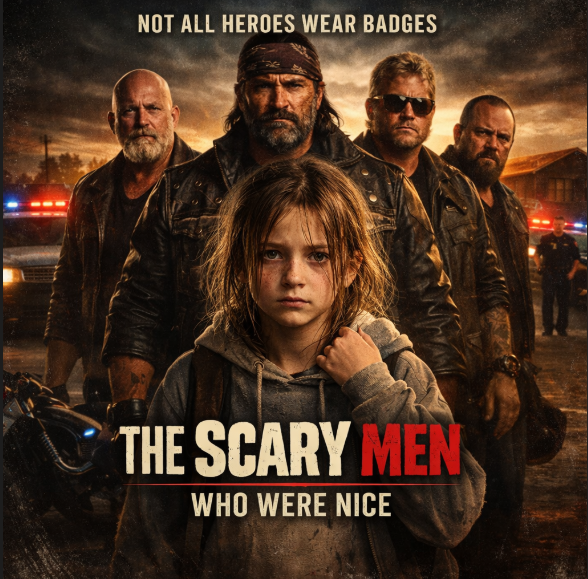
The bell above the restaurant door kept sticking halfway, so every customer had to push twice to get in. Most people didn’t notice. The biker gang did.
They noticed everything.
The place was a roadside diner off Highway 41 — chrome stools, red vinyl booths, a tired jukebox that only played half a song before skipping. Noon crowd. Fryer noise. Burger smoke. Truckers. A tired waitress named Lana refilling coffee like it was oxygen.
At the corner booth sat six bikers — leather vests, road dust, heavy boots. Their motorcycles were lined outside like resting animals.
They looked loud. Dangerous. The kind of men parents warned their kids about.
But they were arguing about milkshakes.
“Chocolate is not a milkshake,” said Marcus, the biggest of them. “It’s dessert soup.”
“It’s literally a milkshake,” said Reed. “It says so in the name.”
“Name lies,” Marcus replied, stabbing his burger.
They were halfway through their meal — burgers, fries, glass bottles of cola — when the door opened halfway… stuck… then slowly pushed again.
A small figure entered.
Nobody turned at first. Then Lana did. She paused mid-pour.
The girl looked about eleven. Too thin for her age. Oversized gray hoodie despite the warm day. Shoes with split sides. Hair tangled like it hadn’t met a brush in days. She stood just inside the door like someone unsure whether the world allowed her indoors.
Marcus noticed because she didn’t look around like kids usually do. No curiosity. No distraction. Just exhaustion.
She walked straight forward — not toward the counter — toward their table.
The gang went quiet.
She stopped beside Marcus. Didn’t look at him. Didn’t ask permission. She picked up his glass bottle of cola… and drank. Long. Desperate. Like water after a desert.
No one moved.
When she finished, she wiped her mouth with her sleeve and set the bottle back exactly where it had been.
The table stared.
Then Reed stood up suddenly and boomed:
“Well damn — guess we need more coke here!”
The whole table burst into loud laughter. Big, rolling, theatrical laughter — the kind that fills a room on purpose.
The room relaxed. Tension dissolved into chuckles. Even Lana smiled in relief.
The girl didn’t.
She swayed slightly — fatigue — and Marcus gently slid a plate of fries toward her without a word.
She stared at them like they were complicated.
“You can eat,” he said softly.
She took one. Then another. Then faster.
Marcus leaned closer. Low voice.
“When did you last eat, kid?”
No answer.
“Got a name?”
A pause.
“…Emily.”
Before he could respond, Reed’s smile vanished. He was looking through the window.
“Marcus,” he said quietly. “Outside. Now.”
Two police cruisers turned into the lot — fast, no sirens, deliberate. That wasn’t routine patrol. That was hunting posture.
Marcus didn’t panic. He observed.
“They’re not here for us,” Reed said.
“I know,” Marcus replied. “They’re here for her.”
Emily froze mid-bite. She hadn’t looked outside — but she knew.
Her fingers started shaking.
Marcus noticed that too.
The restaurant door opened hard this time — no sticking — pushed wide by a uniformed officer with urgency in his shoulders. Another followed. They scanned faces — not casually — specifically.
“Everyone stay seated,” the first officer said.
Nobody moved — except bikers finishing fries.
The officer spotted Emily instantly.
“There she is.”
He stepped forward fast.
Emily slid backward in the booth like a trapped animal.
Marcus stood — slowly — a wall of leather and muscle rising between them.
“Problem?” Marcus asked calmly.
“That child is under active search,” the officer said. “Step aside.”
Marcus didn’t step aside.
“She steal a cola?” Reed asked. “We’re pressing charges then.”
Not a smile from the officer.
“Sir. Move.”
Marcus leaned slightly closer.
“Why are you searching for her?”
“That’s not your concern.”
“That means it is.”
The second officer reached for Emily’s arm. She flinched violently — not the reaction of a guilty kid — the reaction of someone who expects pain.
Marcus saw it.
So did Reed.
And Axel.
And the rest.
The first officer grabbed her wrist roughly.
She cried out — not loud — but raw.
That was enough.
Six bikers stood at once.
Not threatening. Just present. Like iron pillars growing from the floor.
Restaurant noise died.
The officers reassessed.
“Sir,” Marcus said evenly, “you’re handling her like a suspect. She looks like a victim.”
“Move,” the officer repeated.
Marcus lowered his voice further.
“Then tell me what she did.”
The officer hesitated — one beat too long.
Emily whispered something.
Marcus bent closer.
“What was that?”
“They want me to go back,” she said.
“Back where?”
She swallowed.
“Home.”
“You ran away?”
She shook her head violently.
“I escaped.”
Silence.
Marcus looked at the officer again — new eyes now.
“What kind of home needs escaping from?”
The officer’s jaw tightened.
“Sir, you are interfering—”
Axel casually stepped between the officer and Emily — pretending to adjust his belt — but blocking reach.
“Then charge me,” Axel said mildly.
The second officer spoke into his radio — quietly. Too quietly.
Marcus heard the word custody.
He also saw something else — the patrol car logo wasn’t county police.
It was private contract enforcement.
Not normal.
He turned to Lana.
“Call Sheriff Dalton,” he said.
The officer snapped: “Do not make that call.”
Lana already had.
Marcus smiled slightly.
“You boys aren’t local,” he said. “And you’re nervous.”
Emily clutched his vest with tiny fingers.
“They work for him,” she whispered.
“For who?”
“My stepfather.”
“What does he do?”
“He owns the place where kids don’t get to leave.”
Marcus felt heat behind his eyes now.
Two more bikes roared into the lot — gang members who’d been fueling up.
Backup.
The officers felt the shift.
Minutes later, a third cruiser arrived — county marked.
Sheriff Dalton stepped out — gray mustache, sunburned neck, unimpressed expression.
“What’s this circus?” he asked.
The first officer tried to take control of the narrative — too fast — too smooth.
Dalton listened. Then looked at Emily.
Then at Marcus.
“You know this kid?” Dalton asked.
“No,” Marcus said. “But I know fear when I see it.”
Dalton knelt to Emily’s eye level.
“Sweetheart — you hurt?”
She nodded.
“By who?”
She pointed at the two contract officers.
Not accusing — terrified.
Dalton stood slowly.
“Badge numbers,” he said.
They hesitated.
That told him everything.
Turns out — Emily’s stepfather ran a “youth behavior facility” fifteen miles away — already under quiet investigation for illegal confinement and abuse. Emily had slipped out through a maintenance exit at dawn and walked the highway since morning.
The contract officers weren’t rescuing her.
They were retrieving property.
Dalton called it in.
Real sirens came this time.
The two fake-authority men were detained on the spot.
Emily started crying only after the handcuffs clicked — like her body finally believed safety was real.
Marcus gave her another cola — unopened.
“On the house,” he said.
“You own the house?” she asked.
He grinned.
“Today we do.”
Weeks later — after the facility was shut down — Dalton invited the biker gang to a small courthouse ceremony. Emily was placed with a vetted foster family.
She wore clean clothes.
Hair brushed.
Still shy — but alive behind the eyes now.
She spotted Marcus and ran to him without hesitation.
“You’re the loud table,” she said.
“Best table,” Reed corrected.
She handed Marcus a folded paper.
Inside — a crayon drawing.
Six motorcycles.
One little girl in the middle.
Title written crooked across the top:
THE SCARY MEN WHO WERE NICE
Marcus cleared his throat.
“Yeah,” he said quietly. “That sounds about right.”