The day the sirens stopped, the birds kept singing.
Dr. Elias Ward noticed that first.
He stood on the roof of the CDC satellite building outside Denver, wind dragging papers across the concrete, alarms long dead. The city below looked paused — not destroyed, just abandoned by half its people. Cars stood at green lights. A bus door hung open. A coffee cup rolled in the street like a dry leaf.
The disease had been named Andros Collapse Syndrome — ACS — a genetic-triggered immune cascade that attacked male-specific cell markers. It moved like lightning. Forty-eight hours from fever to organ failure. No cure. No resistance. No mutation drift.
Except one anomaly.
Him.
Elias pressed his fingers against his throat, feeling his pulse like proof of a crime.
“I should be dead,” he whispered.
His radio cracked. A woman’s voice — steady, controlled, exhausted.
“Dr. Ward, respond if you’re receiving.”
“I’m here.”
A long breath came through the speaker — relief, human and fragile.
“Good. This is the National Response Council. You are now classified as Priority One Biological Asset.”
“Asset,” he repeated. “Not person.”
“We can argue language later. A convoy is en route.”
By the second week, the new government was entirely female.
Not by ideology — by biology.
Air traffic control was women. Power grid supervisors were women. Police, military command, hospital chiefs, truck drivers, farmers, software engineers. Systems didn’t collapse — they strained, bent, reorganized. Automation filled gaps. Training pipelines accelerated. Old hierarchies vanished overnight.
But one sector panicked:
Human continuity.
Frozen sperm banks helped — but only partially. Samples degraded. Inventories were limited. Genetic diversity projections showed collapse within five generations if nothing changed.
Elias sat alone in a glass conference room while twelve women watched him from the other side.
Scientists. Ethicists. Security officers.
A two-way mirror — except he knew they were there.
He felt like the last candle in a hurricane.
Dr. Mara Levin, epidemiologist and acting national coordinator, entered and sat across from him.
“No restraints,” she said calmly. “No coercion. You’re here voluntarily.”
“Am I free to walk out?”
“Yes,” she said. “But you won’t.”
“Because?”
“You know the math.”
He laughed softly. Not happy — hollow.
“Say it,” he told her.
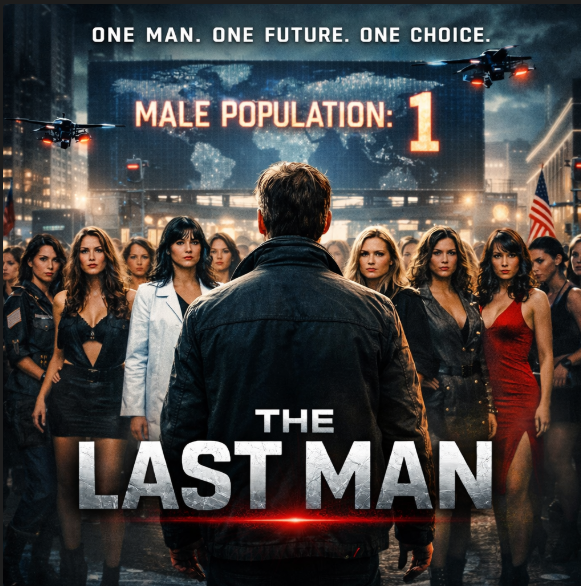
“You are currently the only living male on Earth.”
Hearing it spoken made the air heavier.
The world reacted in phases.
Phase One: Shock
Grief services streamed globally. Memorial walls filled city squares. Names scrolled endlessly. Women wore black bands, not for politics — for brothers, fathers, sons.
Phase Two: Stabilization
Emergency governance networks formed. Resource mapping. Skill reassignment. AI-assisted logistics. Remote-operated heavy industry expanded fast.
Phase Three: The Elias Problem
News of the survivor leaked.
Not his location — just his existence.
He became myth before he became policy.
Some called him The Last Man. Others called him The Seed Carrier. A few called him The Property of Humanity — which made Mara furious.
Security around him increased — not like a prison, but like a president.
He hated it anyway.
“How do you want to be treated?” Mara asked one night.
They sat in a secure mountain facility lounge. No cameras in this room — her rule.
“Like a human,” he said.
“That’s too vague.”
“Not studied. Not scheduled like breeding livestock.”
“No one will force you.”
“You say that now.”
She didn’t answer immediately — and that silence told him more than reassurance would have.
“Some groups are already drafting proposals,” she admitted. “Volunteer reproduction programs. Rotational genetic pairing. Artificial collection protocols.”
He stared into his untouched tea.
“Clinical words for intimate acts,” he said.
“Yes.”
He looked up.
“Do they see me — or just my cells?”
“Both,” she said quietly.
Public opinion fractured.
One movement believed he should live isolated, donating genetic material only through lab extraction — no relationships, no attachments — pure population strategy.
Another movement argued the opposite: he should choose partners naturally to preserve psychological stability and consent.
A third, louder group insisted reproduction should shift fully to cloning and synthetic gamete engineering — removing him from the burden entirely.
Debates filled every network channel.
Elias stopped watching.
The psychological weight came later.
In the shower. In the mirror. In dreams.
He felt watched even when alone.
Desired and resented at the same time.
Women wrote him letters — millions. Some loving. Some pleading. Some angry.
You owe us survival.
You are not obligated to anyone.
Choose me.
Don’t let them use you.
Be our Adam — or refuse and be our last ghost.
He stopped reading after the first thousand.
The first reproduction council meeting with him present lasted nine hours.
Rules were established:
• Absolute consent required at every stage
• Maximum genetic diversity priority
• No exclusivity contracts
• Psychological care mandatory
• No media involvement
• Participation caps per year
One woman stood during the debate — a logistics commander — and said bluntly:
“We must not turn him into a shrine or a stallion. Either breaks him. And if he breaks — humanity breaks.”
That line became policy doctrine.
Still — treatment varied.
Some women around him were gentle, almost protective. They brought normal conversation, jokes, board games, arguments about movies — reminders that he was not a species, just a person.
Others couldn’t hide the intensity in their eyes — the awareness of what he represented. Hope. Continuity. Biological leverage.
He felt it like gravity.
It exhausted him.
“How do you feel?” Mara asked during a psych evaluation session.
“Like a crowded room,” he said.
“Explain.”
“Everyone needs something from me. Even kindness feels like a request.”
“And what do you need?”
He took a long time answering.
“To be wanted for something that isn’t global survival.”
She wrote that down — slowly.
Earth itself changed in subtle ways.
Heavy mining slowed — fewer workers, more robotics. Some oil fields shut down permanently. Emissions dropped sharply. Wildlife corridors expanded as road traffic declined. Cities grew quieter. Night skies became clearer.
Agriculture shifted toward automation and cooperative regional farming networks run mostly by former research scientists and engineers retrained through emergency programs.
Violence rates dropped overall — not vanished, but reduced. Organized war structures dissolved without male-dominated command hierarchies — replaced by defensive coalitions and drone security grids.
The planet exhaled.
Humanity held its breath.
The first child conceived after ACS was born fourteen months later.
Lab-assisted. Carefully screened.
A girl.
The room cried anyway.
Elias watched the recording alone. Not the procedure — just the newborn cry.
He cried too — not from pride — from relief that life still moved forward without needing him every second.
Years passed.
He chose limited participation — controlled, spaced, voluntary.
Some partners became friends. A few became something deeper — complicated, tender, real — though none could ever be private in meaning, even if private in life.
The women around him gradually stopped staring.
He aged from symbol back toward man.
One evening he stood outside the facility watching a sunset burn orange across the Rockies. A young security officer joined him — mid-twenties, calm.
“Does it ever feel less strange?” she asked.
“Yes,” he said.
“When?”
“When people stopped asking what I represent — and started asking what I think.”
She smiled.
“What do you think?”
He watched a flock of birds turn in perfect formation.
“I think humanity didn’t survive because of me,” he said. “It survived because women refused to panic.”
“And you?”
“I just didn’t die.”
She laughed — warm, unceremonious — exactly the kind of laugh he missed from before the world changed.
For the first time in years, he felt invisible for a moment.
It felt like freedom.
And he held onto it like oxygen.