I never believed in things that couldn’t be explained. Not ghosts, not “energies,” not unfinished souls. I believed in paperwork, routine, mortgage payments, and packed school lunches. That’s why what happened that autumn evening still doesn’t sit right in my mind — because it didn’t feel like a story. It felt like something that slipped through a crack in reality and chose my house.
It started on a Thursday.
The sky was turning orange and gray — that in-between time when the neighborhood looks softer than it really is. I was fixing the porch light while my six-year-old daughter, Meera, played near the mailbox. She liked to hop between the concrete squares like they were islands over lava. She was laughing to herself, deep in one of her imaginary worlds.
Then she stopped.
Not gradually — suddenly. Frozen mid-step.
I remember the sound of the screwdriver slipping from my hand and hitting the wood. She was staring across the road toward the old bus stop bench. No one used it anymore since the route changed. Leaves gathered there like forgotten mail.
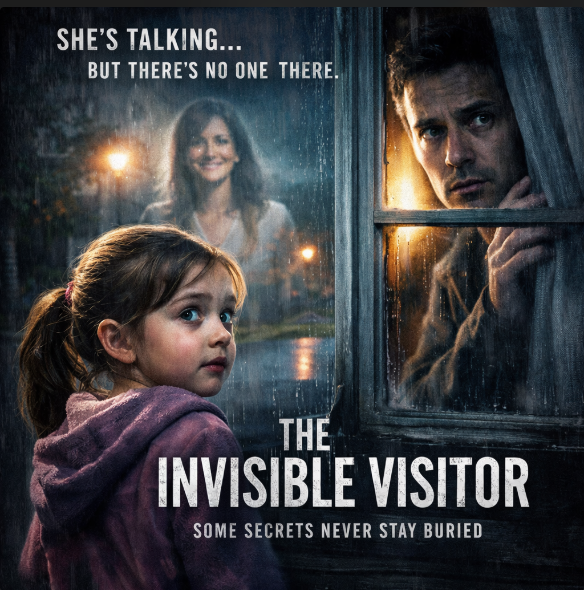
“Papa,” she said quietly, not looking at me, “that lady is asking why you don’t visit her.”
I frowned. “Which lady?”
She pointed.
There was no one there.
“Just the wind, baby,” I said. “Come here.”
But she didn’t move. She tilted her head like she was listening to someone speaking softly.
I walked down the steps. “Meera.”
“She’s smiling,” she said. “But her eyes are crying.”
A strange sentence for a child. Too structured. Too specific.
I looked again across the road. Empty bench. Empty sidewalk. A plastic bag rolled by like a tired tumbleweed.
“Okay, that’s enough outside,” I said, forcing lightness into my voice. “Homework time.”
She came willingly — but she kept glancing back.
That night she asked if we could leave the porch light on longer than usual.
The next day, I forgot about it — or tried to. Kids imagine things. That’s what they do. My wife used to say Meera had “story eyes.” She could see worlds inside shadows.
Used to say.
Grief changes language. You start noticing which verbs you can’t use anymore.
It had been two years since the accident. Two years since the hospital corridor and the doctor who couldn’t hold eye contact long enough. I learned how to function after that. Learned how to become both parents at once.
Friday evening, we got home later than usual. Grocery bags, tired legs, traffic irritation — real life noise. I was unlocking the door when Meera tugged my sleeve.
“She’s here again.”
My stomach tightened. “Who?”
“The smiling mom.”
I turned slowly.
Across the street — I swear — for half a second — I thought I saw a figure under the streetlight. A woman’s outline. Still. Watching.
Then a car passed and the light shifted — and there was nothing.
“You’re seeing shadows,” I said, but my voice came out thin.
We went inside.
While I put groceries away, I heard her talking through the front window. Not loud — conversational. Like she was answering questions.
I walked quietly down the hallway and stopped where she couldn’t see me.
“…he doesn’t remember,” Meera said softly. “But I do.”
Silence.
Then she nodded — listening.
My scalp prickled.
I stepped forward and pulled the curtain aside.
From my angle, the yard was completely empty.
But Meera was smiling at someone.
“Who are you talking to?” I asked.
She didn’t startle — like she expected the interruption.
“The lady,” she said simply.
“There’s no one there.”
She looked confused — not defensive, not playful — confused like adults get when facts don’t match experience.
“She was just here.”
I didn’t sleep well that night.
Memory is a strange animal — it waits until you’re tired to come sit on your chest.
I kept seeing another woman under another light — rain, flashing ambulance colors, twisted metal. I pushed the images away and told myself this was coincidence plus imagination.
Saturday afternoon, Meera asked if she could draw outside with sidewalk chalk. I said yes but kept the door open.
Ten minutes later, I heard her laughing — not her usual laugh — a polite laugh. The kind she used with adults.
I stepped onto the porch.
She was sitting cross-legged, looking up at someone standing just beyond the edge of the lawn.
From where I stood — there was no one.
But Meera’s eyes were tracking a face.
“…that’s what he told me,” she was saying.
I walked down slowly, heart thudding. “Meera.”
She turned. “Papa — she says you used to promise things.”
Cold spread through my arms.
“What things?”
Meera turned back toward the empty space — listening.
Then she repeated carefully, word for word:
“She says — your father is the one who —”
And she stopped.
“Who what?” I asked.
Meera blinked. “She didn’t finish. She’s crying now.”
I looked at the air in front of her and — for just a moment — the world felt misaligned, like a painting knocked crooked.
“Come inside,” I said.
This time my voice shook.
That night I did something I hadn’t done in two years.
I opened the storage box.
Photos. Hospital band. Insurance letters. The last voicemail I never deleted.
And at the bottom — a printed email thread.
I almost didn’t recognize the name at first.
Anaya.
Not my wife.
Earlier than that.
Before marriage. Before responsibility. Before I “made the right choice.”
I sat down slowly.
We had been together three years. I told her I’d leave, that I’d tell everyone, that we’d build something real. Then my father fell sick. Then money became oxygen. Then expectations became handcuffs.
I ended it by disappearing into duty.
She sent messages for months. The last one said:
“You will forget me. But truth has a way of visiting.”
I never replied.
I convinced myself she moved on.
People move on. That’s what adults say to survive themselves.
Sunday evening, the air felt heavy — like a storm thinking about forming.
Meera was again by the window.
Talking.
I didn’t rush this time. I watched first.
She listened. Nodded. Smiled sadly.
Then she said: “He’s scared to remember you.”
My throat closed.
I stepped beside her and looked out.
Empty yard.
But this time — Meera reached up and held someone’s hand.
Her fingers curled around nothing — yet her wrist lifted like there was resistance.
“Don’t,” I whispered.
She looked at me. “Papa, why are you crying?”
I hadn’t noticed I was.
“What does she look like?” I asked.
Meera described her.
Not ghostly. Not damaged. Just gentle. Kind eyes. Tearful smile.
Exactly how Anaya looked the last day I saw her in person.
“Ask her,” I said quietly, “what she wants.”
Meera listened.
Then answered:
“She says — truth shouldn’t be buried with the wrong people.”
A car passed outside. Headlights washed the yard.
For one clear second — I saw her.
Standing near the mailbox.
Real as breath. Eyes full. Not angry — hurt.
Then darkness returned — and she was gone.
I didn’t scream. Didn’t run.
Because deep down — recognition is louder than fear.
The next morning I searched.
Old contacts. Old social accounts. Public records.
I found an obituary from eighteen months ago.
Car accident. Highway overpass. Rain.
No surviving family listed.
I sat there a long time.
Not because I believed she was visiting — but because guilt, when it finally stands up, casts a very human shadow.
That evening Meera played outside again.
She talked less.
When I asked why, she said:
“The crying lady said goodbye. She said you heard her now.”
I asked what she meant.
Meera shrugged. “Grown-up things.”
Children say that when they know more than they should.
I still don’t believe in ghosts.
But I believe in unfinished truth.
I believe regret finds doors children can open easier than adults.
And sometimes — when dusk hits just right — I see a woman across the street under the light, smiling through tears.
I don’t wave.
I just stand there — and remember properly this time.