The lunch bell rang like a burst of freedom, and within seconds the classroom transformed from disciplined silence into cheerful chaos. Chairs scraped. Zippers opened. Laughter bounced off the pastel-colored walls. Sunlight streamed through the wide windows, warming the tiled floor and lighting up dozens of colorful lunch boxes that popped open like tiny treasure chests.
The classroom belonged to Grade Four, a lively group of children who carried stories in their backpacks and dreams in their pockets. There was Ethan, who always brought peanut butter sandwiches cut into perfect triangles. Mia, whose mother packed neatly sliced fruits in separate little containers. Oliver traded cookies for chips every single day. Lily proudly showed everyone the cupcakes her grandmother baked each morning.
Clusters of children formed quickly. They compared snacks, swapped bites, teased each other, and spoke over one another in the happy language only children understand. The room felt full — of sound, of movement, of belonging.
In the very last row, near the tall window where the sunlight was softer, sat a boy named Noah.
Noah was quiet even on normal days. He wasn’t unfriendly, just careful. He observed more than he spoke. His hair was slightly messy, as if someone had once tried to comb it but didn’t finish. His uniform was clean but a little faded. He carried himself in a way that made him almost invisible among louder personalities.
He slowly placed his lunch box on the desk.
Around him, wrappers crinkled and bottles popped open.
He unlatched the small metal clip.
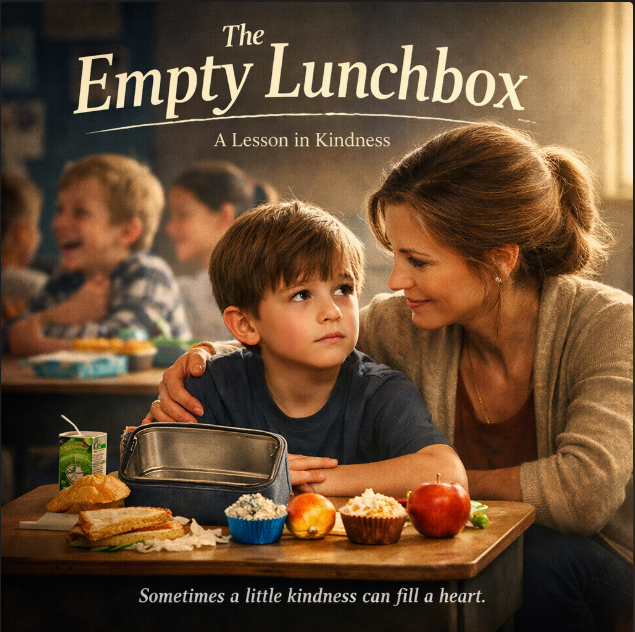
Inside, there was nothing.
No sandwich.
No fruit.
Not even crumbs.
Just empty steel reflecting the sunlight.
Noah stared at it for a few seconds longer than necessary, as if something might magically appear. Then he gently closed it halfway but didn’t shut it completely. His fingers traced the edge of the lid. His stomach made a quiet sound, but it was swallowed by the laughter in the room.
Across the classroom, kids were sharing fries. Someone was complaining that their apple slices were turning brown. Someone else had spilled juice and was giggling instead of apologizing.
Noah glanced around.
For a brief second, he smiled — not because he felt happy, but because he didn’t want to look different. He folded his hands on top of the empty box and sat still.
At the front of the classroom, Mrs. Carter watched.
Mrs. Carter had been teaching for over twenty years. She believed that children spoke even when they said nothing. She knew the difference between loud happiness and quiet sadness. While most teachers used lunch break to check papers or sip tea, she often observed her students — their friendships, their moods, their unspoken struggles.
Today, something felt off.
Her eyes moved from table to table until they stopped at the back corner.
Noah.
He wasn’t eating.
She narrowed her gaze slightly. She noticed how still he was. How he didn’t join the trading conversations. How his shoulders seemed a little heavier than usual.
She gently placed her red pen on the desk.
Without making a scene, she began walking toward him.
The classroom noise continued, unaware.
Noah sensed movement and looked up. For a second, panic flickered in his eyes. He instinctively moved to close the lunch box fully, but Mrs. Carter had already seen.
She stopped beside his desk.
They looked at each other.
No words were spoken.
Noah tried to smile again, but this time it trembled.
Mrs. Carter pulled a chair quietly and sat beside him. She didn’t ask questions. She didn’t call attention. She simply sat.
In that small act, something softened.
After a few moments, she gently opened her handbag and took out her own lunch — a simple container with sandwiches and a small thermos.
She placed it between them.
Noah looked confused at first.
Mrs. Carter broke a sandwich in half and pushed one piece toward him.
Still no words.
Just kindness.
His eyes widened slightly. He hesitated — the kind of hesitation that comes from being used to saying no. But hunger and something deeper — the need to be seen — slowly defeated hesitation.
He accepted the sandwich.
He took a small bite.
Then another.
Across the classroom, something unexpected happened.
Mia noticed.
Children notice more than adults think.
She nudged Ethan and whispered. Soon, a few eyes turned toward the back. But instead of teasing, there was quiet curiosity.
Oliver stood up first.
He walked over holding two cookies.
He didn’t say anything. He simply placed one on Noah’s desk and gave a quick shrug, as if to say, “I had extra.”
Lily followed with a cupcake.
Ethan brought a juice box.
One by one, without announcement or performance, children began leaving small portions of their lunches on Noah’s desk.
No speeches.
No dramatic gestures.
Just simple offerings.
Noah looked at the growing collection in front of him. His eyes began to shine — not from hunger anymore, but from something warmer.
Mrs. Carter watched silently, her heart full.
The classroom noise shifted. It was no longer just laughter — it carried a subtle understanding.
Noah wiped his eyes quickly, embarrassed but grateful. He whispered a small “thank you,” almost too soft to hear. But they heard it.
That afternoon, something invisible changed.
The next day, when lunch break arrived, Noah hesitated again before opening his lunch box.
But this time, it wasn’t empty.
Inside were two simple slices of bread.
Not fancy. Not colorful. But something.
He looked surprised.
That morning, before school, there had been a quiet knock at his small apartment door. Mrs. Carter had visited his mother the previous evening after school. She learned about the job loss. The long nights. The quiet struggles they tried to hide.
Mrs. Carter didn’t bring charity.
She brought support.
She connected Noah’s mother with the school’s meal assistance program. She assured her there was no shame — only community. She made sure breakfast and lunch would now be provided daily, discreetly.
Noah didn’t know all the details. He just knew his lunch box wasn’t empty anymore.
At school, something else had changed too.
Oliver now saved him a seat.
Mia asked if he wanted to trade fruit.
Ethan invited him to join their weekend soccer game.
Children can be cruel sometimes — but they can also be beautifully kind when shown how.
Weeks passed.
Noah began smiling more. He raised his hand once during math class. Then again during reading. His voice, once hesitant, grew steady.
The empty lunch box became a distant memory.
One afternoon, Mrs. Carter stayed back after class. She watched as Noah laughed loudly — the kind of laugh that fills a room — while racing his friends to the school gate.
She felt tears sting her eyes.
Not because of sadness.
But because she understood something powerful.
Sometimes, the loudest hunger isn’t for food.
It’s for belonging.
Months later, during a school assembly about kindness, the principal praised the students for their unity and compassion. No names were mentioned. No story was explained. But everyone in that classroom knew.
When lunch bell rang again that day, the room filled with the same joyful noise as always.
But now, in the back corner near the window, Noah wasn’t alone.
He sat surrounded by friends.
His lunch box opened — full.
His heart opened — fuller.
And across the room, Mrs. Carter smiled quietly to herself.
No dramatic speeches.
No applause.
Just a classroom where one small act of noticing turned into a wave of kindness.
And sometimes, that is enough to change a life.