The street was too quiet.
Not peaceful—unnaturally quiet, like the world itself was holding its breath.
Streetlights flickered on one by one, casting long, trembling shadows across cracked pavement. A cold wind pushed loose paper down the road, scraping against the curb like whispers that didn’t want to be heard.
In the middle of that silence stood a boy.
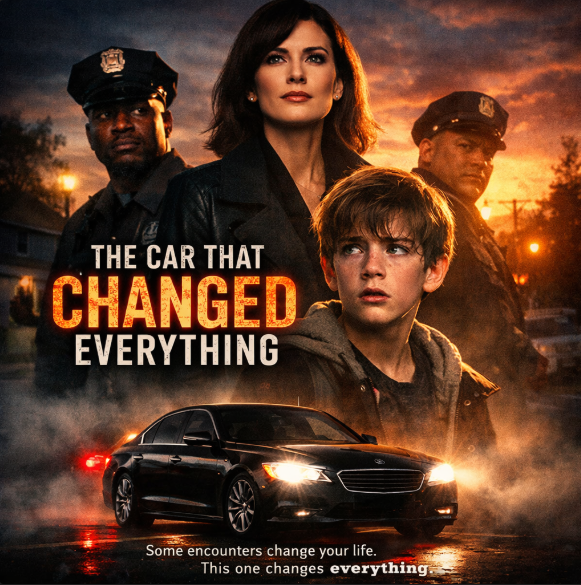
Fourteen years old. Thin. Pale. His hands trembled—not from guilt, not from defiance—but from fear so raw it shook his bones. His school backpack lay open on the ground, its contents spilled like evidence of a life interrupted: a notebook, a broken pencil, a half-eaten sandwich wrapped in foil.
Two uniformed officers stood in front of him.
Their voices were controlled, measured, professional—but there was tension underneath, the kind that crawls into the chest and tightens the lungs.
“Calm down,” one of them said. “Just breathe.”
The boy tried.
He really did.
But his chest burned. His heart slammed like it was trying to escape. Every sound felt too loud. Every second felt like a countdown to something terrible.
“I didn’t do anything,” he said, his voice cracking. “I swear. I was just walking home.”
The officers exchanged a look—not angry, not cruel, but cautious. The kind of look people give when they don’t yet know the full story… and that uncertainty itself becomes dangerous.
“Watch your tone,” the second officer said calmly. “We’re trying to help you.”
Help.
The word felt heavy. Unbelievable.
The boy clenched his fists. Tears blurred his vision, turning streetlights into glowing halos. He felt small—smaller than he had ever felt in his life.
And then—
The sound.
A low, smooth engine hum cut through the silence.
Both officers turned their heads.
The boy turned too.
A black car rolled slowly onto the street.
Not a police car. Not an ordinary sedan. It moved with purpose—quiet, controlled, deliberate. Its headlights sliced through the dusk like sharp white knives, illuminating the boy’s face, the officers’ boots, the scattered remains of his school day.
The car stopped.
Perfectly.
The engine shut off.
For a moment, nobody moved.
Then the driver’s door opened.
A woman stepped out.
She was dressed in black—tailored coat, polished shoes, posture straight as steel. Her presence changed the air instantly, as if gravity itself had shifted to acknowledge her.
She looked at the officers.
Then at the boy.
And when her eyes met his—
Something broke.
His breath hitched. His knees nearly gave out.
Because in that look was recognition.
Not judgment.
Not suspicion.
Recognition.
She walked forward slowly, heels clicking against the pavement, each step echoing louder than it should have. The officers instinctively straightened.
“Evening,” she said. Her voice was calm—but beneath it was authority, sharp and undeniable. “Is there a problem?”
“We’re handling a situation,” one officer replied carefully.
Her gaze didn’t waver.
“I know,” she said. “And now I’m here.”
The boy swallowed hard.
“Ma’am,” he whispered, barely audible. “I—I didn’t—”
She raised a hand.
Not to silence him.
To reassure him.
“I know,” she said softly, without even looking at him. “You don’t have to explain.”
The officers stiffened.
“You know him?” one asked.
She finally turned her full attention to them.
“Yes,” she said. “Very well.”
A pause.
The kind of pause that stretches too long. That makes people uncomfortable. That forces truths to the surface.
“I’m taking responsibility for him,” she continued. “He’ll come with me.”
The officers hesitated.
Procedure. Protocol. Questions.
But something about her—her confidence, her stillness, her certainty—made those things feel suddenly fragile.
“Who are you?” one officer asked.
The woman smiled.
Not kindly.
Not cruelly.
Knowingly.
“Someone who has been looking for him,” she said. “For a very long time.”
The boy’s breath caught.
“What… what do you mean?” he asked.
She turned to him then, really looked at him, as if memorizing every detail—his face, his fear, the way he stood like the world had already disappointed him too many times.
“You’ve been running,” she said gently. “Even when you didn’t know it.”
Tears finally fell.
“I just wanted to go home,” he whispered.
Her expression softened.
“And you will,” she said. “Just not the way you imagined.”
She opened the back door of the black car.
The interior was dark. Quiet. Safe.
For the first time that evening, the boy felt something unfamiliar.
Relief.
He looked back at the officers.
They said nothing.
They didn’t stop him.
They didn’t need to.
He stepped toward the car.
Before he got in, he turned back to the woman.
“Why me?” he asked.
Her eyes glistened for the first time.
“Because,” she said, her voice low and heavy with meaning, “the world has a habit of ignoring the ones who matter most… until it’s almost too late.”
He climbed into the car.
The door closed with a soft, final sound.
The woman returned to the driver’s seat.
As the engine started, one officer finally spoke.
“Ma’am,” he said. “What happens now?”
She looked at them through the open window.
“Now?” she replied.
The corner of her mouth lifted slightly.
“Now the story changes.”
The car pulled away.
Its taillights disappeared into the night.
The street returned to silence.
But it was no longer empty.
Because something irreversible had just happened.
And somewhere in the darkness ahead, a boy who had felt invisible moments ago was about to learn—
Some encounters don’t just save you.
They rewrite who you were meant to become.