No one remembered how long they had been lying on the cold marble floor.
Seconds stretched into something heavier—thicker—like time itself had been pressed flat against their lungs. The smell of metal, sweat, and fear filled the air inside the downtown bank.
A woman near the counter was crying quietly, trying not to make a sound. A man in a suit had his face pressed into the floor, eyes open, staring at nothing.
Then the knife glinted.
“Stay on the ground! Everyone!”
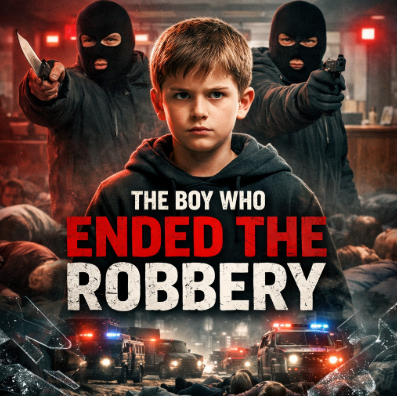
The shout echoed off the walls, sharp and panicked. One of the thieves paced between bodies, boots thudding like a countdown. He wore a black ski mask pulled tight, breath fogging the fabric. In his hand, a long knife trembled—not from fear, he told himself, but from adrenaline.
The second thief stood near the vault door, watching the room, eyes darting behind his mask. This wasn’t supposed to take long. In and out. Simple.
But nothing ever stayed simple.
The security guard had already been disarmed. Phones were scattered across the floor. The alarm had been cut—or so they thought. Every person in the bank had learned the same lesson in the last thirty seconds: move, and you could die.
Except one.
The boy had been lying beside his mother near the waiting chairs. Twelve years old. Sneakers scuffed. Hoodie a size too big. When the shouting started, his mother had pulled him down hard, whispering over and over, Don’t look. Don’t move.
But the boy was looking.
He wasn’t staring at the knife.
He was staring at the thieves’ hands.
At the way one man kept adjusting his grip. At the slight shake in the other’s knees. At the way their voices cracked when they yelled.
The boy exhaled slowly.
And then he stood up.
The sound wasn’t loud—but it was loud enough.
A sharp intake of breath. Someone gasped. Someone else whispered, “No.”
The pacing thief froze mid-step.
“What did I say?” he snarled, swinging around. “Get down!”
The boy didn’t flinch.
He looked small standing there in the middle of the bank, surrounded by adults pressed into the floor. But his eyes were steady. Clear. Older than twelve.
“You guys have to leave now,” he said.
His voice wasn’t loud. It didn’t shake.
“I’m giving you a last warning.”
For half a second, no one moved.
Then the thieves laughed.
A short, ugly sound.
“You think this is funny?” the knife-wielding thief snapped, stepping forward. “This ain’t a movie, kid.”
The boy tilted his head slightly, like he was listening to something no one else could hear.
“No,” he said. “It’s not.”
His mother reached for his leg, fingers trembling. “Please,” she whispered. “Please sit down.”
The boy didn’t look at her.
The second thief raised his gun—then hesitated.
Because something felt wrong.
There was no panic in the kid’s face. No bravado. No fear. Just certainty.
“You have maybe ten seconds,” the boy continued. “After that, it won’t be your choice anymore.”
The knife came up, pointed directly at his chest.
“On the ground. Now.”
The boy smiled.
That was when the lights flickered.
Just once.
The sound came next—a low hum beneath the building, almost like distant thunder.
The thieves stiffened.
“What the hell was that?” one muttered.
The boy’s eyes flicked briefly toward the ceiling, then back to them. “That’s your warning expiring.”
The vault door behind the second thief clicked.
Then clicked again.
And then—locked.
The thief spun around. “Did you touch something?”
“I didn’t touch anything!” the other snapped.
From somewhere above them, a calm mechanical voice filled the bank.
“Emergency protocol activated.”
The color drained from both men’s faces.
“No,” the knife-wielder whispered. “No, no, no—”
The boy finally raised his voice.
“Everyone stay down,” he said, firm and clear. “This will be over in a minute.”
Red lights flooded the room.
Steel shutters slammed down over the exits with a deafening crash. The thieves rushed toward the door—but it was already sealed, thick metal locking into place.
“What did you do?” the man screamed, spinning back toward the boy.
The kid didn’t answer.
He reached into his hoodie pocket.
The knife lifted higher.
“Don’t—”
The boy pulled out a small black device and pressed a button.
Outside, sirens erupted all at once. Not distant. Not approaching.
They were already there.
The windows darkened as armored vehicles rolled into position. Spotlights blasted through the glass. A voice boomed from hidden speakers, calm and absolute.
“This is federal law enforcement. Drop your weapons and get on the ground.”
The thieves panicked.
The one with the knife lunged.
He never made it two steps.
The floor beneath him sparked, and his body locked mid-motion, collapsing as electricity surged through concealed plates built into the bank’s security system. The second thief froze—then dropped his gun, hands shaking violently.
“Please,” he whispered. “Please, I didn’t know—”
The boy finally sat down.
Silence filled the room, broken only by sobbing and the distant crackle of radios.
Within minutes, heavily armed agents flooded the bank, securing the thieves, checking on customers, helping people to their feet. Medics rushed in. The tension drained like a storm passing.
An agent knelt in front of the boy.
“You did exactly what we trained you to do,” she said quietly.
The boy nodded, suddenly looking his age again.
His mother pulled him into her arms, crying openly now. “You scared me,” she whispered.
“I know,” he said softly. “I’m sorry.”
As the agents escorted the thieves out in handcuffs, one of them turned back, eyes wild behind the mask.
“That kid,” he muttered. “That kid wasn’t normal.”
The agent didn’t respond.
Outside, reporters gathered, cameras flashing. Headlines would come fast. Brave Child Stops Bank Robbery. Twelve-Year-Old Hero.
But inside the bank, as the boy walked out holding his mother’s hand, one agent spoke quietly into her radio.
“Asset remains secure,” she said. “Threat neutralized.”
The boy glanced up at her.
“Am I in trouble?” he asked.
She smiled slightly. “No,” she said. “But you’re going to have a lot of homework.”
He groaned. Just a kid again.
Behind them, the bank doors reopened. Life resumed. But for everyone who had been lying on that cold floor, one truth would never fade:
Sometimes the most dangerous thing in the room isn’t the man with the knife.
It’s the quiet kid who tells you to leave—
and means it.