
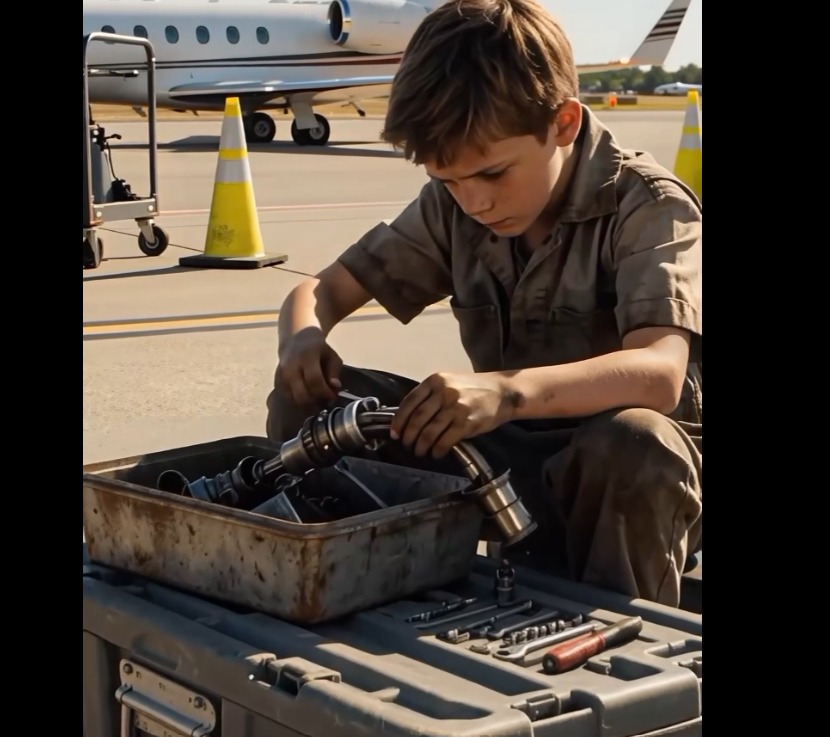
The afternoon sun beat down on the maintenance section of a busy American airport.
Beyond the restricted maintenance fencing, private jets waited beside hangars while commercial aircraft slowly taxied toward distant gates.
Mechanics moved between tool carts, fuel trucks, and service vehicles. The constant hum of engines mixed with the beeping of reversing machinery.
But near one of the maintenance areas, away from the crowds, something unusual was happening.
A twelve-year-old boy sat on the ground.
His name was Caleb Mercer.
His clothes were old and covered with dirt. His shoes were badly worn, and his sleeves were stained with grease.
Beside him sat a small metal toolbox that looked as though it had been repaired almost as many times as the aircraft components in front of him.
Several detached aircraft parts were spread carefully across a protective maintenance mat.
Caleb worked silently.
He didn’t have expensive equipment.
He didn’t have an official uniform.
He didn’t even have the kind of tools professional aviation mechanics normally used.
Yet his hands moved with remarkable precision.
He inspected one component, adjusted a small mechanism, tightened a fastener, and carefully tested the movement.
Then he moved to another part.
A mechanic walking nearby stopped for a moment and watched him.
“How did that kid even get in here?” the mechanic muttered.
Another mechanic shrugged.
“Security probably knows about him.”
But nobody approached Caleb.
Not yet.
For weeks, rumors had been spreading through the airport.
Someone had been repairing damaged aircraft components that mechanics had struggled to diagnose.
Nobody knew exactly who was doing it.
Some employees claimed it was an experienced retired engineer.
Others believed a private aviation company had hired an unknown specialist.
Then one morning, a maintenance supervisor found a handwritten note beside a malfunctioning component.
Try checking the secondary alignment.
The supervisor followed the suggestion.
The problem disappeared.
There was only one strange thing.
The handwriting looked like it belonged to a child.
And that afternoon, Caleb was sitting beside the runway.
He had no idea that someone important was about to find him.
Suddenly, footsteps thundered across the pavement.
A wealthy-looking man in his fifties came storming toward him.
His expensive suit was perfectly pressed, and two security guards followed closely behind him.
The man’s name was Richard Halbrook, the owner of a private aviation company that operated several high-end aircraft.
Richard pointed furiously toward the components.
“Hey! What are you doing with that?”
Caleb slowly looked up.
“Repairing these parts.”
Richard stared at him.
Then he looked at the boy’s dirty clothes.
Then at the toolbox.
Then back at the aircraft components.
A sarcastic smile appeared on his face.
“You can’t repair these parts.”
Caleb didn’t respond.
He simply returned to his work.
Richard laughed.
“You hear me? Those aren’t toys.”
Caleb tightened another fastener.
One of the guards suddenly stepped closer to Richard.
His expression had completely changed.
“Sir…”
Richard continued watching Caleb.
“What?”
The guard lowered his voice.
“He’s the one everyone is talking about.”
Richard turned.
“What are you talking about?”
“The boy.”
Richard looked at Caleb again.
“The twelve-year-old?”
The guard nodded.
“That’s him.”
Richard stared for several seconds.
Then he burst out laughing.
“This kid? No way.”
The guard didn’t laugh.
“I’m serious, sir.”
Richard walked closer.
“You’re telling me this child is the person who fixed those aircraft problems?”
“Yes.”
Richard shook his head.
“That’s ridiculous.”
Caleb continued working.
Richard pointed toward the component.
“Tell me something, kid. Where did you learn this?”
Caleb paused.
“My grandfather.”
Richard’s expression changed slightly.
“Your grandfather?”
Caleb nodded.
“He was a mechanic.”
“What kind of mechanic?”
Caleb looked at the aircraft part.
“Aircraft.”
Richard crossed his arms.
“Where does your grandfather work?”
“He doesn’t anymore.”
“Why?”
Caleb lowered his eyes.
“He passed away.”
For the first time, Richard stopped laughing.
But he still wasn’t convinced.
He pointed toward another component.
“Fine. If you’re so smart, tell me what’s wrong with that.”
Caleb examined it.
He didn’t touch it immediately.
He studied the housing.
Then the connecting points.
Then a small section near the edge.
“That one isn’t broken.”
Richard raised an eyebrow.
“Excuse me?”
“The component is fine.”
“Then why was it removed?”
Caleb pointed toward one side.
“The problem is here.”
Richard leaned closer.
“Where?”
“Alignment.”
One of the airport mechanics nearby heard the conversation and walked over.
“He’s right.”
Everyone turned.
The mechanic looked at Richard.
“We’ve been trying to figure that out for two days.”
Richard’s face became serious.
The mechanic continued.
“The component keeps passing inspection by itself, but once installed, the system gives inconsistent readings.”
Caleb nodded.
“Because the calibration changes under load.”
The mechanic stared at him.
“How do you know that?”
Caleb shrugged.
“I tested it.”
Richard looked from the mechanic to Caleb.
“You’re telling me this boy found something your team missed?”
The mechanic hesitated.
“Apparently.”
Richard looked at Caleb.
“Show me.”
Caleb opened his toolbox.
He pulled out a small hand tool.
The mechanic immediately stopped him.
“Wait.”
He looked at Richard.
“We can’t let him work on anything without authorization.”
Richard nodded.
“He’s right.”
Caleb quietly put the tool down.
Richard studied the boy.
“Who brought you here?”
Caleb didn’t answer.
“Your parents?”
Silence.
Richard frowned.
“Where are they?”
Caleb looked toward the runway.
“My mom works nights.”
“And she knows you’re here?”
Caleb shook his head.
Richard sighed.
“Then you shouldn’t be here.”
Caleb closed his toolbox.
“I know.”
He started gathering his things.
The mechanic suddenly stopped him.
“Wait.”
Caleb looked up.
The mechanic pointed toward the toolbox.
“What’s that?”
Caleb looked at it.
“My grandfather’s.”
The mechanic crouched down.
There was a faded label on the side.
MERCER AVIATION — TECHNICAL SERVICES
The mechanic’s eyes widened.
He looked at Caleb.
“Mercer?”
Caleb nodded.
“Daniel Mercer?”
Caleb looked surprised.
“Yes.”
The mechanic stood up.
“You mean Daniel Mercer?”
Caleb nodded again.
Richard’s expression changed.
He knew that name.
Daniel Mercer had once been considered one of the most talented aircraft maintenance engineers in the region.
Richard had met him years earlier.
But Daniel had disappeared from the industry after a serious accident.
Richard stared at Caleb.
“You’re his grandson?”
“Yes.”
Richard looked at the toolbox again.
Suddenly, the old stories began making sense.
The mysterious handwritten notes.
The unexplained repairs.
The unusual observations.
The boy.
Richard turned toward the mechanic.
“How long has he been doing this?”
The mechanic answered quietly.
“Nobody knows.”
Richard looked at Caleb.
“Why?”
Caleb shrugged.
“Sometimes mechanics throw away parts that can still be fixed.”
The mechanic frowned.
“That’s what you’ve been doing?”
Caleb nodded.
“My grandfather taught me not to replace something just because it’s difficult.”
Richard remained silent.
Caleb continued.
“He said the easiest solution isn’t always the best one.”
The words hit Richard harder than he expected.
He remembered Daniel saying almost exactly the same thing years earlier.
Richard looked at the aircraft component again.
Then at Caleb.
“Can you actually fix it?”
Caleb hesitated.
“If I’m allowed.”
Richard glanced at the mechanic.
The mechanic nodded.
“We can test his diagnosis without letting him work directly on the aircraft.”
Richard agreed.
A controlled inspection was arranged.
Caleb stood beside the technicians while they examined the component.
He didn’t touch anything until someone specifically asked him to.
Then he pointed toward a tiny area.
“There.”
The technicians inspected it.
One of them frowned.
“I don’t see anything.”
Caleb pointed again.
“The wear pattern.”
The technician adjusted his inspection light.
His eyes widened.
“Wait.”
Everyone gathered around.
A tiny irregularity was visible.
The mechanic looked at Caleb.
“That’s it.”
The technicians ran additional tests.
The results confirmed Caleb’s observation.
Richard stood several feet away, completely silent.
The wealthy businessman who had laughed at the boy now looked genuinely stunned.
Finally, he walked toward Caleb.
“Why didn’t you tell anyone?”
Caleb looked at him.
“Nobody asked.”
Richard almost smiled.
Then he noticed Caleb’s toolbox.
It was badly damaged.
“How long have you had that?”
“Since my grandfather died.”
Richard nodded slowly.
“Would you like a proper toolbox?”
Caleb looked surprised.
“Why?”
“Because if you’re going to keep learning, you shouldn’t have to work with broken tools.”
Caleb looked at his old toolbox.
Then back at Richard.
“I don’t need expensive tools.”
Richard smiled.
“Maybe not.”
He looked toward the mechanics.
“But you deserve good ones.”
A few days later, something unexpected happened.
Caleb was invited to an official aviation education program.
Not because he was famous.
Not because someone wanted publicity.
But because the engineers wanted to understand how he had developed such unusual mechanical intuition at such a young age.
They discovered something remarkable.
Caleb wasn’t simply memorizing repair procedures.
He understood why things failed.
His grandfather had taught him to observe vibration, wear patterns, alignment, temperature changes, and mechanical behavior.
Caleb had turned those lessons into his own method.
One senior engineer eventually asked him:
“What do you want to become when you grow up?”
Caleb thought for a moment.
“An aircraft engineer.”
The engineer smiled.
“You might become one.”
Caleb looked through the hangar window at a commercial aircraft preparing for departure.
“I want to build things that don’t break.”
The engineer laughed softly.
“That’s a very ambitious goal.”
Caleb shook his head.
“No.”
He looked at his grandfather’s old toolbox.
“It’s just what he taught me.”
Months later, the story of the twelve-year-old boy from the runway maintenance area had spread throughout the aviation community.
But Caleb never became arrogant.
He still carried the old toolbox.
He still asked questions.
And whenever someone praised him, he gave the same answer.
“My grandfather taught me.”
As for Richard Halbrook, he never forgot the afternoon when he had laughed at a dirty twelve-year-old boy.
Years later, Richard would tell the story whenever someone judged a person by their clothes, age, or appearance.
He would always finish with the same lesson:
“That day, I thought I was looking at a kid who didn’t belong near an aircraft.”
He would pause.
“I was actually looking at someone who understood them better than most of the adults in the room.”
And somewhere in a quiet workshop, Caleb would still be working.
Not trying to prove anyone wrong.
Not trying to become famous.
Just turning a small collection of tools, patience, and knowledge into something extraordinary.