The streets of downtown New York were packed with people rushing to work, tourists taking pictures, and street performers hoping to earn a few dollars.
Yellow taxis honked at intersections, vendors shouted over the noise, and giant digital billboards illuminated the sidewalks.
But that afternoon, something unusual brought the entire street to a standstill.
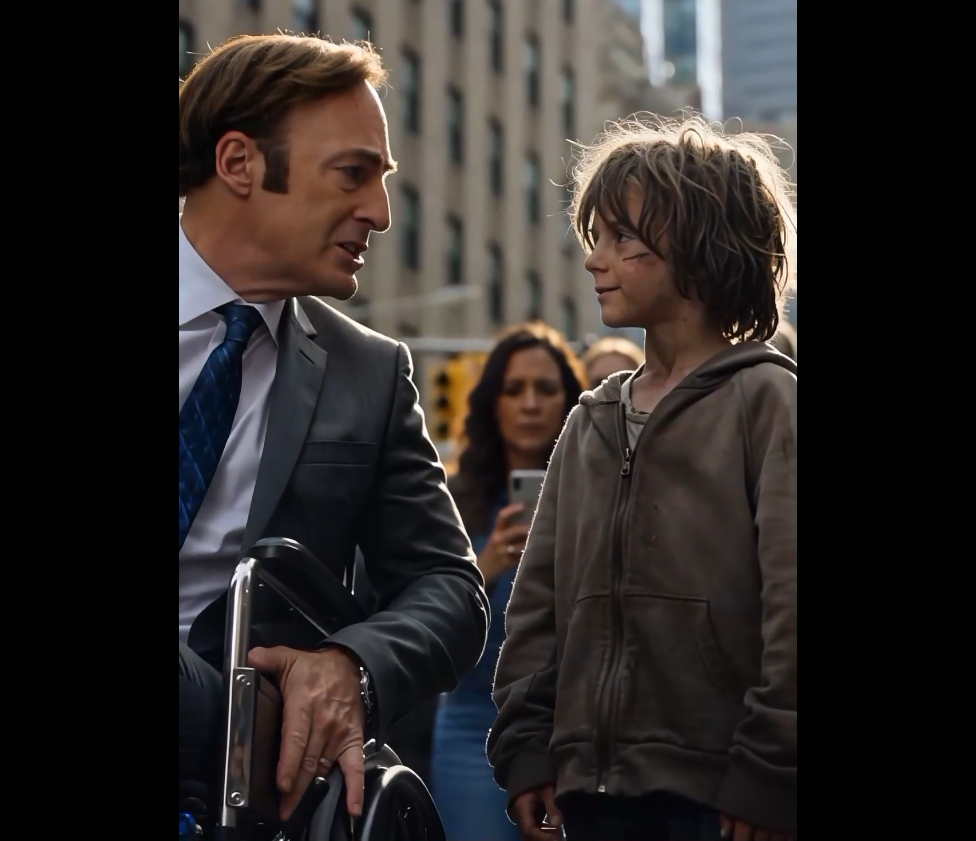
A wealthy-looking man sat in a black wheelchair near the entrance of a luxury shopping district. He wore an expensive navy-blue suit, a white shirt, a silver watch, and polished leather shoes. His hair was perfectly styled, but his face told a different story.
His eyes were swollen from crying.
Beside him stood a security guard holding an umbrella, while another man carried a leather briefcase filled with documents. A small crowd had gathered around the wheelchair, curious about the commotion.
The wealthy man suddenly raised a megaphone to his mouth.
“PLEASE! I NEED EVERYONE TO LISTEN!”
His voice echoed between the tall buildings.
People stopped walking.
The man struggled to control his emotions, but tears rolled down his cheeks.
“If anyone can make me walk again, I will give them ONE MILLION DOLLARS!”
The crowd erupted into whispers.
“One million dollars?” a woman murmured.
“Is he serious?” another person asked.
The man gripped the armrests of his wheelchair.
“I have visited the best hospitals in America! I’ve paid the world’s greatest specialists! I’ve spent years searching for someone who can help me!”
His voice cracked.
“But nobody can tell me whether I’ll ever stand on my own feet again.”
He lowered the megaphone and covered his face.
“I don’t want my money anymore. I don’t want my cars, my houses, or my businesses. I just want to walk again.”
For a moment, nobody spoke.
The man was Daniel Whitmore, a multimillionaire real estate developer who had once appeared on the covers of business magazines. Before his accident, he had been known for his confidence, ambition, and ruthless approach to business.
Three years earlier, a terrible car accident had damaged his spinal cord. Since then, he had undergone multiple surgeries and countless rehabilitation sessions.
His doctors had explained that his chances of regaining the ability to walk were uncertain.
Daniel had refused to accept their verdict.
He had spent millions searching for a miracle.
And now, standing in front of strangers on a crowded New York street, he was offering his fortune to anyone who could give him back his old life.
Most people felt sorry for him.
Some shook their heads.
Others quietly recorded the scene on their phones.
Then a small figure emerged from the crowd.
He was an eight-year-old boy wearing an oversized, dirty gray hoodie, torn trousers, and sneakers with holes near the toes. His hair was messy, his cheeks were smudged with dirt, and a faded backpack hung from one shoulder.
He looked like a child who had spent far too many nights sleeping wherever he could find shelter.
People instinctively moved aside as he approached the wheelchair.
A security guard stepped forward.
“Hey, kid. Stay back. This isn’t a game.”
But the boy ignored him.
He stopped directly in front of Daniel and looked up at the wealthy man.
“I can make you walk again.”
A few people laughed.
Daniel slowly lifted his head.
“What did you just say?”
The boy repeated himself without blinking.
“I said I can make you walk again.”
The security guard laughed dismissively.
“Kid, this man has the best doctors in the world. You think you can do what they couldn’t?”
The boy turned toward him.
“I wasn’t talking to you.”
The crowd fell silent.
Daniel stared at the child. For the first time that afternoon, there was something other than despair in his eyes.
Hope.
He leaned forward in his wheelchair.
“Are you saying you can really help me?”
The boy nodded.
“Yes. But I won’t take your money.”
Daniel blinked in disbelief.
“You don’t want a million dollars?”
“No.”
“Then what do you want?”
The boy’s expression changed. A strange little smirk appeared on his face.
“I have one condition.”
Daniel immediately grabbed the megaphone again.
“Anything! Tell me what you want. A house? Food? A private school? I’ll give you everything!”
The boy took one step closer.
“Think again, mister.”
His smile disappeared.
“Not everyone can do that.”
The words sent a strange chill through the crowd.
Daniel swallowed nervously.
“What does that mean?”
The boy glanced at the expensive watch on Daniel’s wrist.
“Before I tell you my condition, I need to ask you something.”
“Ask anything.”
The boy looked directly into his eyes.
“Three years ago, did you drive a black SUV on Riverside Drive?”
Daniel’s face went pale.
The security guard immediately moved between them.
“That’s enough. We’re leaving.”
But Daniel raised his hand.
“Wait.”
He looked at the boy again.
“Yes,” he whispered. “I was driving a black SUV. Why?”
The boy’s smirk returned.
“Then you remember the accident.”
Daniel’s breathing became uneven.
Of course he remembered.
He remembered the rain, the slippery road, the sudden impact, and the deafening sound of metal crushing against metal.
But there was one part of that night he had spent three years trying to forget.
A child.
A little boy had been standing near the road when Daniel lost control of his vehicle. Daniel’s car had swerved onto the sidewalk before crashing into a concrete barrier.
When he regained consciousness in the hospital, he learned that his spinal cord had been severely damaged.
He had also learned that the police had investigated a report about a child who had disappeared from the area that night.
Daniel had hired lawyers, cooperated with investigators, and insisted he had never seen anyone before the crash.
But sometimes, in the middle of the night, he remembered a small figure standing in the rain.
He had convinced himself it was a trick of his damaged memory.
Now, standing before him, was a homeless child who seemed to know things nobody in the crowd could possibly know.
Daniel’s voice trembled.
“How do you know about that accident?”
The boy reached into his backpack.
The security guard immediately grabbed his arm.
“Don’t move!”
“Let him go!” Daniel shouted.
The guard released the boy.
Slowly, the child pulled out a small, cracked photograph.
He held it toward Daniel.
The photograph showed a little boy standing beside a woman in front of a modest brick house. The woman was smiling, her arm wrapped around the child.
Daniel stared at the picture.
He recognized the woman.
She had been the person he saw near the road that night.
His hands began to shake.
“Where did you get that?”
The boy’s eyes filled with tears, but his voice remained steady.
“She was my mother.”
The crowd gasped.
Daniel looked as though the ground had disappeared beneath him.
“Your mother?”
The boy nodded.
“She was taking me home that night. You hit the barrier, and your car came onto the sidewalk. My mother pushed me out of the way.”
He paused, struggling to breathe.
“She saved my life.”
Daniel’s lips parted, but no words came out.
The boy continued.
“But she was badly hurt. I screamed for help. I begged people to stop.”
Tears rolled down his cheeks.
“And you…”
He looked at Daniel.
“You were lying on the road, crying that you couldn’t feel your legs.”
Daniel closed his eyes.
Fragments of the accident rushed back into his mind.
The rain.
The shattered windshield.
A woman lying motionless nearby.
A child screaming.
He had remembered the woman. He had remembered the ambulance arriving. But he had never learned what happened to her afterward.
“What happened to your mother?” he whispered.
The boy looked down at the photograph.
“She died in the hospital two days later.”
A woman in the crowd covered her mouth.
Daniel’s face crumpled.
“No…”
He shook his head repeatedly.
“No, I didn’t know. I swear I didn’t know.”
“You never came to see her,” the boy replied.
Daniel looked at his security guard, then at the briefcase beside him.
“I was in the hospital for months. My lawyers handled everything. I thought—”
“You thought money could handle everything.”
The boy’s words cut through the noise of the street.
Daniel fell silent.
For three years, he had blamed the accident for taking away his freedom. He had mourned the life he could no longer live, the sports cars he could no longer drive, and the stairs he could no longer climb.
But he had never known that another family had lost someone that night.
Someone who had saved a child while he was helpless on the road.
Daniel covered his face.
“I’m sorry,” he whispered. “I’m so sorry.”
The boy wiped his tears with the sleeve of his hoodie.
“I didn’t come here for an apology.”
“Then what is your condition?” Daniel asked.
The child stepped closer to the wheelchair.
“You said you’d do anything to walk again.”
“Yes.”
“Even if it means losing everything?”
Daniel looked confused.
“My money?”
The boy shook his head.
“No. Your pride.”
He pointed toward the crowded sidewalk.
“You want to walk because you hate being helpless. You think standing on your feet will make you the man you used to be.”
Daniel stared at him.
“But my mother taught me something before she died.”
The boy held the photograph against his chest.
“She told me that a person’s worth isn’t measured by what they can do for themselves. It’s measured by what they do for other people.”
The street had become completely silent.
“My condition is simple,” the boy continued. “If you really want me to help you, you must stop treating people like they’re invisible just because they have nothing.”
Daniel lowered his head.
“And you must help the people you ignored while you were busy buying things you didn’t need.”
The boy paused.
“Homeless children. Families sleeping in shelters. People who can’t afford their medicine. People who need help but are too ashamed to ask.”
Daniel looked at the boy’s torn shoes.
For the first time, he truly saw him.
Not as a homeless child.
Not as a strange interruption.
But as a child who had lost his mother and had somehow survived on the streets.
Daniel’s voice broke.
“I promise.”
The boy studied him carefully.
“Don’t promise because you think I’ll make you walk. Promise because it’s the right thing to do.”
Daniel nodded through his tears.
“I promise.”
The boy finally smiled.
“Good. Now let’s see what your doctors have been missing.”
He turned toward Daniel’s security guard.
“Can you help us get somewhere quiet? And call a doctor who understands spinal cord injuries. I need to know what movements Mr. Whitmore can safely attempt.”
The guard looked stunned.
“You said you could make him walk.”
“I said I could help him.”
The boy’s expression became serious.
“I never said it would happen in five minutes.”
A few people exchanged confused looks.
Daniel wiped his face.
“What exactly are you going to do?”
The child pulled a folded sheet of paper from his backpack.
It was covered with handwritten notes, small diagrams, and medical terms.
Daniel stared at it.
“Where did you learn all this?”
The boy hesitated.
“My mother was a physical therapist.”
Daniel’s eyes widened.
“She used to help injured people who couldn’t afford treatment. After she died, I found her old books. I read them every night.”
He looked at Daniel’s legs.
“I’ve also been watching rehabilitation sessions through the windows of a clinic near the shelter where I sleep.”
“But you’re only eight years old,” Daniel whispered.
“I know.”
The boy gave him a determined look.
“That’s why I need a real doctor. I can help you practice what you’ve learned, but nobody should promise that you will walk again. Your injury is serious.”
For the first time, Daniel heard something different from the promises he had paid millions to hear.
Honesty.
The boy wasn’t offering a miracle.
He was offering effort, knowledge, and a chance to try again.
Over the following weeks, Daniel arranged for the boy to work with a licensed rehabilitation team under appropriate supervision. He also made sure the child had a safe place to live, access to education, and people who could protect him.
Daniel kept his promise.
He established a foundation that funded rehabilitation for people who could not afford it. He opened a program supporting homeless children and families, and he personally visited shelters instead of sending someone else to represent him.
But his own recovery remained uncertain.
Some days, he felt almost no improvement. Other days, he noticed small changes that encouraged his therapists to continue.
The boy never allowed him to give up.
“Remember your condition,” he would say whenever Daniel grew frustrated.
Daniel would smile sadly.
“I remember.”
Six months later, Daniel returned to the same New York street where everything had begun.
A crowd gathered around him again.
The boy stood beside his wheelchair, wearing clean clothes and a school backpack.
A reporter raised a microphone.
“Mr. Whitmore, everyone wants to know. Can you walk now?”
Daniel looked at the boy.
Then he turned toward the crowd.
“Not yet,” he answered honestly. “But I’m no longer measuring my life by whether I can stand.”
He took a deep breath.
“I’m measuring it by whether I can make someone else’s life better.”
Suddenly, the boy placed a hand on Daniel’s shoulder.
“Are you ready?”
Daniel nodded.
With his therapist standing nearby and his hands gripping the parallel bars set up for the demonstration, he prepared to attempt a supported standing exercise he had practiced for weeks.
The crowd fell silent.
Slowly, carefully, and with professional assistance, Daniel pushed himself upward.
His knees trembled.
His face tightened with effort.
For a brief moment, he rose into a supported standing position.
The crowd erupted into applause.
Daniel began to cry.
But the boy didn’t cheer.
He was staring at Daniel with a strange expression.
“What is it?” Daniel asked, breathing heavily.
The child reached into his backpack and pulled out another envelope.
“I found this in my mother’s belongings.”
Daniel opened it with shaking hands.
Inside was a letter written by the boy’s mother before the accident.
Daniel read the first line.
If anything ever happens to me, please make sure Daniel Whitmore learns the truth.
His smile vanished.
The letter continued.
He wasn’t the one who caused the accident.
Daniel looked up in horror.
“What?”
The boy’s eyes filled with tears.
“My mother had discovered something about your company before she died.”
He stepped closer and whispered the words that made Daniel’s blood run cold.
“Someone had tampered with your car’s brakes that night.”
Daniel stared at him.
“Who?”
The boy slowly turned toward the security guard standing behind them.
The guard’s face had gone completely white.
And when the boy spoke his final words, Daniel realized that his accident might never have been an accident at all.
“The man who tried to kill you has been standing beside you this entire time.”