I never planned to get involved that day. It was supposed to be a quiet afternoon — coffee, fresh air, and ten minutes of peace between meetings. The park was one of those perfect suburban American parks — trimmed grass, soft wind, distant dog barks, and children laughing like nothing bad had ever happened in the world.
I noticed the girls because they were serious about their work.
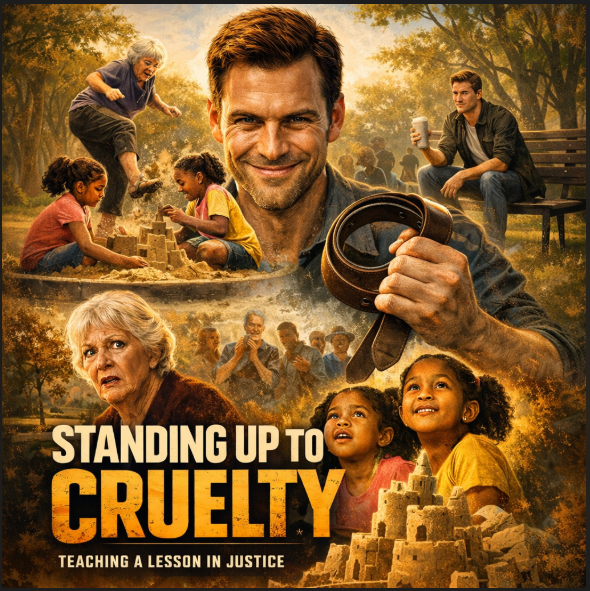
Two little girls, maybe seven or eight years old, kneeling in the sandbox like architects. One shaped towers with a plastic cup, the other carved tiny windows with a stick. They weren’t just playing — they were building a kingdom. Their shoes were off, socks dusty, hair tied in uneven ponytails. Every few seconds they leaned back and admired the structure like proud engineers.
“Princess tower goes here,” one declared.
“No — that’s the guard tower,” the other corrected.
I smiled into my coffee.
That’s when the shadow fell over them.
An elderly woman stepped into the sandbox area without hesitation — stiff posture, expensive walking shoes, lips pressed into a thin line of disapproval. She looked at the castle like it offended her personally.
Before either girl could react, the woman swung her foot forward and crushed one of the towers.
Sand collapsed.
The girls froze.
“What are you doing here?” the woman snapped. “You’re making a mess. Go play somewhere else. Shoo. Shoo.”
It wasn’t just what she said — it was how she said it. The disgust. The ownership in her tone, as if she owned the ground beneath them.
One girl instinctively tried to rebuild the broken tower with trembling fingers.
The woman kicked again — harder.
Sand scattered across their legs.
Both girls stepped back now, eyes wide, confused more than anything. Children don’t expect cruelty without warning. Adults are supposed to follow rules they don’t understand yet — not break them.
I felt something shift inside my chest.
Not anger at first. Recognition.
I had seen that look before — years ago — directed at my younger sister in a different park, different city, same tone. I remembered doing nothing then. Remembered the drive home silence. Remembered her asking, “Did I do something wrong?”
My coffee suddenly tasted bitter.
The woman waved her hands dismissively. “This area is not for you. Go.”
The girls gathered their toys slowly, unsure whether to argue or obey. No adult nearby seemed to be theirs. Maybe a caregiver was at the restroom. Maybe a parent on a phone call. Maybe — and this happens more often than people admit — they came alone because the park was supposed to be safe.
My cup hit the ground before I decided to drop it.
The sound made the woman turn.
I stood.
I didn’t rush. Didn’t shout. I just walked — measured steps — toward the sandbox. My face was calm. Calm enough to be unsettling.
She looked relieved at first — like backup had arrived.
“Good,” she said, pointing. “Tell them they can’t—”
I walked past her and knelt beside the girls instead.
“That’s a strong foundation,” I said softly, studying the half-destroyed castle. “Who designed the towers?”
They looked at me, unsure whether they were in trouble.
“She did,” one said, pointing to her friend.
“Good engineering,” I nodded. “Needs reinforcement walls though.”
The woman scoffed behind me. “Excuse me?”
I looked over my shoulder — not angry — just curious.
“Yes?”
“They were told to leave.”
“By who?” I asked.
“By me.”
I smiled slightly. Not friendly — precise.
“Do you work for the park?”
“No.”
“City staff?”
“No.”
“Security?”
“No.”
“Then it seems,” I said gently, turning back to the sand, “you kicked down a structure that doesn’t belong to you and gave orders you’re not authorized to give.”
Her face tightened. People nearby had started watching. Tension spreads fast in quiet places.
“I don’t like their behavior,” she said.
“They were building a castle.”
“They were making a mess.”
“It’s a sandbox.”
Silence rippled outward. A couple on a nearby bench exchanged looks.
I removed my belt slowly — not in threat — but to draw a clean line in the sand around the castle’s base, marking a neat boundary circle.
“There,” I said. “Construction zone. Protected site.”
The girls stared — then one giggled nervously.
The woman stepped back, confused now. Control had slipped, and she didn’t understand how.
“You’re being ridiculous,” she snapped.
“Maybe,” I agreed. “But here’s what’s not ridiculous — teaching children that public spaces belong to everyone.”
I stood and brushed my hands off.
“Would you like to help rebuild?” I asked her politely.
Her mouth opened — then closed.
“I would never—”
“That’s okay,” I nodded. “Learning usually starts with watching.”
I raised my voice just enough to carry.
“Hey folks — quick vote. Should the castle be rebuilt?”
A man with a stroller clapped once. Then a teenager. Then the couple on the bench. Momentum — soft but real.
Community is quiet until someone gives it permission to speak.
The girls looked stunned.
Within two minutes, three strangers were handing over water bottle caps for towers, leaves for flags, and a plastic spoon for a bridge. Someone produced a tiny toy dinosaur as a “royal guardian.”
The woman stood outside the circle — isolated now — watching something she tried to stop grow larger than before.
Power hates replacement.
When the castle stood again — bigger, better — I stepped back and bowed slightly to the girls.
“Architects,” I said.
They bowed back, fully committed to the ceremony.
The woman muttered, “This is absurd,” but her voice had lost its authority. It sounded smaller now — like a complaint instead of a command.
I finally looked at her fully.
“You had a choice today,” I said quietly. “You could have encouraged them. Corrected them kindly. Or walked past.”
She didn’t respond.
“Instead, you chose humiliation. That’s a habit — not a moment.”
Her eyes flickered — anger mixed with something else. Recognition, maybe.
“No one stopped you before,” I continued. “That’s why you thought you could do it again.”
The park had gone still — not silent — but attentive.
“Today,” I finished, “someone did.”
I picked up my empty coffee cup from the ground and tossed it into the trash nearby.
Conversation over.
No threats. No shouting. No revenge.
Just a mirror held up long enough for her to see herself.
I returned to my bench.
Five minutes later, one of the girls ran over and handed me a small sand-covered leaf.
“For your help,” she said.
“A royal medal?” I asked.
She nodded seriously.
I placed it in my pocket like treasure.
The castle stood another hour before the wind took it — which is exactly how castles are supposed to fall.
But the lesson stayed longer.
Sometimes justice isn’t loud.
Sometimes it’s just refusing to let small cruelty go unchallenged — and inviting everyone else to remember who the park belongs to.