The afternoon heat pressed down on the city like a heavy hand, slowing everything—traffic, conversations, even thoughts. The road shimmered under the sun, and people moved along it with quiet urgency, eager to get wherever they were going.
Amid all that movement, one small figure stood out.
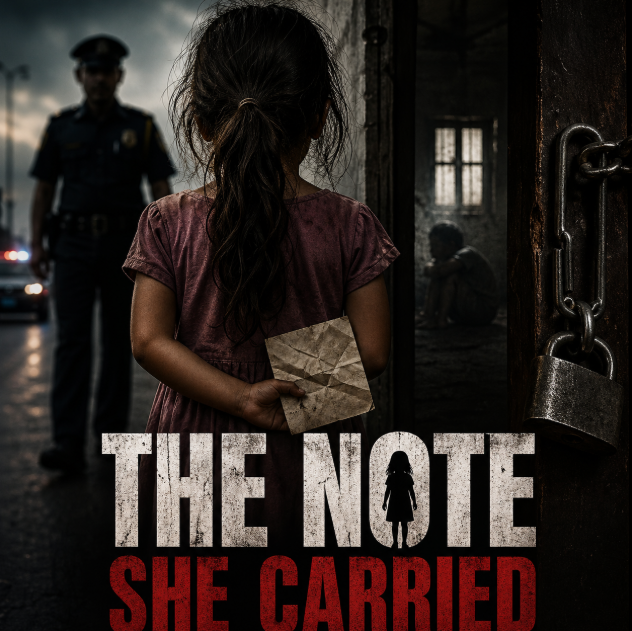
A little girl, no more than seven or eight, walked alone along the edge of the road. Her steps were steady but slow, as if she had been walking for a long time. Her dress was slightly dusty, her hair loosely tied, strands sticking to her forehead with sweat. She wasn’t crying. She wasn’t calling for anyone.
She just walked.
People noticed her, of course. Some glanced briefly, assuming a parent must be nearby. Others frowned but kept going. In a busy city, concern is often brief—just a passing thought before life pulls you back.
But the girl wasn’t lost.
She knew exactly where she was going.
At the intersection ahead, a traffic police officer stood directing vehicles. His uniform was crisp despite the heat, whistle hanging from his neck, one hand raised to stop a stream of cars while the other signaled bikes to move forward. His face carried the practiced patience of someone used to chaos.
The girl stopped a few feet away from him.
For a moment, she just stood there, looking up.
The officer didn’t notice at first. His attention was locked on the traffic. Horns blared, engines rumbled, and the rhythm of the road demanded focus.
Then she stepped closer.
“Uncle,” she said softly.
He didn’t hear.
She reached out and gently touched his sleeve.
He turned, slightly irritated at first—people interrupted him all the time—but the moment he saw her, his expression shifted.
“Hey… where are your parents?” he asked, lowering himself slightly to her height.
She didn’t answer that.
Instead, she held out a folded piece of paper.
“Please read this,” she said.
There was something about her voice—calm, almost too calm—that made him pause. Kids her age usually spoke with hesitation, or fear, or confusion.
She didn’t.
The officer took the paper.
It was crumpled, as if it had been held tightly for a long time. He unfolded it casually at first, expecting something simple—a phone number, maybe an address.
But as his eyes moved across the words, his face changed.
The irritation disappeared.
Then the calm.
Then everything else.
His posture stiffened. His grip on the paper tightened. His eyes scanned it again, faster this time, as if hoping he had misunderstood.
He hadn’t.
“What…?” he whispered under his breath.
The noise of the road seemed to fade around him.
He looked at the girl again, this time not as a lost child—but as something else entirely.
“Where did you get this?” he asked, his voice lower now.
She didn’t look scared.
She just pointed down the road behind her.
“My house,” she said.
A cold weight settled in his chest.
He didn’t ask another question.
Instead, he grabbed his walkie-talkie, pressing the button so hard his knuckles turned white.
His voice, when it came out, was sharp—controlled, but laced with urgency.
“Control, this is Unit 17,” he said. “We have a situation here.”
There was a brief crackle on the other end.
“Go ahead, Unit 17.”
He glanced at the paper again.
“I need immediate backup,” he said. “Possible hostage situation. Repeat—possible hostage situation involving minors.”
There was a pause.
Then: “Location?”
He gave it quickly, his eyes never leaving the girl.
“And dispatch emergency services,” he added. “This is urgent.”
He released the button.
The world rushed back in—the horns, the heat, the movement—but everything felt different now.
Dangerous.
He knelt down in front of the girl again.
“What’s your name?” he asked gently.
“Anya,” she said.
“Anya… is anyone else at your house?”
She nodded.
“My brother,” she said. “And… him.”
The officer’s jaw tightened.
“Who is ‘him’?” he asked carefully.
She hesitated this time.
Not out of fear—but as if choosing her words.
“He locks the doors,” she said. “He doesn’t let us go outside.”
A chill ran through the officer.
He looked at the paper again.
The handwriting was shaky, clearly done by a child—but the message was precise.
“We are locked in. He said if we tell anyone, he will hurt us. Please help before night.”
There was also an address written below.
And a time.
Tonight.
The officer swallowed hard.
“How did you get out?” he asked.
Anya looked down at her hands.
“He forgot to lock the back door,” she said. “Just for a little time.”
“And you came straight here?”
She nodded.
“I saw you yesterday,” she added. “You help people.”
The words hit him harder than anything else.
For a moment, he didn’t know what to say.
Sirens began to echo in the distance.
Backup was coming.
Good.
But time felt like it was slipping through his fingers.
“Anya,” he said, keeping his voice steady, “I need you to stay with me, okay?”
She nodded again.
No fear.
No tears.
Just that same calm expression.
That’s when it truly sank in.
This child had walked out of something no child should ever experience—and instead of breaking down, she had focused on one thing:
Getting help.
The police vehicles arrived within minutes, tires screeching slightly as they pulled up. Officers stepped out quickly, reading the situation from the tension in Unit 17’s posture.
He stood and handed the paper to his superior.
“This is what she gave me,” he said.
The senior officer read it—and his expression mirrored the shock.
“How long ago did she leave?” he asked.
The officer looked at Anya.
“Not long,” he said. “We still have time.”
The team moved fast.
Instructions were given. Positions assigned. The address was relayed again and again to ensure no mistake.
As they prepared to leave, the officer looked down at Anya one more time.
“You did something very brave,” he said.
She looked at him, her expression unchanged.
“My brother is still there,” she said.
“I know,” he replied. “And we’re going to bring him back.”
For the first time, something flickered in her eyes.
Not fear.
Hope.
The convoy sped down the road, sirens cutting through traffic, clearing the path ahead.
Back at the intersection, the noise resumed, the city moving on as if nothing had happened.
But for those who knew—
Everything had changed.
Because somewhere, behind a locked door, a child was still waiting.
And another child had just made sure they wouldn’t be forgotten.