WHAT CAN’T BE ERASED
Lucas learned quickly that silence was their greatest weapon.
The facility didn’t look like a prison. That was intentional. Soft walls. Neutral colors. No bars. No chains. Just doors that only opened from the outside and cameras hidden behind mirrored glass.
A place designed to convince the outside world—and sometimes the people inside—that nothing illegal was happening.
Lucas counted days by meals. Always the same nutrition packs. Always measured. Always logged.
He listened.
That was how he survived.
Doctors talked when they thought children didn’t understand. Lawyers talked even more.
“…exposure risk increases if they’re kept together.”
“…insurance carriers are already nervous.”
“…if one of them talks, settlements won’t hold.”
Lucas learned names. Project codes. Corporate entities registered in Delaware and Nevada. Shell companies stacked on shell companies, each one designed to collapse before the truth reached the top.
He learned that the program was funded by a coalition of private defense contractors and health insurers.
The goal wasn’t healing.
It was cost reduction.
If they could prove that certain children could survive extreme trauma, deprivation, and stress without long-term care, insurance companies could legally deny future claims.
No lifelong disability payments.
No chronic care coverage.
No lawsuits.
Children like Lucas were the proof.
They called it resilience optimization.
Lucas called it murder with better vocabulary.
Maya was the first crack in their system.
She stopped responding to commands. Stopped eating. Stopped cooperating. Not violently—quietly. The kind of quiet that made people nervous.
One night, Lucas heard raised voices outside his door.
“She’s destabilizing the others.”
“We can’t afford another incident.”
“Then isolate her.”
The door across the hall opened. Maya was dragged out, eyes glassy, feet barely touching the floor.
“Lucas!” she screamed.
That was the moment he stopped waiting.
The escape didn’t come from strength.
It came from paperwork.
The facility ran on systems—digital logs, biometric access, legal authorizations that had to be renewed every seventy-two hours. And people made mistakes when they believed no one was watching.
Lucas noticed a pattern: every night at 2:17 a.m., the network reset for backups.
For exactly ninety seconds, internal door controls defaulted to manual override.
Someone had built that failsafe in to protect data.
No one had considered children learning it.
Lucas waited three nights to be sure.
On the fourth, he acted.
When the doors unlocked, he didn’t run.
He walked.
Cameras still tracked motion, not intention.
He moved calmly, barefoot on polished floors, heart hammering but face blank.
He found Maya first.
She was strapped to a bed, pale but breathing.
“I’m getting you out,” he whispered, cutting the restraints with a stolen scalpel.
Her eyes filled with tears. “They said no one would come.”
Lucas didn’t answer.
They didn’t have time for comfort.
Alarms screamed seconds later.
Too late.
The breach sent the facility into chaos.
Security rushed the wrong corridors. Lockdowns triggered inconsistently. Lucas and Maya slipped through maintenance tunnels designed for equipment, not people.
They emerged outside into cold night air.
Fences loomed ahead.
Beyond them—trees.
Real ones.
They ran.
A guard shouted. A shot rang out. Dirt exploded near Lucas’s feet.
They didn’t stop.
The fence tore Maya’s gown. Lucas shoved her through, slicing his own arm in the process. Pain meant nothing.
Freedom was louder.
They vanished into the dark.
Three days later, the world changed.
Not with sirens.
With headlines.
It started with a leak.
Anonymous files sent to investigative journalists. Internal emails. Video footage. Medical reports stamped CLASSIFIED.
Lucas had memorized the emergency upload credentials he’d overheard doctors argue about.
He’d sent everything.
By the time authorities arrived at the facility, it was already empty.
Burned hard drives. Shredded documents. No children. No doctors.
Just a paper trail too big to erase.
The lawsuits followed.
Parents who had been paid settlements years ago were contacted by attorneys who told them the truth: their children hadn’t died. They’d been taken.
Insurance companies scrambled. Stocks dipped. Executives resigned “for personal reasons.”
Congress announced hearings.
The phrase “medical human rights violations” dominated the news cycle.
And quietly, without a press conference, a federal judge issued a sealed court order reopening dozens of cold cases.
The system tried to absorb it.
It failed.
Because people believed the children.
Lucas watched it all from a safe place.
A real hospital this time. One with windows.
Maya slept beside him, finally peaceful.
A woman entered the room—a lawyer, though she didn’t introduce herself that way.
“We can protect you,” she said. “Witness protection. New identities.”
Lucas shook his head. “No.”
She frowned. “They’ll look for you.”
“I know,” he said. “But hiding lets them pretend this was a one-time mistake.”
She studied him. “What do you want?”
Lucas looked at the screen showing breaking news.
“I want the truth to stay loud.”
Years later, people would argue about responsibility.
About oversight failures. About policy loopholes. About how something like that could happen in America.
They’d use careful words.
But survivors would remember the simpler truth.
The road didn’t save them.
Running didn’t save them.
Speaking did.
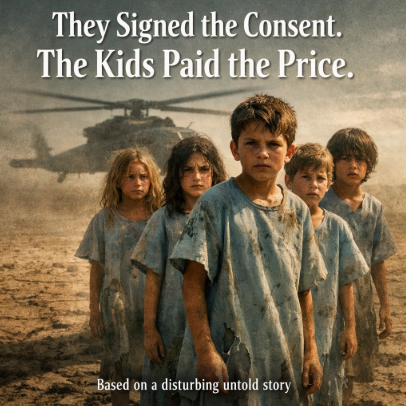
And somewhere, in archived court records and permanent investigative reports, five children in torn blue hospital gowns would no longer be classified as assets, or data points, or liabilities.
They would be called what they always were.
Victims.
And witnesses.