
The Cost of Listening
Marissa didn’t sleep that night.
She lay on her couch, still wearing the same clothes from the morning, the smell of smoke clinging to her blazer. Every time she closed her eyes, she saw twisted metal and flashing red lights. Every time she opened them, her phone sat on the coffee table, dark and silent, like it was waiting.
The news replayed the footage on a loop.
“Transit authorities confirm a multi-vehicle collision involving two Route 17 buses…”
The anchor’s voice was calm, practiced. The words beneath the screen were not.
INJURIES REPORTED. MULTIPLE PASSENGERS HOSPITALIZED. INVESTIGATION UNDERWAY.
Marissa muted the television.
Her hands were still trembling.
She should have been grateful. That was what everyone told her. The police officer who took her statement. The paramedic who checked her vitals. Even her attorney, who had already called to discuss potential witness compensation and whether she qualified for any insurance claims related to emotional distress.
“You’re lucky,” he’d said. “Very lucky.”
But luck didn’t explain the phone call.
Or the text messages.
Or the woman on the roadside who hadn’t asked for a single dollar.
Marissa picked up her phone and scrolled through her call history again. The number was still listed as Unknown. No voicemail. No trace. She checked her messages—screenshots, timestamps, everything saved like evidence. If this turned into a lawsuit, she wanted records.
Still, a question gnawed at her.
Why her?
She wasn’t special. She wasn’t kind. She hadn’t even listened.
At 2:17 a.m., she finally stood up and grabbed her keys.
The city felt different at night. Quieter. Honest. The kind of quiet that made you confront things you’d been avoiding. She drove without music, without GPS, letting instinct guide her back to Jefferson Avenue.
The bus stop was still there.
The liquor store glowed under flickering neon. The medical billing office remained dark, a FOR LEASE sign taped crookedly to the glass.
The cardboard square was gone.
So was the beggar.
Marissa’s chest tightened.
She stepped out of her car and walked toward the rusted street sign. The ground was clean, like no one had sat there in days. No cross. No belongings. Nothing.
“Hello?” she called softly, feeling foolish.
No answer.
A man’s voice spoke behind her.
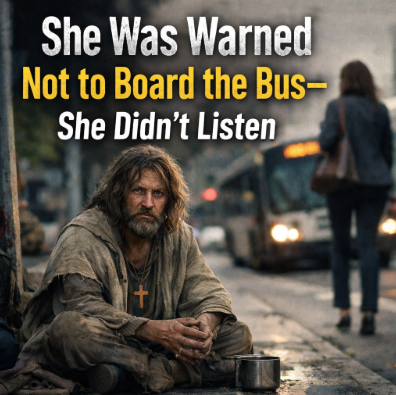
“You looking for the preacher lady?”
Marissa spun around.
A security guard stood near the liquor store, leaning against the wall. Middle-aged. Tired eyes.
“Yes,” she said quickly. “The woman who sits here. She was here this morning.”
The guard snorted. “She ain’t a preacher. And she ain’t always here.”
“What do you mean?”
“She shows up before bad days,” he said, shrugging. “Then disappears.”
Marissa’s skin prickled. “You’ve seen her before?”
“Yeah. Couple times a year, maybe.” He paused, studying her face. “You board the bus today?”
Marissa swallowed.
“I did.”
The guard exhaled slowly. “Then you’re lucky.”
“That’s what everyone keeps saying.”
He shook his head. “Ain’t luck.”
Marissa felt a chill creep down her spine. “Then what is it?”
The guard looked away, toward the road. “She warned my brother once. Five years ago. Told him not to take his truck out that morning.”
“And?”
“He laughed,” the guard said quietly. “Didn’t listen.”
Marissa didn’t need to ask what happened next.
Her phone buzzed.
A new message.
You came back.
Her breath caught.
She typed.
Where are you?
Several seconds passed.
Where I’m needed.
Her hands shook harder now.
Why me? she typed. Why warn me?
The response took longer this time.
Because you were willing to hear—even when you didn’t listen.
Marissa frowned. That didn’t make sense.
I ignored you, she typed. I boarded the bus.
Yes.
Then why did I survive?
The dots appeared. Disappeared. Appeared again.
Because you got off.
Marissa’s heart pounded.
She realized something then—something she hadn’t allowed herself to see.
The warning hadn’t been about the bus.
It had been about the choice.
The officer’s voice echoed in her memory: Evacuate immediately.
She had moved first. She hadn’t frozen. She hadn’t argued. She hadn’t waited for certainty.
She had acted.
Her phone buzzed again.
Most people don’t.
Tears blurred Marissa’s vision.
What are you? she typed.
A long pause.
Then the final message.
A witness.
The screen went dark.
The number vanished.
Marissa stood there, breathing hard, the city humming around her. Somewhere down the road, a bus passed—different route, different night.
She didn’t flinch.
In the weeks that followed, the lawsuits came. Investigations. Insurance claims. Settlements negotiated behind closed doors. The story faded from headlines, replaced by newer tragedies.
But Marissa changed.
She slowed down.
She looked at people.
And every now and then, when she saw someone sitting on the side of the road with nothing but time and tired eyes, she stopped.
Not to give money.
But to listen.
Because some warnings don’t come from authority.
They come from witnesses.
And they don’t repeat forever.
END OF STORY



One thought on “(Part 3) She Was Warned Not to Board the Bus – She Didn’t Listen”