
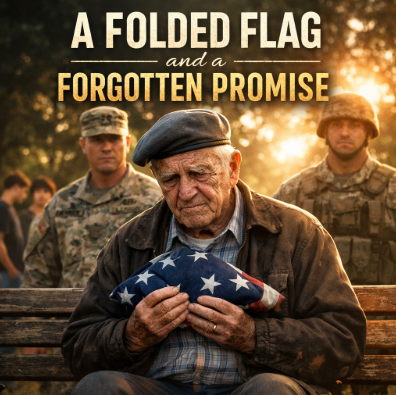
What the Flag Still Means
Daniel didn’t sleep that night.
He sat in his small living room, the lamp beside his recliner casting a warm, uneven glow across the walls. The house was quiet in the way only old houses were—soft creaks, distant ticking, memories hiding in corners. The folded flag rested on the table in front of him, exactly where it always did.
He kept replaying the moment in the park.
The laughter.
The foot on the fabric.
The sound of boots on pavement.
And then—something new. Something he hadn’t felt in a long time.
Being seen.
At 6:12 a.m., his phone rang.
Daniel stared at it, confused. Almost no one had this number. He let it ring twice before answering.
“Hello?”
“Mr. Carter?” a woman asked.
“Yes.”
“This is Channel Seven News. We’re calling about the video.”
Daniel’s chest tightened. “What video?”
There was a pause on the other end.
“The one from the park yesterday, sir. It’s… everywhere.”
Daniel ended the call without another word.
He turned on the television.
Every channel.
Every screen.
The same clip.
The footage wasn’t perfect—shaky, poorly framed—but it didn’t need to be. The moment spoke for itself. The old man on the bench. The teenagers laughing. The flag on the ground. The soldiers stepping in.
The room filled with voices—anchors, commentators, strangers arguing, praising, debating.
Some were angry.
Some were emotional.
Some were ashamed.
But all of them were watching.
Daniel reached out and touched the flag.
“I didn’t ask for this,” he whispered.
By noon, there was a knock at his door.
Then another.
And another.
He opened it to find people standing on his porch—neighbors he barely recognized, a woman holding flowers, a man with his hand over his heart. Someone had brought a small American flag and placed it gently near the doorframe.
A young boy stepped forward, no more than ten years old.
“My dad said you’re a hero,” the boy said.
Daniel shook his head. “No, son. I’m just someone who remembers.”
The crowd grew throughout the afternoon.
Veterans. Families. People who had watched the video and felt something stir inside them—anger, pride, guilt, gratitude. Some saluted. Some cried. Some simply stood quietly, as if unsure what to do with the emotions the moment had awakened.
By sunset, the sidewalk outside Daniel’s house looked like a vigil.
That night, Daniel stood on his porch holding the flag—not high, not for show. Just steady.
He spoke only once.
“This flag doesn’t belong to me,” he said, voice carrying in the hush. “It belongs to everyone who believes freedom costs something.”
No one applauded.
They didn’t need to.
The next morning, the park was different.
Daniel returned to the bench at four o’clock, unsure of what he’d find. He almost turned back when he saw the crowd—but he kept walking.
People lined the path.
Some stood.
Some saluted.
Some removed their hats.
Two familiar figures waited near the bench.
The soldiers.
Miller smiled when he saw Daniel. “Thought you might come.”
“I always do,” Daniel said.
Behind them, a small group of teenagers stood together—different clothes, different expressions, same faces.
The boy who had stepped on the flag stepped forward.
“I’m sorry,” he said, voice low. “I didn’t understand. I do now.”
Daniel studied him for a long moment.
Then he nodded. “That’s all anyone can ask.”
The boy swallowed hard. “Thank you for not giving up on us.”
Daniel sat down on the bench.
The flag rested on his lap once more.
But this time, he wasn’t alone.
A veteran sat beside him.
Then another.
Then a woman whose sister never came home.
Then a child who wanted to learn why the colors mattered.
The bench filled.
The park filled.
And across the country, something quiet but powerful began to happen.
People argued less about the flag—and talked more about the people behind it.
Names were remembered.
Stories were shared.
Silences were honored.
That night, Daniel wrote a letter.
Not to the news.
Not to the soldiers.
Not even to the boys.
He wrote to his son.
You were right, he wrote.
It still matters.
He folded the letter and placed it beneath the flag.
Outside, the park lights glowed softly, illuminating the bench that had changed everything—not through anger or force, but through restraint.
Through memory.
Through respect.
The flag never left Daniel’s hands again.
And neither did its meaning.
—The End

One thought on “Part 3: A Folded Flag and a Forgotten Promise”