
PART 2 (FINAL): The Video They Didn’t Expect
The video hit the internet at 8:43 p.m.
By 9:10, it was everywhere.
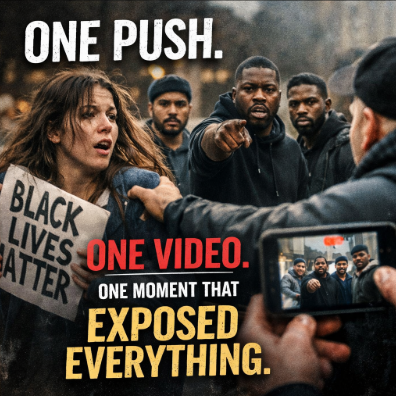
Maya Carter was sitting on the edge of her bed, shoes still on, sign leaning against the wall like a quiet witness, when her phone began vibrating nonstop. Not buzzing. Vibrating, as if something inside it was trying to break free.
Unknown numbers. Missed calls. Notifications stacking so fast they blurred into each other.
She ignored it at first.
She was still replaying the moment in her head—the shove, the laughter, the sound of footsteps rushing in. Her body hadn’t caught up with reality yet. Her hands still felt cold.
Then a text came through from her cousin in Chicago.
“Maya… is this you???”
A link followed.
She clicked it.
The video started mid-chant.
“Black lives matter! Black lives matter!”
Her own voice. Familiar. Steady. Then the laughter. The mocking question. The shove.
Her stomach dropped.
The clip was less than twenty seconds long, but it captured everything—the escalation, the fear, the shift when the four men stepped in. The moment power changed hands without a punch being thrown.
The comments were already in the thousands.
Some supportive. Some furious. Some disgusting.
But what shocked her wasn’t the hate.
It was the names.
Someone had tagged the liquor store. Someone else had recognized one of the men. Another comment claimed to know where he worked.
The internet was doing what it always did—moving faster than truth, faster than law, faster than consequences.
Maya closed the app.
Her phone rang immediately.
This time, she answered.
“Ms. Carter?” a calm voice asked. “This is Detective Harris with the Jefferson Police Department. We’d like to ask you a few questions.”
The next morning, Jefferson Avenue didn’t look the same.
News vans lined the street. Cameras pointed at the brick wall where the men had stood. Yellow tape fluttered in the wind, dramatic and unnecessary, but effective.
Maya watched it all from across the street, flanked by her older brother and a lawyer she’d met less than twelve hours ago.
“Just answer what they ask,” the lawyer said quietly. “Nothing more.”
Maya nodded.
Inside the precinct, the air smelled like stale coffee and paperwork. Detective Harris wasn’t unkind. He wasn’t overly friendly either.
“Did you feel threatened?” he asked.
“Yes,” Maya said without hesitation.
“Did any of the men have a weapon?”
“No.”
“Did the physical contact cause injury?”
“No—but—”
“But it doesn’t have to,” he said, nodding. “Harassment and assault don’t require bruises.”
That sentence stayed with her.
By noon, two of the men had been identified. One had been suspended from his job pending investigation. Another had deleted his social media accounts entirely.
The third— the one who pushed her—was still quiet.
Too quiet.
That silence broke at 3:17 p.m.
A press release hit the wires.
“We were misrepresented. The video lacks context.”
Maya read it twice.
Then laughed—a short, humorless sound.
Context.
As if there was a version of reality where pushing a woman for protesting peacefully made sense.
The backlash was immediate.
Former coworkers came forward. Old posts resurfaced. A pattern began to form, ugly and undeniable.
By evening, an attorney had reached out on Maya’s behalf—not one she’d called.
“This could become a civil case,” he said. “Harassment. Emotional distress. Potentially more.”
Maya stared out her window at the street below.
She hadn’t planned for this.
She hadn’t wanted a lawsuit, or headlines, or to become a symbol people argued about online.
She’d just wanted to walk.
That night, she dreamed of silence again—but this time it wasn’t empty. It was heavy with voices waiting to be heard.
The hearing happened three weeks later.
Small courtroom. Wooden benches. The kind of place where truth felt both fragile and sharp.
The men sat on one side. Maya on the other.
The judge didn’t raise his voice. He didn’t need to.
“This court recognizes the right to free speech,” he said. “But it also recognizes the right to personal safety.”
He looked directly at the defendant.
“You crossed that line.”
The ruling was clear.
Mandatory counseling. Community service. A formal apology entered into the record.
Some called it too light.
Some called it justice.
Maya didn’t know what to call it.
Outside the courthouse, reporters waited. Microphones hovered like insects.
“Do you feel vindicated?” someone asked.
Maya paused.
“I feel heard,” she said. “That’s not the same thing—but it’s a start.”
Later that evening, she returned to Jefferson Avenue alone.
No cameras this time. No crowd.
Just the street, unchanged and familiar.
She stood where it had happened.
She thought about the men who stepped in without being asked. About the people who had filmed instead of looking away. About the thousands who had watched and decided what it meant.
She lifted a new sign—clean, unbent.
BLACK LIVES MATTER.
A car slowed. The driver raised a fist in solidarity.
Another honked.
Someone across the street clapped once. Then twice.
Maya smiled—not because everything was fixed, but because something had shifted.
Courage, she realized, wasn’t about being fearless.
It was about being visible.
And this time, she wasn’t alone.

One thought on “Part 2: One Push. One Video. One Moment That Exposed Everything”