She Wasn’t Supposed to Be Alone
The first thing Maya Carter noticed wasn’t the noise.
It was the silence inside her chest.
Not fear. Not doubt.
Just a heavy stillness—like the moment before a storm breaks.
She tightened her grip on the cardboard sign as she stepped onto the cracked sidewalk of Jefferson Avenue. The letters were thick and uneven, written in black marker she’d bought that morning from a gas station.
BLACK LIVES MATTER.
The street looked ordinary. Too ordinary for what the sign represented.
Cars rolled past. A man watered his lawn. A woman pushed a stroller while scrolling her phone. Life continued, uninterrupted, uncaring.
Maya took a breath.
“Black lives matter,” she said.
Her voice felt small at first, swallowed by traffic. She said it again, louder.
“Black lives matter.”
She wasn’t part of a group. No megaphone. No crowd. No cameras.
Just her.
Twenty-seven years old. Graduate degree. Student loan debt. A job that barely paid rent. And a belief that had kept her awake too many nights to ignore anymore.
She walked.
Every step felt deliberate, like crossing an invisible line.
Her phone buzzed in her pocket—texts from friends who had begged her not to go alone.
At least wait for the march this weekend.
You don’t know who’s out there.
It’s not safe.
Maya ignored it.
If safety was the price of silence, she wasn’t interested.
She raised the sign higher.
“Black lives matter!”
A few heads turned. Some drivers honked—not in support, not in anger, just reflex. One man shook his head. Another woman gave a small nod, eyes soft, like she wanted to say something but didn’t.
Maya kept walking.
That’s when she heard the laughter.
It came from her right—sharp, sudden, ugly. The kind of laughter that didn’t belong to joy.
She slowed.
Four men leaned against the brick wall outside a closed liquor store. Late twenties, early thirties maybe. Baseball caps. Hoodies. Beer bottles resting at their feet even though it wasn’t noon yet.
One of them elbowed the other.
“Yo, you seeing this?”
Maya didn’t look at them. She knew better. She’d grown up knowing better.
“Black lives matter!” she shouted again, her voice steadier now.
The laughter grew louder.
“Hey!” one of them called out. “Say it again. I didn’t hear you.”
Maya’s heart beat faster, but she didn’t stop walking.
Another voice joined in, mocking the rhythm of her chant.
“Black lives matterrrr,” he sang, dragging the words like a joke.
Her jaw tightened.
She had told herself this would happen. That words would come. That looks would follow. That resistance wasn’t always quiet.
But knowing something might happen and standing inside it were two very different things.
“Tell me something,” the tallest guy said, stepping off the wall. “Is one of them your boyfriend or what?”
The others burst out laughing.
Maya stopped.
Her feet felt glued to the pavement.
She turned—not fully, just enough to face them. Enough to show she wasn’t invisible.
“That’s not funny,” she said.
Her voice didn’t shake. That surprised her.
The man shrugged. “Just asking questions. Thought that was allowed in America.”
Another one chimed in. “Yeah, freedom of speech, right? Or does that only work one way?”
Maya felt heat crawl up her neck.
“This isn’t about you,” she said. “Just leave me alone.”
She turned to walk away.
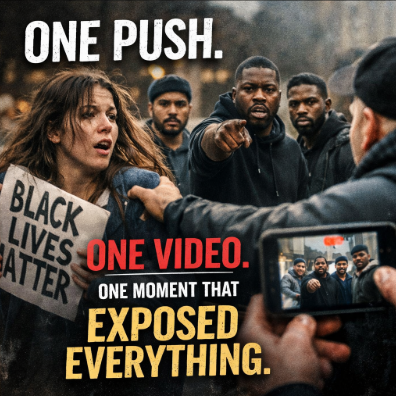
That was when it happened.
A hand shoved her shoulder—harder than necessary, harder than accidental.
She stumbled forward, barely catching herself before falling.
The sign bent in her hands.
For half a second, the world went quiet.
Then her breath came back in a sharp gasp.
“Don’t touch me!” she snapped, spinning around.
The men laughed again.
“Relax,” one said. “You act like we hit you.”
Maya’s hands trembled. Not from weakness—but from adrenaline. From the realization that this wasn’t just words anymore.
People across the street slowed. A woman stopped walking. A man glanced over, hesitated, then looked away.
No one stepped in.
Maya felt something crack inside her—not her courage, but her illusion.
This was how it happened.
Not with mobs. Not with headlines.
With silence.
With people choosing not to see.
The tall guy took another step toward her. Close enough now that she could smell beer on his breath.
“You wanna yell in public,” he said, voice low, “you gotta be ready for public reactions.”
Her mind raced.
Get out. Walk away. Don’t escalate.
She backed up a step.
Then another.
That’s when she heard footsteps—fast, purposeful, heavy.
“Hey!”
The voice cut through the moment like a blade.
Maya looked past the men.
Four Black men were crossing the street toward them. Not running—but moving with intention. The kind that made space without asking for it.
One of them, tall and broad-shouldered, stepped forward first.
“Back up,” he said.
His voice wasn’t loud. It didn’t need to be.
The man who had pushed Maya scoffed. “This got nothing to do with you.”
The newcomer didn’t blink.
“It does now.”
The other three positioned themselves naturally—no posturing, no threats. Just presence.
Power without performance.
“Y’all think this is funny?” another one asked, his jaw tight. “Harassing a woman for walking down the street?”
The laughter was gone now.
The tall guy glanced around, suddenly aware of how the scene had shifted. Of eyes watching. Of numbers no longer in his favor.
“Man, whatever,” he muttered. “She started it.”
The first man stepped closer.
“She didn’t touch you,” he said. “You touched her.”
Silence fell again—but this time, it belonged to them.
Maya realized she was holding her breath.
“Walk away,” the man said. “Before this turns into something you don’t want.”
For a moment, it looked like the situation might explode anyway. Ego has a way of fighting back even when logic says retreat.
Then one of the guys grabbed the tall one’s sleeve.
“Forget it,” he said under his breath. “Not worth it.”
One by one, they backed off. The laughter didn’t return. The jokes didn’t either.
They disappeared down the sidewalk, leaving behind only the echo of what could’ve happened.
Maya’s knees felt weak.
She lowered the sign slowly.
“You okay?” one of the men asked, turning to her now. His voice softened.
She nodded, even though her chest still burned.
“Thank you,” she said. “I didn’t know if—”
“You didn’t do anything wrong,” he cut in gently. “You hear me?”
She nodded again, harder this time.
Cars passed. Life resumed. The street pretended nothing had happened.
But Maya knew better.
As the men walked away, one of them glanced back.
“Don’t stop,” he said. “That’s what they want.”
Maya looked down at her bent sign.
Then she straightened it.
And lifted it again.
Black lives matter.
She didn’t know it yet—but somewhere nearby, a phone camera had captured everything.
And soon, the whole country would be watching.
Part 2: One Push. One Video. One Moment That Exposed Everything