
STORY PART 2
The ambulance sirens grew louder, slicing through the night air like a warning no one inside Harper & Lane had seen coming.
By the time the first paramedics rushed through the restaurant doors, three people were down.
A woman lay unconscious near the bar, an oxygen mask pressed to her face. Another man sat slumped in a chair, clutching his chest, pale and sweating. A third diner vomited onto the polished hardwood floor as staff members scrambled, shouting over one another.
“Clear the area!” a paramedic yelled. “We need space!”
The manager stood frozen near the host stand, her face drained of color. This was no longer about bad publicity or negative reviews. This was about liability.
She grabbed her phone with shaking hands and dialed the restaurant’s insurance provider, already imagining the words medical claims, negligence, and civil lawsuit flashing across her future.
In the kitchen, the dishwasher finally spoke.
“I think… I think I know that man,” he whispered to a line cook.
The cook snapped at him. “Not now!”
“No,” the boy insisted, eyes wide. “The beggar. I’ve seen him before. Not on the streets.”
Before he could finish, the back door opened.
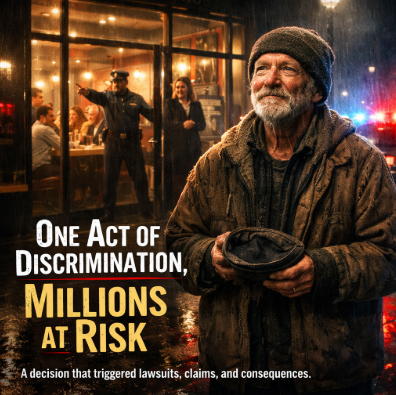
The beggar walked in calmly.
No one stopped him this time.
The room fell silent.
Outside, police cars lined the curb, red and blue lights painting the restaurant walls in harsh flashes. A fire truck had arrived. So had an unmarked black SUV, now parked directly behind the emergency vehicles.
The man in the tailored suit stepped forward, flashing a badge that didn’t belong to the police.
“I’m with the state,” he said firmly. “And I represent him.”
He nodded toward the beggar.
The security guard—the same one who had shoved the man out less than half an hour earlier—felt his stomach drop.
Inside, the beggar knelt beside the woman who had collapsed first. He didn’t touch her food. He didn’t touch her drink.
He placed two fingers gently on her wrist.
“Pulse is weak,” he said quietly.
One of the paramedics looked up sharply. “Sir, step back.”
But before anyone could move him, the woman’s body convulsed. She gasped, eyes snapping open as if pulled from deep water.
“I… I can breathe,” she whispered.
The paramedic froze.
Her oxygen saturation climbed rapidly on the monitor.
“What the hell…” he muttered.
The second man, the one clutching his chest, suddenly inhaled deeply and sat upright, coughing hard but alive.
The vomiting stopped. The dizziness faded.
Within minutes, the crisis was over.
No CPR. No defibrillator. No emergency medication.
Just silence.
And confusion.
The restaurant manager’s knees gave out. She sat heavily in a chair, staring at the beggar as if he were a ghost.
“What did you do?” she asked.
The beggar stood slowly, meeting her eyes without anger.
“I asked for bread,” he said. “You answered with pride.”
Police officers entered then, along with two men in dark suits carrying leather folders. One of them spoke calmly but firmly.
“This establishment is now part of an active investigation.”
The word investigation hit the room like a bomb.
A woman near the window whispered, “Is this a lawsuit?”
Another man muttered, “We’re all witnesses now.”
The manager’s phone buzzed. Her insurance agent was calling back.
She didn’t answer.
In a quiet corner of the restaurant, the dishwasher finally found his voice again.
“I knew it,” he whispered, tears streaming down his face. “I knew it was him.”
A server grabbed his arm. “Who?”
The boy swallowed hard.
“Three years ago, my mom collapsed at a bus stop. No insurance. No money. Hospital said they couldn’t do anything without paperwork.”
He looked toward the beggar.
“That man stayed with her. Prayed. Held her hand. She woke up before the ambulance even came.”
The server felt her throat tighten.
“But… who is he?” she asked.
The answer came moments later.
One of the men in suits cleared his throat and addressed the room.
“My name is Daniel Carter,” he said. “I’m a senior legal advisor for a federal oversight task force.”
He gestured toward the beggar.
“And this man is under my protection.”
Murmurs rippled through the crowd.
“Protection from who?” someone asked.
“From people who misunderstand him,” Carter replied evenly. “And from places that fail moral audits.”
The manager stared at him in disbelief. “Moral… audits?”
“Yes,” Carter said. “This restaurant was flagged six months ago for discriminatory practices. Unreported incidents. Denial of service.”
Her heart pounded. “We’ve never—”
“You pushed a hungry man onto the street,” Carter interrupted. “On camera. With witnesses. During business hours.”
The guard took a step back, suddenly aware of how exposed he was.
“This will trigger multiple actions,” Carter continued. “Civil liability. A review of your insurance coverage. Possible revocation of operating licenses. And—depending on how this proceeds—a court order mandating restitution.”
The word restitution echoed in the manager’s mind like a death sentence.
One of the diners finally spoke up, voice shaking.
“This is insane. He’s just a man.”
The beggar turned to him.
“Yes,” he said gently. “I am.”
Then he added, softly, “And so was Jesus.”
The room went completely still.
Later that night, after statements were taken and the ambulances left, the restaurant sat empty. Chairs were stacked. The lights dimmed.
The manager sat alone at a table, paperwork spread in front of her. Incident reports. Preliminary medical assessments. A call log from her insurance company warning of coverage disputes due to “gross negligence.”
Her phone buzzed again.
This time, it was her attorney.
She answered with trembling fingers.
“They’re saying this could turn into a class-action lawsuit,” she whispered. “What do I do?”
The attorney sighed on the other end. “Prepare for settlement talks. And pray.”
She laughed bitterly.
Pray.
Outside, the beggar stood beneath a streetlight, his coat fluttering in the breeze.
Daniel Carter approached him quietly.
“It’s started,” Carter said. “The oversight board will move fast. Media will follow.”
The beggar nodded.
“They always do.”
Carter hesitated. “Why do you keep doing this? You don’t have to.”
The beggar looked back at the restaurant one last time.
“Because hunger reveals truth,” he said. “And pride always testifies against itself.”
Carter swallowed. “What happens now?”
The beggar smiled—the same calm, unsettling smile from earlier.
“Now,” he said, “they answer for what they chose.”
Across the city, news alerts began to light up phones.
EMERGENCY AT DOWNTOWN RESTAURANT — INVESTIGATION UNDERWAY
PATRONS REPORT MIRACULOUS RECOVERIES — OFFICIALS SILENT
Social media exploded.
Videos of the beggar being shoved out resurfaced, shared millions of times. Comment sections turned into battlefields—faith versus skepticism, compassion versus policy, mercy versus law.
And somewhere deep inside Harper & Lane’s corporate offices, executives prepared for the fight of their lives.
Because this was no longer just about one hungry man.
It was about accountability.
And this time, there would be no hiding behind insurance policies, legal loopholes, or carefully worded apologies.
The beggar had asked for bread.
They had answered with mockery.
And now, the cost would be far greater than any meal they could have given.


It happened as Jesus spoke it. Whoever does this to the smallest of mine have done it to Me. If you reject to be kind
and help you will be found wanting.
True