“Now You’ve Done It, Granny!” — The Woman She Insulted Was the Last Person She Should Have Humiliated
“YOU’RE PURE! WHY ARE YOU HOLDING HER HAND?”
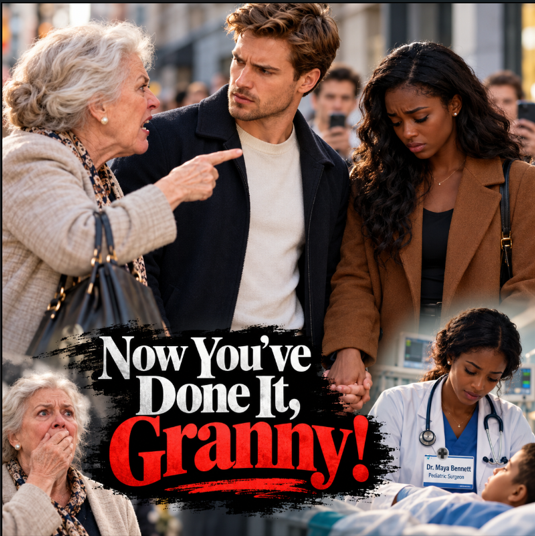
The old woman’s voice cut through the busy sidewalk so sharply that several people stopped walking. A young white man stood frozen beside his Black girlfriend, their fingers still intertwined. The woman who had shouted at them looked furious, as if their simple act of holding hands had personally offended her.
The young man’s girlfriend slowly lowered her eyes. Her smile disappeared, replaced by the familiar expression of someone who had been reminded, once again, that some people believed love needed their permission.
But the old woman had made one terrible mistake.
She had judged a couple she knew absolutely nothing about.
And before the next few minutes were over, she would discover that the quiet woman she had just humiliated was someone she could never have imagined.
“Excuse me?” the young man asked, his voice calm.
The elderly woman straightened her coat. “You heard me! You’re a respectable white man. You should be ashamed of yourself, walking around with her as if this is perfectly normal!”
People nearby began exchanging uncomfortable glances. A man carrying a coffee slowed down. A mother gently pulled her child closer. Someone across the street lifted a phone, sensing that the confrontation was about to get worse.
The Black woman said nothing. She simply tried to withdraw her hand.
Her boyfriend held it a little tighter.
“Hey,” he whispered, turning toward her. “Look at me.”
She raised her eyes.
“You haven’t done anything wrong,” he told her.
She gave him a tiny nod, but the sadness in her expression remained. She had heard insults before. Sometimes people stared. Sometimes they made comments under their breath. And sometimes, like today, someone decided that their prejudice deserved to be announced to the entire street.
She had learned to keep walking.
But her boyfriend had learned something different.
Silence could protect your peace, but it could also give cruel people the impression that their behavior was acceptable.
He turned back to the old woman.
“Ma’am, we’re just walking. We haven’t bothered you.”
“That’s exactly the problem!” she snapped. “People like you have forgotten what you should be proud of. Your family would be disgusted!”
The young man stared at her for a moment, almost as if he could not believe what he was hearing.
Then his expression changed.
He stopped trying to understand her.
Instead, he gave her a small, almost amused smile.
“Now you’ve done it. Do you even know who she is, Granny?”
The old woman blinked.
“What did you just call me?”
“Granny,” he repeated calmly. “Although, after what you’ve just said, I’m not sure you deserve the courtesy.”
A few people in the crowd struggled to hide their reactions. Someone muttered, “Oh, wow.”
But the old woman wasn’t embarrassed yet. She was angry.
“I don’t care who she is!” she shouted. “Nothing changes the fact that—”
“Nothing?” he interrupted. “You’re absolutely certain?”
For the first time, uncertainty flickered across her face.
The young woman finally looked directly at the old woman. There was no hatred in her eyes, no desire to shout back. Just a quiet disappointment that somehow made the situation more uncomfortable than any insult could have.
“Why would you speak to strangers like that?” she asked softly.
The question seemed to irritate the elderly woman even more.
“Because somebody has to tell you people the truth!”
The young man exhaled slowly.
“Interesting,” he said. “You’re standing in the middle of a public street, insulting someone you’ve never met, and you think you’re the one telling the truth.”
The old woman opened her mouth, but he continued.
“You don’t know her name. You don’t know her character. You don’t know what she’s done for anyone. You saw her skin color, looked at me, and decided you had the right to tell us how we should live.”
He paused.
“And you call yourself respectable?”
That question landed harder than his earlier sarcasm.
The crowd had grown larger. Several people were openly watching now. The old woman glanced around and realized that the attention she had initially commanded was no longer working in her favor.
“People like you always twist everything!” she protested. “You think you can say whatever you want because everyone is afraid of offending you!”
“No,” he replied. “We think we deserve the same basic respect you expect for yourself.”
His girlfriend squeezed his hand.
“It’s okay,” she whispered.
He turned toward her. “No, it isn’t. And you shouldn’t have to pretend it is just to make someone else comfortable.”
For a moment, her composure cracked. Her eyes became glassy, and she looked away, fighting back tears.
The old woman noticed.
Instead of apologizing, she made one final mistake.
“Oh, don’t start crying now,” she said dismissively. “Nobody has even done anything to you!”
The young man’s face went completely still.
The sarcasm vanished.
“That’s enough.”
He didn’t shout. He didn’t threaten her. He simply spoke with such unmistakable firmness that the surrounding conversations faded.
“You don’t get to insult her, humiliate her, and then decide whether she’s allowed to feel hurt.”
The elderly woman took a small step backward.
And then the young woman finally spoke again.
“My name is Dr. Maya Bennett.”
The old woman barely reacted.
“Congratulations,” she said sarcastically. “That doesn’t impress me.”
Maya nodded slowly, as though she had expected exactly that response.
“No,” she said. “It probably wouldn’t.”
She reached into her handbag and took out a small identification card attached to a professional lanyard. She didn’t thrust it into the old woman’s face or wave it around for the crowd. She simply held it in her hand.
Her boyfriend looked at the card, then back at the old woman.
“That’s why I asked if you knew who she was.”
The elderly woman’s eyes narrowed.
“What is she? Some kind of celebrity?”
Maya almost smiled.
“No. I’m a doctor.”
The old woman shrugged impatiently.
“So?”
“I’m a pediatric surgeon at St. Catherine’s Children’s Hospital,” Maya replied. “I spent yesterday operating on a little boy whose heart stopped twice during surgery. His parents stood outside that operating room for six hours, praying someone could save their son.”
The crowd fell silent.
Maya continued, her voice steady.
“I went home last night at three in the morning. Today was my first day off in weeks. I was walking with the man I love, trying to enjoy one peaceful afternoon.”
She looked down briefly at their joined hands.
“And somehow, even that was too much for you.”
The old woman’s expression shifted. She looked at Maya’s identification card again, then at her face.
For the first time, she seemed to understand that the woman she had dismissed as unworthy had spent her life doing something extraordinary.
But Maya wasn’t finished.
“Do you know what that little boy’s mother told me yesterday?” she asked.
Nobody answered.
“She told me that she didn’t care what color my skin was. She didn’t care where I was born. She only cared that I was the person standing between her child and death.”
Maya paused, swallowing the emotion that had risen into her throat.
“And when her son opened his eyes, she held my hands and thanked me for giving her another chance to be his mother.”
A woman in the crowd wiped her eyes.
Maya looked straight at the elderly woman.
“That mother trusted me with the most precious person in her life. Yet you looked at me for five seconds and decided I was beneath you.”
The old woman’s lips parted, but no words came.
Her certainty had begun to crumble.
The young man stepped forward—not aggressively, but enough to make his next words impossible to ignore.
“That’s the difference between you and her, Granny. Maya spends her days looking at people and asking how she can help them. You looked at her and decided she didn’t deserve to stand beside me.”
He glanced at the people gathered around them.
“And the saddest part? She didn’t need to save anyone today to deserve respect. She deserved it before you knew her name.”
Nobody applauded immediately.
The silence itself said enough.
Then the man with the coffee shook his head and said, “He’s right.”
Another passerby added, “She should apologize.”
The old woman looked around desperately. A few moments earlier, she had expected the crowd to agree with her. Now, every face seemed to reflect the ugliness of what she had said.
“I didn’t know she was a doctor,” she muttered.
Maya’s expression softened, but only slightly.
“That isn’t the point.”
The old woman looked up.
“What?”
“If I worked in a supermarket, cleaned offices, drove a bus, or stayed home caring for my family, would I deserve less respect?”
The question left the elderly woman speechless.
Maya continued, “You shouldn’t need to know someone’s profession, achievements, or reputation before you decide to treat them like a human being.”
The old woman lowered her gaze.
For several seconds, nobody moved.
Then, in a much quieter voice, she said, “I didn’t mean for this to happen.”
The young man raised an eyebrow.
“You meant to insult her. You just didn’t expect anyone to challenge you.”
The old woman’s face reddened.
He wasn’t wrong, and she knew it.
Finally, she turned toward Maya.
“I’m sorry,” she said, barely above a whisper.
Maya studied her for a moment.
“Are you sorry because you hurt me,” she asked, “or because everyone heard you?”
The question struck deeper than any public humiliation could have.
The old woman looked down at her trembling hands.
“I… I don’t know.”
It was the first honest answer she had given all afternoon.
Maya nodded.
“Then perhaps you should think about that.”
She slipped her identification card back into her handbag and turned toward her boyfriend.
“Come on. Let’s go.”
He intertwined his fingers with hers again.
As they began walking away, the old woman called after them.
“Wait!”
They stopped, but neither turned immediately.
The elderly woman took a shaky breath.
“What should I do?” she asked. “I mean… how do I make this right?”
Maya turned around.
“You can’t erase what you said. But you can decide what kind of person you want to be after saying it.”
The old woman stared at her.
“Start by never speaking to another stranger that way again,” Maya added. “And when you see someone being treated as if they don’t belong, don’t become another person making them feel alone.”
For a moment, the elderly woman appeared ready to argue.
Instead, she nodded.
Maya and her boyfriend continued down the sidewalk, still holding hands. He glanced at her and asked quietly, “Are you okay?”
She let out a long breath.
“Not completely,” she admitted. “But I am now.”
He squeezed her hand.
“You know what I love about you?”
“What?”
“You could have destroyed her with a hundred different insults. Instead, you gave her something to think about.”
Maya smiled sadly.
“Maybe she’ll think about it.”
“Maybe,” he said. “But whether she does or not, she doesn’t get to decide your worth.”
Behind them, the old woman remained standing on the sidewalk. The crowd gradually dispersed, leaving her alone with the words she could no longer take back.
She had approached a couple believing she was defending some idea of purity.
Instead, she had exposed the impurity of her own judgment.
And the woman she had tried to humiliate had walked away with her dignity untouched.
Because the truth is simple: a person’s worth isn’t determined by their skin color, their job, or the person they choose to love. It’s revealed by how they treat others—especially when they believe nobody important is watching.
And sometimes, the person you look down on is the very person who teaches you what respect actually means.