I never told anyone this before… because even now, when I think about that evening, it doesn’t feel real. It feels like a scene from a movie — loud, fast, impossible — and at the center of it all was a six-year-old boy with steady hands and eyes far older than his age.
The highway was alive with noise — horns, engines, shouting vendors from the service lane. It was just before sunset, that orange hour when everything looks dramatic without trying. Cars rushed past like streaks of metal and light.
Then came the sound.
A violent screech. A spin. A crash so heavy that birds burst from nearby trees.
A sedan had swerved to avoid a truck and slammed into the divider. The front crumpled. Smoke rose. Traffic froze in a wave.
People ran toward the wreck, but as always happens, they stopped at a distance — close enough to watch, far enough to avoid responsibility.
Inside the car, a man hung half-conscious, his door twisted open. His forehead was cut, his breathing uneven. Someone shouted, “Call an ambulance!” Another person shouted, “Don’t touch him!” A third just recorded video.
In the crowd stood a small boy holding a red toy car in his hand. His name was Aarav.
He was traveling with his parents, who ran a small roadside tea stall fifty meters away. His mother was pouring chai. His father was counting change. Neither noticed when Aarav slipped between two adults and started walking toward the wreck.
He didn’t run at first. He observed.
Smoke. Position of the body. The sound of breathing.
Then he ran.
A woman tried to grab his shoulder. “Hey! No — stay back!”
He ducked under her arm and reached the injured man.
What happened next made the crowd fall silent.
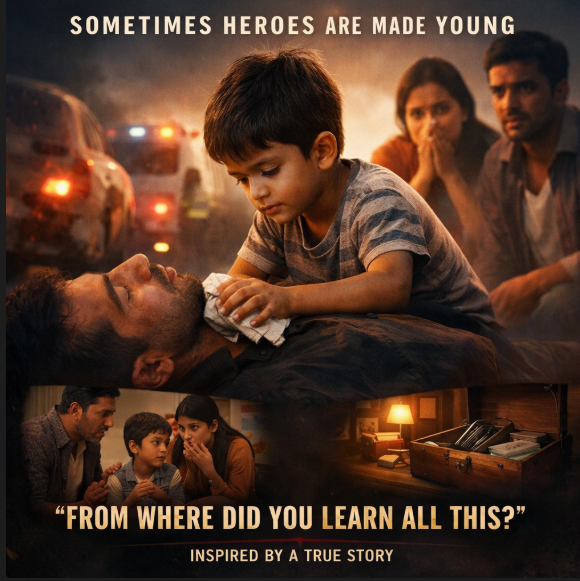
The boy didn’t panic. He didn’t cry. He didn’t shout. He placed his toy car on the road, knelt, and tilted the injured man’s head gently backward to open the airway — a movement too precise to be accidental.
A few people exchanged confused looks.
“Who is this kid?”
Aarav put his ear near the man’s mouth and nose. He counted under his breath.
“Breathing… but weak,” he murmured.
Someone laughed nervously. “What is he doing?”
The boy removed his small cotton scarf and folded it thick, then pressed it firmly against the bleeding cut on the forehead to slow the flow. His hands were steady — not rushed, not scared.
“Uncle, can you hear me?” he asked clearly.
The man groaned faintly.
“That’s good,” Aarav said softly. “Stay with me.”
A biker stepped forward. “Move, kid, you’ll hurt him.”
Without looking up, Aarav replied, calm and firm: “If you move him now, his neck could be injured.”
The biker froze.
That sentence — not the words, but the confidence — changed the air.
Sirens sounded faintly in the distance.
Aarav looked around quickly. “Does anyone have cloth? Clean cloth!”
A shopkeeper handed a towel. Aarav folded and reinforced the pressure bandage. Then he checked the man’s wrist pulse with two fingers — exactly placed.
A medical intern in the crowd pushed forward, stunned. “Who taught you that?”
No answer. The boy was busy.
“Sir, blink if you can hear me,” Aarav said. “Don’t sleep.”
The injured man blinked weakly.
“There,” Aarav nodded. “Good.”
When the ambulance arrived, the paramedics rushed out — and slowed down when they saw the scene already stabilized. Airway open. Bleeding controlled. Patient responsive.
One paramedic whispered to the other, “Who gave first aid?”
The entire crowd pointed at the child.
The paramedic knelt to Aarav’s level. “You did this?”
“Yes,” Aarav said simply. “He needed help.”
The medic checked everything, then gave a short impressed laugh. “Textbook steps.”
They lifted the man carefully onto a stretcher.
As they loaded him, the injured man weakly caught Aarav’s wrist. His lips moved.
“Thank… you…”
Aarav smiled. “You’re okay.”
Only then did his parents arrive — breathless, terrified.
His mother grabbed him tight. “Are you mad? That was dangerous!”
His father looked from the ambulance to the bandage work to the paramedic’s nod of respect.
“What… did you do?” his father asked quietly.
Before Aarav could answer, the medic said, “Your son likely prevented serious complications. He knew exactly what not to touch and what to stabilize.”
His mother stared. “But… how?”
Aarav picked up his toy car from the road.
“Can we go home?” he asked.
That night, after dinner, the house was unusually quiet. No TV. No radio. Just the ceiling fan and questions waiting in the air.
His parents sat across from him.
His mother spoke gently. “Beta… from where did you learn all that?”
Aarav swung his legs slowly from the chair.
“From Doctor Kabir,” he said.
They frowned. No such doctor lived nearby.
“Who is that?” his father asked.
Aarav pointed to the old wooden trunk near the wall.
Inside it were books — worn, underlined, carefully preserved. They belonged to Aarav’s grandfather, who had died before the boy was born. He had been a rural field medic — not a full doctor, but the kind who reached accident sites first, who treated farmers, who taught safety workshops in villages.
After his passing, the books remained untouched.
Except by Aarav.
“I look at the pictures every day,” the boy said. “And the steps. Red boxes mean danger. Blue boxes mean help steps.”
The father opened one book — Emergency Response Basics — filled with diagrams of airway positioning, bleeding control, recovery posture.
Many pages had tiny pencil tick marks.
“You can read this?” his mother asked softly.
“Not all words,” Aarav admitted. “But I remember shapes.”
His father sat back slowly, stunned.
“How long have you been studying these?”
“Since I was four,” Aarav said. “Dadu helped people. I wanted to also.”
His mother covered her mouth.
“Why didn’t you tell us?” she whispered.
Aarav shrugged. “You were busy.”
There was no accusation in it. Only truth.
His father walked to him and placed a hand on his head — not playful, not casual — respectful.
“You didn’t just help,” he said quietly. “You saved.”
Aarav thought for a moment.
“He was not saved,” the boy corrected gently. “He is being saved.”
The precision of that answer sent a chill through both parents.
Three days later, a car stopped near their tea stall.
The injured man stepped out — bandaged, slow, but alive.
He asked for the boy.
When Aarav came, the man bent — despite pain — and folded his hands in gratitude.
“I don’t remember the crash,” he said, voice thick, “but I remember your voice telling me not to sleep.”
He handed Aarav a small boxed gift — a child’s medical kit toy set.
Aarav smiled politely.
“I already have one,” he said.
The man laughed. “I believe you do.”
Years later, when people asked that man what survival felt like, he always gave the same answer:
“It felt like being ordered to live — by a child who spoke like a doctor.”
And when Aarav was asked in school what he wanted to become, he never said “doctor.”
He said:
“First — useful. Then we’ll see.”