The afternoon sun hung low over a busy street in downtown America, reflecting sharply off the polished surface of a black luxury sedan parked at the curb. The car looked flawless at first glance—sleek, expensive, powerful. But its owner didn’t see beauty. He saw the inconvenience.
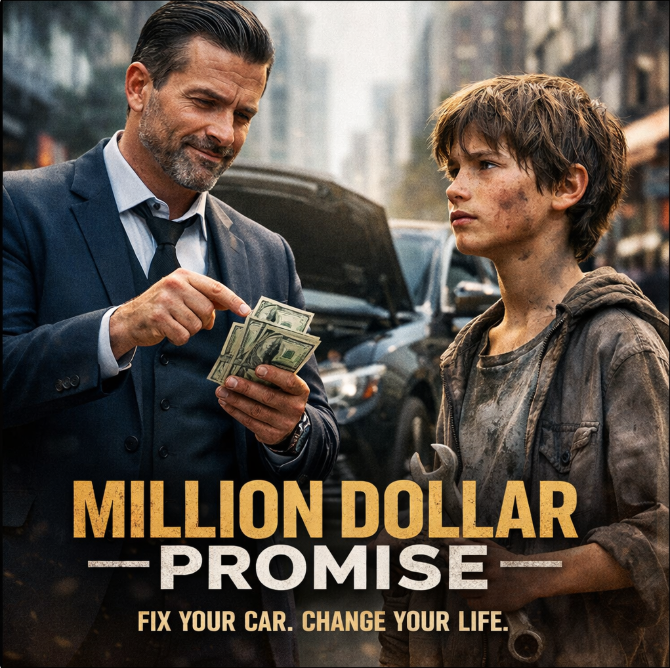
Adrian Cole adjusted his tailored navy suit and kicked the front tire in frustration. “Damn this piece of junk!” he snapped loudly, ignoring the curious glances of pedestrians walking past.
His voice carried the tone of a man who was used to control—used to problems being solved instantly with money or authority.
The engine had died without warning. The dashboard flashed unfamiliar symbols. Adrian had an important meeting in less than thirty minutes. Investors. Contracts. Millions on the table. And now this.
He pulled out his phone, but the signal was weak between the tall buildings. He muttered another curse under his breath.
From across the street, someone had been watching him.
The boy looked no older than fourteen. His clothes were torn and faded, two sizes too big, hanging loosely from his thin frame. Dirt streaked across his cheeks, and his sneakers had holes in the sides. Yet his eyes were sharp—observant, calculating.
He hesitated before crossing the street. People like Adrian usually didn’t like being approached. But hunger had a way of overpowering fear.
The boy stopped a few feet away. “I can fix your car,” he said quietly. “But you have to feed me.”
Adrian slowly turned, his polished shoes scraping slightly on the pavement. His gaze moved from the boy’s messy hair to his worn-out clothes. He let out a dry laugh.
“Really?” he said, irritation dripping from every word. “Go fix your clothes first.”
The boy’s jaw tightened, but he didn’t walk away.
“Okay,” he replied, trying to steady his voice. “At least give me something to eat.”
Adrian shook his head in disbelief. “This city never runs out of surprises,” he muttered. Then, with a smirk, he crossed his arms. “Fine. If you can fix my car, I’ll give you one million dollars… and food.”
He expected the boy to flinch. To laugh. To admit defeat.
Instead, the boy nodded.
“Open the hood,” he said.
For a moment, Adrian just stared at him. But he didn’t have time to argue. With a sigh of annoyance, he popped the hood and stepped back.
The boy approached the engine carefully. His fingers moved with unexpected confidence, brushing aside plastic covers and checking connections. Adrian watched with mild amusement.
“You planning to tighten bolts with magic?” Adrian scoffed.
The boy ignored him.
His name was Marcus. And long before the streets became his home, he had spent countless afternoons in a small garage behind his mother’s apartment. His father had been a mechanic—one of the best in their neighborhood. Marcus had learned to listen to engines before he learned algebra.
After his father passed away and his mother fell sick, bills piled up. Eviction came quickly. The system didn’t wait for grief to settle.
Marcus leaned closer to the engine, listening. He noticed a loose battery terminal. He found corrosion around a connection. Simple, but enough to shut everything down.
He looked around and spotted a small toolkit in the trunk, likely forgotten from a previous service visit.
“Can I?” he asked.
Adrian shrugged impatiently.
Marcus grabbed a wrench and tightened the connection carefully. He scraped off the corrosion using a small metal edge. His movements were precise, focused.
A small crowd had started to gather, curious about the unlikely scene.
“Kid thinks he’s a mechanic,” someone whispered.
Marcus stepped back. “Try starting it.”
Adrian rolled his eyes dramatically and slid into the driver’s seat. He turned the key.
The engine roared to life.
Clean. Smooth. Perfect.
Adrian froze.
He turned the key off and on again. The engine responded instantly.
Silence fell over the small crowd. Then murmurs.
Adrian stepped out of the car slowly, his expression no longer arrogant—but confused.
“How did you…?”
“Loose terminal,” Marcus said simply. “Corrosion too. Happens sometimes.”
Adrian stared at him. This wasn’t luck. The boy knew what he was doing.
“You just saved me a tow truck and probably a few hundred dollars,” Adrian muttered.
Marcus didn’t smile. “You said you’d feed me.”
Adrian looked at his watch. He was still late. But something had shifted inside him. For the first time that afternoon, his frustration wasn’t the loudest emotion. It was something else.
He reached into his wallet and pulled out a few hundred-dollar bills.
Marcus looked at the money but didn’t reach for it. “You said food.”
The simplicity of the answer struck harder than expected.
Adrian hesitated, then gestured toward a nearby restaurant. “Come on.”
Inside, the contrast was almost uncomfortable. Polished floors. Crystal glasses. Soft music. Heads turned as Marcus walked in beside Adrian.
They sat at a corner table.
“Order whatever you want,” Adrian said.
Marcus scanned the menu carefully. He didn’t choose the most expensive dish. He picked something simple—burger, fries, water.
When the food arrived, he ate slowly at first. Then hunger took over. Adrian watched silently.
“You learned that from your dad?” Adrian finally asked.
Marcus nodded. “He used to say engines talk. You just have to listen.”
Adrian leaned back in his chair.
He thought about his own father—an immigrant who had built a small repair shop before expanding into a chain of dealerships. Adrian had inherited the empire, but not the humility.
“You said one million dollars,” Marcus said quietly, not looking up.
Adrian almost laughed—but stopped himself.
He had said it mockingly. As a joke.
But the boy hadn’t taken it as one.
“What would you do with a million dollars?” Adrian asked.
Marcus paused. “Get my mom treatment. Get a place to live. Go back to school. Maybe open a garage like my dad.”
There was no greed in his voice. Just clarity.
Adrian felt something unfamiliar—shame.
He thought about the millions he moved around daily, numbers on screens, investments in companies he barely understood anymore. And here sat a boy who could rebuild an engine but couldn’t afford a meal.
Adrian made a decision that surprised even himself.
“Finish eating,” he said quietly.
An hour later, instead of driving to his meeting, Adrian drove Marcus to a private clinic. He made calls. Real ones. Not promises.
Tests were scheduled. A temporary apartment was arranged through one of his foundation’s housing programs—one he had rarely paid attention to before.
And as for the million dollars?
Adrian didn’t hand over a suitcase of cash. Instead, he created a trust fund in Marcus’s name—structured for education, living expenses, and future business investment. Managed responsibly. Protected.
When he handed Marcus the paperwork weeks later, the boy looked overwhelmed.
“You kept your word,” Marcus said softly.
Adrian nodded. “You kept yours first.”
Months passed. Marcus returned to school. His mother began treatment. Adrian visited occasionally—not as a benefactor, but as a mentor.
The investors’ meeting Adrian had missed that day? It rescheduled. The deal still went through. But somehow, it felt smaller than what had happened on that street.
One evening, Adrian stood outside Marcus’s new school, watching him laugh with friends.
He remembered the words he had said in irritation: piece of junk.
The car had never been the problem.
It was perspective.
Sometimes it takes a broken engine to fix a broken heart.
And sometimes, the richest lesson comes from the poorest teacher.