The afternoon sun hung low over a quiet suburban street in California, casting long shadows across perfectly trimmed lawns and parked cars that gleamed under the golden light.
It was the kind of neighborhood where everything seemed calm, controlled, and predictable—until that moment.
A sharp chirp of a police siren cut through the stillness.
Marcus barely flinched.
He was gliding down the street on his matte-black racing bicycle, the kind of machine that turned heads without trying. Lightweight carbon frame, razor-thin tires, smooth gears—it wasn’t just expensive, it was precise.
To Marcus, though, it was freedom. Wind in his face, road beneath his wheels, nothing complicated.
“Hey! Stop right there!”
The voice was loud, edged with authority—and something else.
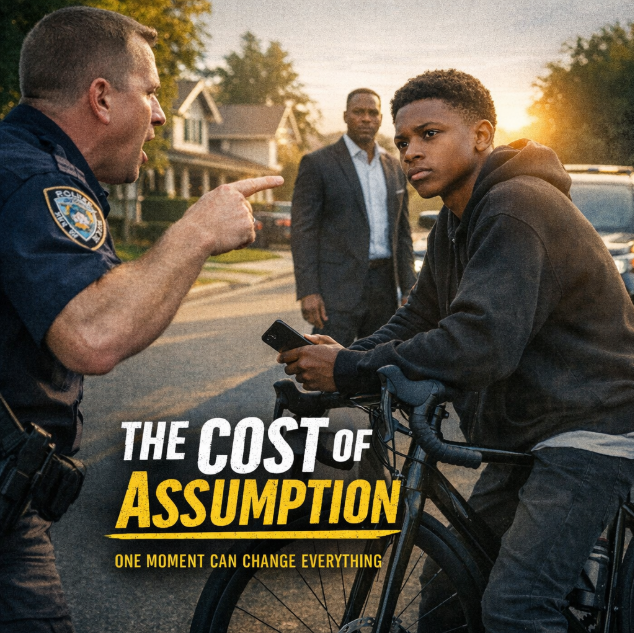
Marcus slowed, braking smoothly to the curb. He turned his head calmly as a police cruiser rolled up behind him. A white officer stepped out, his movements quick, already tense.
“Yes, sir?” Marcus said, steady.
The officer didn’t answer immediately. His eyes locked onto the bicycle. He walked closer, circling Marcus slowly, studying every detail of the bike like it didn’t belong there.
“That yours?” the officer asked.
“Yes.”
A short, skeptical exhale escaped the officer.
“That’s a high-end bike,” he said. “Custom build. Easily a few thousand dollars.”
Marcus stayed quiet.
The officer stopped in front of him, arms folding across his chest.
“I don’t think your parents can afford that for you.”
The words dropped like a weight.
Not a question.
An assumption.
Marcus blinked once, processing it. His grip on the handlebars tightened slightly, but his voice remained calm.
“Seriously?” he said. “Do you know who my father is?”
The officer smirked—dismissive, almost amused.
“I don’t care about you people.”
For a moment, the world seemed to go still.
The breeze softened. The distant hum of traffic faded. Even the birds seemed quieter.
Marcus didn’t react the way most would expect. He didn’t argue. He didn’t raise his voice.
Instead, something shifted in his expression—his calm turning sharper, more controlled.
He reached slowly into his pocket.
The officer stiffened. “What are you doing?” he snapped.
Marcus pulled out his phone.
“Just wait,” he said, locking eyes with him. “And watch.”
The officer chuckled. “Go ahead.”
Marcus dialed.
The call connected almost instantly.
“Hey, Dad,” Marcus said. “I’m on Maple Street. A police officer stopped me.”
A pause.
“No, I’m fine,” he added. “But you should come.”
He hung up and slipped the phone back into his pocket.
The officer shook his head, amused. “Calling your dad like that’s going to change anything?”
Marcus didn’t respond.
He just stood there.
Waiting.
Seconds stretched into a minute.
Then another.
The quiet neighborhood began to notice. Curtains shifted behind windows. A man walking his dog slowed his pace. A woman watering her lawn paused, her gaze fixed on the scene.
Then—
A low, powerful engine sound approached from down the street.
A black SUV turned the corner.
It wasn’t flashy, but it carried weight. Purpose.
It pulled up behind the police cruiser and came to a smooth stop.
The engine shut off.
The driver’s door opened.
A man stepped out—tall, composed, dressed in a sharp suit that spoke of authority without needing to say a word. His presence alone changed the atmosphere.
Marcus exhaled slightly. “Dad.”
The man nodded once and walked forward, his eyes moving from Marcus to the officer.
“Officer,” he said calmly, “what seems to be the issue?”
The officer cleared his throat, straightening slightly.
“Routine stop,” he said. “Suspicious circumstances.”
The man glanced briefly at the bicycle, then back at him.
“Suspicious?” he repeated.
“Yes,” the officer said. “That bike doesn’t match… the situation.”
The man stepped closer, his gaze steady.
“And what situation would that be?” he asked.
The officer hesitated—just a fraction too long.
“I think you understand,” he said.
The man held his eyes.
“No,” he replied. “I don’t.”
A brief pause.
“My name is Jonathan Carter.”
The officer nodded. “Alright, Mr. Carter—”
“I’m the Deputy Chief of Police for this district.”
The air changed instantly.
The officer’s expression froze. Confidence drained, replaced by realization.
“And Marcus,” Jonathan added, resting a hand on his son’s shoulder, “is my son.”
Silence filled the street.
Heavy. Unavoidable.
“I… I didn’t realize,” the officer said.
Jonathan gave a slight nod. “No,” he said. “You didn’t.”
Marcus watched quietly, his face calm but observant.
Jonathan took a step closer.
“You saw a Black kid on an expensive bike,” he said evenly. “And instead of asking a question with respect, you made an assumption.”
The officer swallowed.
“I was doing my job,” he said.
Jonathan’s expression didn’t change.
“No,” he replied. “You were acting on a judgment.”
Another police car appeared at the far end of the street, slowing as the officers inside recognized the situation. They stayed back.
Jonathan continued, his voice calm but firm.
“Do you know what your badge represents?”
The officer didn’t answer.
“It represents responsibility,” Jonathan said. “Not suspicion based on appearance.”
The officer looked down briefly, then back up.
“I understand,” he said quietly.
Jonathan studied him.
“Then show it,” he said. “Apologize.”
The officer hesitated.
Then he looked at Marcus—really looked at him this time.
Not his clothes.
Not the bike.
Him.
“I’m sorry,” he said.
Marcus gave a small nod.
Not dramatic.
Just acknowledgment.
Jonathan stepped back.
“Let’s go,” he said.
Marcus got back on his bike. Before riding off, he paused and looked at the officer one last time.
“Next time,” Marcus said calmly, “just ask.”
Then he pushed off and rode down the street, the sunlight catching the frame of his bike as he moved.
Jonathan followed, getting back into the SUV. Moments later, it pulled away.
The street slowly returned to its quiet rhythm.
But something had changed.
The officer stood beside his cruiser, silent.
Same uniform.
Same badge.
But not the same understanding.
For the first time that day—
He didn’t see suspicion.
He saw the cost of a single assumption.