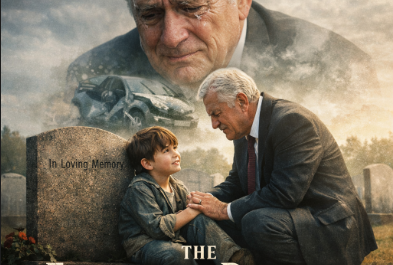

I never believed that a person could disappear while still being alive — until my father did.
People said he ran away. Some said he drank himself to death. Some whispered he chose the streets over his family. But they didn’t know him like I did. They didn’t know the man who once stitched my torn schoolbag at midnight, who walked five kilometers so I could ride the bus, who lied about eating so I could have the last roti.
For thirty years, I looked for him.
My name is Meera. I am sixty-two years old now. Wealthy, people say. Successful. Respectable. But there has always been a broken chair in my heart — the one where my father should have been sitting.
He disappeared the night everything burned.
I was twelve. Our small house caught fire due to a faulty stove. I remember smoke, shouting, neighbors throwing water, my mother crying. I remember my father pushing me out through the window. After that — chaos. In the confusion, he vanished. No body. No proof. Just absence.
Relatives took us in. Then life hardened. Poverty sharpened its teeth. My mother fell sick within two years and never recovered. Before dying, she held my wrist and said only one thing:
“He didn’t leave. He would never leave you.”
That sentence became my compass.
Years passed. I studied, worked, fought, survived. I built a textile business from a rented room and one sewing machine. Every city I traveled to — I searched. Every shelter, every hospital list, every old-age home — I checked. I funded missing-person boards quietly. My staff thought it was charity.
It wasn’t charity. It was hunger.
This morning was supposed to be ordinary. A factory inspection. A meeting. A charity cheque ceremony. My driver took a wrong turn due to road construction and stopped near an older part of the city — broken footpaths, hanging wires, garbage corners life forgot.
I was about to tell him to reverse when I saw him.
Some people say recognition fades with time. They are wrong. Blood remembers.
He was sitting near a pile of garbage bags, wrapped in a torn shawl, gray beard uncut, shoulders bent like old branches. But the eyes — those same deep, patient eyes — scanning people without asking them for anything.
My breath stopped.
“Madam?” the driver asked.
“Wait,” I whispered.
My hands were shaking when I opened the car door. The city noise felt distant, like underwater sound. Each step toward him felt like walking through years, not meters.
I stood in front of him.
Up close, time had written brutally on his face. A scar near his temple — from when he slipped fixing our roof. My throat closed.
He looked up slowly, the way tired people do — expecting nothing.
Our eyes met.
Confusion first. Then caution. Then a faint searching look — like someone opening an old book in their mind.
I could not control my voice. It broke out of me.
“I looked for you everywhere.”
His eyebrows trembled. His lips parted but no sound came. He studied my face with painful effort, like assembling a puzzle with missing pieces.
I knelt slightly so he could see me better.
“Baba… it’s me. Meera.”
His fingers shook. He lifted his hand halfway, then stopped, afraid to believe.
“You remembered me?” he whispered.
I laughed and cried at the same time — an ugly, helpless sound.
“Remembered you? I never stopped looking.”
Tears gathered in his eyes but didn’t fall. Pride — even now.
“I thought…” he said slowly, “you must have hated me.”
The sentence hit like a blow.
“Hated you? They said you ran away. I never believed them.”
He looked down at his hands. Cracked nails. Dirt lines. History of hard ground.
“That night,” he said, voice thin, “after I pushed you out, the roof beam fell. I woke up in a clinic across the river. Head injury. Memory broken. I remembered my name… nothing else. No address. No family. By the time things came back… everything was gone.”
“Why didn’t you come back?” I asked softly.
He gave a tired smile. “Came where? The house was ashes. Neighbors said the family moved away. I searched two years. Then money finished. Strength finished. Shame started.”
He looked around at the garbage heap beside him.
“After some time, you stop being a man. You become leftover.”
I held his hand. It was lighter than I remembered — like holding bundled sticks.
“Someone is waiting for you at our home, dear.”
He flinched slightly at the word home — like a stray dog hearing a whistle from childhood.
“I am not fit to enter your car,” he said. “People will talk.”
“Let them,” I said. “They talked when you fed me instead of yourself too.”
For the first time, his tears fell.
My driver stood frozen. Two shopkeepers nearby watched openly. A young boy recorded on his phone. I didn’t care. Thirty years is longer than embarrassment.
“Can you stand?” I asked.
He tried — failed — then tried again. I supported him. He was frighteningly light. Poverty had eaten him slowly.
When he stood, he looked at the car like it was a temple door he didn’t deserve to enter.
“I smell,” he said apologetically.
“I have waited thirty years,” I replied. “I can wait ten minutes more for perfume.”
He laughed — a cracked, rusty sound — but it was my childhood again.
The ride home was silent. He kept looking out the window, afraid the city might disappear if he blinked. Twice he touched the seat fabric like it was unreal.
At the house gate, he hesitated.
“This is yours?” he asked.
“This is ours,” I corrected.
Inside, my staff panicked, confused. I simply said, “Prepare the guest room. And hot water.”
He stopped me. “Not guest room,” he said gently. “Anywhere near the door is fine.”
I took him past every room — deliberately — like rewriting his belonging into the walls.
Bath water turned gray. Then darker. Then clear. When he came out in fresh clothes, hair combed back, beard trimmed — time reversed twenty years. Not fully — but enough to hurt.
We ate together. He watched each dish like a museum piece.
“You still break roti with your left first,” he smiled.
“You still notice everything,” I replied.
That night, he fell asleep mid-sentence while telling me a story from my childhood I thought he had forgotten. I sat beside the bed long after, just listening to him breathe — proof, rhythm, miracle.
People online later called it a touching reunion video. The clip went viral. Messages came. Interviews requested. I refused them all.
They saw ten seconds.
They didn’t see thirty years.
Tomorrow I will take him to the doctor. Then for new glasses. Then to the temple he used to visit. Slowly, we will rebuild memory like stitching — small, careful, patient.
Some people return as ghosts.
Some return as answers.
My father returned as proof — that love does not always stay, but it also does not die.
It waits.