
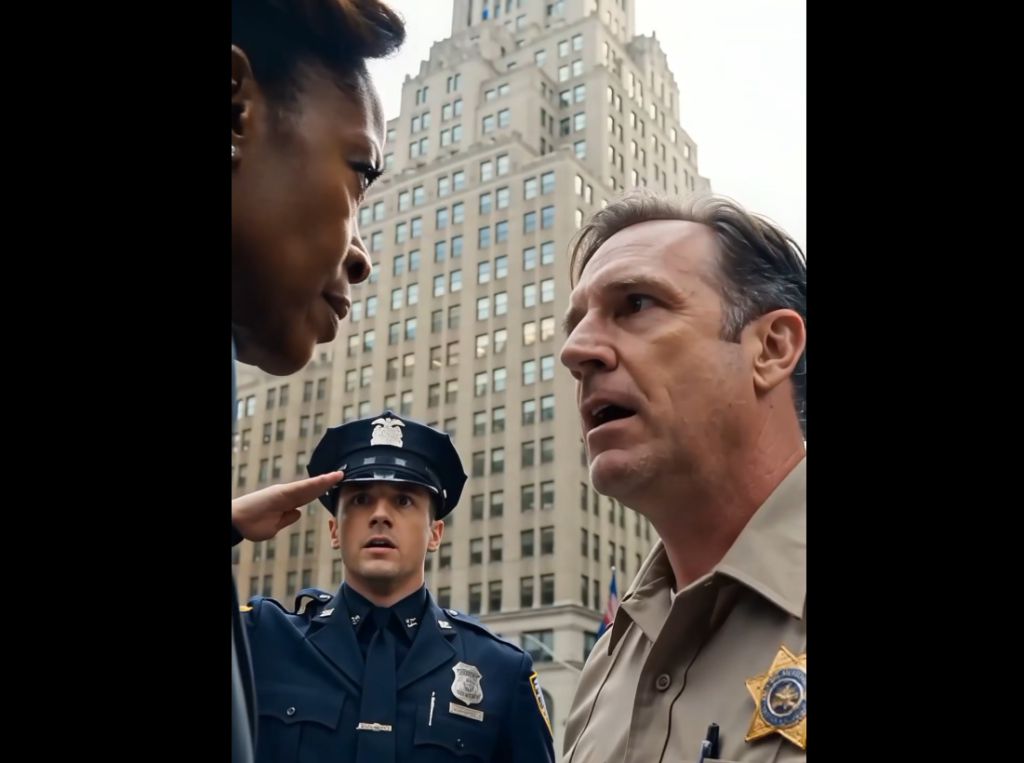
The morning rush in downtown Atlanta was in full swing. Cars moved through crowded intersections, office workers hurried along the sidewalks, and street vendors called out to passing customers.
Nobody paid much attention to anyone else. Everyone had somewhere to be.
Among the crowd walked a forty-year-old Black woman wearing a tailored navy-blue suit, polished black shoes, and a simple silver watch. Her name was Victoria Hayes.
She carried a slim leather folder beneath her arm and walked with the quiet confidence of someone who had spent years learning to remain calm under pressure.
Her expression was serious, but there was nothing threatening about her. She was simply walking toward the government building where she had an important meeting scheduled.
She had barely crossed the next intersection when a police cruiser pulled to the curb.
Officer Derek Collins stepped out.
Collins was in his early forties and had spent nearly fifteen years wearing a badge. He was known among some colleagues for his aggressive attitude and among local residents for the way he treated people he considered beneath him.
He noticed Victoria approaching and moved directly into her path.
“Hey! Stop right there!”
Victoria stopped and looked at him.
“Good morning, officer. Is there a problem?”
Collins glanced at her from head to toe before letting out a mocking laugh.
“Do you think you can just walk around here whenever you want?”
Victoria frowned slightly.
“I’m sorry? I’m walking on a public sidewalk.”
Collins stepped closer.
“Stop! You people can’t walk here for free.”
Several pedestrians slowed down. A man standing outside a coffee shop lowered his cup. A woman waiting at a bus stop pulled out her phone.
Victoria stared at Collins for a moment, trying to determine whether he was joking.
He wasn’t.
“Officer,” she said evenly, “this is a public street. I’m not breaking any laws.”
Collins smirked.
“Are you telling me how to do my job?”
“No. I’m asking why you’re stopping me.”
“Because I said so.”
Victoria took a slow breath. She had spent years dealing with difficult people, and she knew that losing her temper would only make the situation worse.
“Then I suggest you explain your legal reason for stopping me.”
Collins laughed loudly enough for the nearby pedestrians to hear.
“Listen to this woman! She thinks she’s some kind of lawyer.”
Victoria adjusted the folder beneath her arm.
“You’re making a very expensive mistake, Sheriff.”
Collins immediately burst into laughter.
“Oh, really?”
He spread his arms dramatically, inviting the watching crowd to join in.
“And what exactly are you going to do about it? Call somebody? Complain to my supervisor?”
Victoria didn’t answer.
Her silence irritated him more than an argument would have.
“That’s what I thought,” he continued. “People like you always think they can threaten officers when they don’t get their way.”
A young man near the coffee shop muttered, “She’s not even doing anything.”
Collins turned sharply.
“You want to get involved, too?”
The young man stepped back.
Nobody wanted to become the next target.
Victoria watched the exchange, her expression growing colder. She wasn’t afraid of Collins. But she was beginning to understand that he believed the badge gave him permission to humiliate anyone he chose.
“Officer Collins,” she said, glancing at the name on his uniform, “I want you to think very carefully about what you’re doing.”
His smile vanished for a second.
“How do you know my name?”
“It’s written on your uniform.”
A few people in the crowd exchanged looks. Collins realized that his attempt to intimidate her wasn’t working.
He pointed toward the opposite side of the street.
“Move along. And next time, learn to show some respect.”
Victoria didn’t move.
“Respect is something you demonstrate through your actions, officer. It isn’t something you can demand while disrespecting everyone around you.”
Collins stepped closer, his voice rising.
“Are you refusing a lawful order?”
“What lawful order? You haven’t given me a legal reason to leave.”
For a moment, the two stared at each other.
Then Collins laughed again.
“Unbelievable. You really think you’re somebody important.”
Victoria looked directly into his eyes.
“I don’t need to convince you of who I am.”
She turned her head slightly as another police cruiser approached the intersection.
The vehicle stopped beside Collins’s cruiser. A second officer stepped out, adjusting his uniform as he walked toward them.
His name was Officer Michael Reynolds.
Reynolds had served in the department for more than twenty years. He was experienced, respected, and usually quick to recognize when a situation was becoming unnecessarily confrontational.
At first, he assumed Collins had stopped someone for a routine inquiry.
Then he saw the woman.
He froze.
His eyes widened as recognition spread across his face.
“Commissioner Hayes?”
Victoria turned toward him.
“Good morning, Officer Reynolds.”
Reynolds immediately straightened his posture and raised his hand in a formal salute.
“Ma’am!”
The crowd fell silent.
Collins slowly turned his head.
He looked at Reynolds, then at Victoria, then back at Reynolds.
“What did you just call her?”
Reynolds lowered his hand.
“Commissioner Hayes.”
Collins gave a nervous laugh.
“Wait a minute. You know her?”
Reynolds stared at him as though he couldn’t believe the question.
“Know her? Officer Collins, this is Victoria Hayes, the newly appointed state police commissioner.”
The color drained from Collins’s face.
For the first time that morning, he had absolutely nothing to say.
Victoria Hayes wasn’t merely a senior official visiting the city. She was the woman responsible for overseeing statewide policing standards, reviewing departmental accountability procedures, and working with law enforcement agencies to improve public trust.
She had spent nearly two decades in public service. She had worked patrol assignments, supervised investigations, led internal reform initiatives, and earned a reputation for refusing to tolerate misconduct.
And now, she was standing in front of a police officer who had just mocked her in public without knowing her identity.
Collins swallowed hard.
“Commissioner Hayes, I—”
Victoria raised one hand.
“Don’t.”
He stopped speaking immediately.
She looked around at the crowd. Several people were still recording. The young man near the coffee shop had his phone raised, capturing every second.
Victoria then turned back to Collins.
“About thirty seconds ago, you told me that people like me couldn’t walk here for free.”
Collins’s mouth opened, but no words came out.
“You stopped me without explaining any lawful reason. You mocked me when I asked a reasonable question. And when I requested an explanation, you treated my question as a personal challenge to your authority.”
“Ma’am, there has to be some misunderstanding,” Collins said quickly. “I was just conducting a routine check.”
“A routine check?”
“Yes, ma’am.”
“Then tell me what prompted it.”
Collins glanced at Reynolds, hoping his colleague might somehow rescue him.
Reynolds remained silent.
“I thought the situation looked suspicious,” Collins finally replied.
Victoria tilted her head.
“What, specifically, was suspicious?”
Collins hesitated.
“I can’t say exactly, ma’am.”
“Then perhaps you should reconsider how you decide whom to stop.”
His face reddened.
“Commissioner, I apologize. I didn’t know who you were.”
Victoria’s expression hardened.
“That is precisely the problem, Officer Collins.”
He looked up.
She continued, her voice calm but firm.
“If you had known who I was, would you have spoken to me differently?”
Collins said nothing.
“Would you have mocked me? Would you have told me that I couldn’t walk on a public sidewalk? Would you have laughed when I asked you to explain your actions?”
The silence around them became uncomfortable.
Victoria stepped slightly closer.
“Because if your answer is yes, then you understand exactly what you did wrong. You simply assumed that I wasn’t important enough to deserve professional treatment.”
Collins shook his head.
“No, ma’am. That’s not what I meant.”
“Then what did you mean?”
He had no answer.
The woman at the bus stop finally spoke.
“Commissioner, I saw the whole thing. She wasn’t doing anything wrong.”
Another pedestrian nodded.
“He came out of nowhere and started insulting her.”
The young man with the phone stepped forward.
“I recorded everything. The whole interaction.”
Collins turned toward him.
“You recorded me?”
The young man held up his phone.
“Yes. You were doing it in public.”
Collins looked as though the ground had disappeared beneath his feet.
Victoria didn’t celebrate his embarrassment. She didn’t smile or raise her voice. Instead, she looked at the people who had witnessed the encounter.
“Thank you for speaking up,” she told them. “No one should have to prove their importance before being treated with dignity.”
Then she turned toward Reynolds.
“Officer Reynolds, please document what happened here. I want the incident reported through the appropriate channels, and I want the available recordings preserved.”
“Yes, Commissioner.”
Collins quickly stepped forward.
“Ma’am, please. I have a family. I’ve served this department for fifteen years. One bad moment shouldn’t destroy my career.”
Victoria studied him.
“Fifteen years?”
“Yes, ma’am.”
“Then you have had fifteen years to understand the responsibility that comes with your badge.”
His eyes dropped to the pavement.
“I’m sorry.”
Victoria’s voice softened slightly, but her words remained firm.
“An apology matters when it is followed by accountability. It does not erase what happened.”
Collins nodded, looking increasingly shaken.
She continued.
“I am not going to decide your future on a sidewalk. There will be a fair review of the incident, and you will have an opportunity to explain your actions. The evidence will speak for itself.”
Reynolds nodded in agreement.
“Understood, Commissioner.”
Victoria then turned toward the surrounding crowd.
“Let me make one thing clear. A police badge is not a license to humiliate people. It is a responsibility to serve them. Every person deserves to be treated fairly, regardless of their appearance, their background, or their position in society.”
For several seconds, nobody spoke.
Then the young man near the coffee shop began clapping.
A woman joined him. Then another.
Soon, several people were applauding, not because Victoria had revealed an impressive title, but because she had refused to let an officer’s behavior go unchallenged.
Victoria acknowledged them with a small nod.
She adjusted her folder and started toward the government building.
Before she had taken more than two steps, Collins spoke again.
“Commissioner?”
She stopped and looked back.
“I really am sorry.”
Victoria regarded him for a long moment.
“Then make sure the next person you stop receives the respect you should have shown me.”
She turned and continued walking.
Reynolds remained beside Collins, waiting until Victoria was out of earshot before speaking.
“You need to understand something,” he said quietly.
Collins looked at him.
“What?”
Reynolds glanced toward the street where the commissioner had disappeared.
“You were lucky.”
Collins frowned.
“Lucky? How?”
“Because the woman you insulted was someone who knew exactly how to hold you accountable. Imagine how you would have treated someone who didn’t know their rights, didn’t have a phone, and didn’t have the confidence to challenge you.”
Collins looked down at his badge.
For the first time, he seemed to understand that the incident wasn’t just about losing face in front of a powerful official. It was about the people he might have treated the same way when nobody was watching.
Later that afternoon, the video began circulating online.
Within hours, thousands of people had watched the confrontation. The clip showed Collins’s mocking expression, Victoria’s calm response, and Reynolds’s sudden salute.
Comments poured in.
“She didn’t raise her voice once, and he still lost control of the situation.”
“Imagine thinking you can disrespect somebody just because you assume they’re powerless.”
“The salute was the moment his entire attitude changed.”
Others pointed out something more important: Victoria deserved respectful treatment before anyone knew her name.
The department confirmed that the incident had been referred for an official review. Collins was required to submit a written report and participate in the department’s established accountability process. No immediate decision was announced about his employment.
Meanwhile, Victoria arrived at her meeting and continued with her scheduled work.
She didn’t call a press conference to celebrate the confrontation. She didn’t demand that the department punish Collins before reviewing the evidence. She simply insisted that the incident be handled properly.
That evening, as she left the government building, Reynolds approached her.
“Commissioner, may I ask you something?”
“Of course.”
“When Collins realized who you were, he looked more frightened than I’ve ever seen him. Did you know that would happen?”
Victoria gave a faint, tired smile.
“No.”
“Then why did you stay so calm?”
She looked toward the busy street outside.
“Because the moment someone tries to provoke you, you have a choice. You can let their behavior decide who you become, or you can decide how you’re going to respond.”
Reynolds nodded slowly.
“And Collins?”
“He’ll have to decide what kind of officer he wants to be.”
Victoria paused before adding, “But I hope he remembers something from today.”
“What is that, ma’am?”
“People shouldn’t have to be powerful to deserve respect.”
Reynolds stood silently as she walked away.
The following morning, the department began reviewing the available video footage and witness statements. Collins was given notice of the review, and the department initiated its standard procedures for examining the encounter.
For the first time in years, Collins had to confront an uncomfortable question: had he been serving the public, or had he grown accustomed to believing that the public existed to serve him?
He had no easy answer.
And perhaps that was where the real consequences began.
Because Victoria Hayes had not needed to threaten him, humiliate him, or order his immediate dismissal.
She had simply forced him to face his own behavior.
And now, the entire city was watching.
Sometimes, the most powerful person in the street isn’t the one wearing the badge. It’s the person who refuses to surrender their dignity when someone tries to take it away.