On 11th January 2016, fate chose to test love in its cruelest form.
Snow had started falling before dawn, soft at first, then relentless—covering the small town of Aspen Ridge, Colorado, the pine-lined roads, the rooftops, and every fragile hope Emily Carter had left. That morning, the world looked clean and quiet, but her heart was anything but.
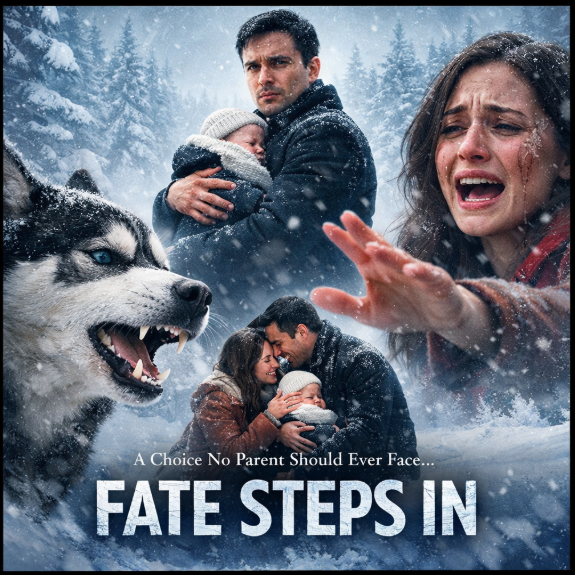
Daniel Carter stood at the edge of their cabin, dressed neatly despite the freezing cold. His dark winter coat was buttoned perfectly, his gloves spotless, his face calm—too calm. In his arms lay their six-month-old son, Noah, wrapped tightly in a thick wool blanket. The baby slept peacefully, unaware that his life was balanced on a decision that could never be undone.
Emily noticed it the moment she woke up—the silence.
No coffee brewing.
No radio playing softly in the kitchen.
No Daniel humming under his breath, like he always did.
Just the sound of snow brushing against the windows.
Then she saw the empty crib.
Her heart dropped.
She ran outside barefoot, the cold slicing into her skin like knives. And there he was—walking away from their home, toward the dense forest bordering the White River National Forest. Toward the place locals warned children never to wander into.
“Daniel!” she screamed. “Stop!”
He didn’t turn.
She ran, slipping in the snow, lungs burning, tears freezing on her cheeks.
“My baby!” she cried. “Please… please don’t do this!”
Only then did Daniel stop.
But he didn’t turn around.
Because if he did, he knew he would break.
Daniel was not a cruel man. He never had been.
He was the kind who shoveled his elderly neighbor’s driveway without being asked. The kind who left food out for stray animals during winter storms. The kind who stayed awake all night holding Emily’s hand when she had pneumonia, whispering jokes until she smiled.
When Noah was born, Daniel had cried—not loudly, not dramatically—but quietly, overwhelmed with gratitude.
But life does not spare good men.
Three months earlier, Daniel had collapsed at work. The diagnosis came like a death sentence spoken gently.
A rare genetic neurological disorder.
Progressive. Incurable. Painful.
And hereditary.
The neurologist’s voice was calm, practiced.
“Your son has a seventy-percent chance of inheriting it.”
Daniel felt the room tilt.
“If symptoms appear,” the doctor continued, “the child will suffer chronic pain, loss of motor control, and increasing dependency on medical support.”
That night, Daniel didn’t sleep. He sat beside Noah’s crib, counting every rise and fall of his tiny chest, memorizing his face as if time were already running out.
Then came the second blow.
The treatment Daniel needed to slow his own condition was expensive—far beyond what his insurance covered. Within months, he would lose his job. His strength. His ability to walk without help. Eventually, his ability to speak clearly.
Soon, Emily would be caring for two lives instead of one.
And Daniel knew something Emily didn’t.
He had found a private humanitarian adoption trust in Seattle, funded by donors who specialized in high-risk infants. Children placed there were raised with the best medical care, constant genetic monitoring, and resources their small mountain town could never provide.
But there was a condition.
The child had to be left anonymously.
No names.
No contact.
No explanations.
Daniel hated the rule.
But he hated the thought of Noah screaming in pain more.
So he decided to carry the sin alone.
“Don’t come closer,” Daniel said quietly as Emily reached him.
She collapsed to her knees in the snow.
“You’re his father,” she sobbed. “You love him. I know you do.”
Daniel’s hands tightened around the blanket.
“I love him more than my own life,” he whispered, voice cracking. “That’s why I can’t keep him.”
Emily froze.
“What are you saying?”
“If he stays with us,” Daniel continued, staring at the forest, “there’s a chance his entire life will be suffering. We won’t be able to save him. But if I leave him where he can be found—where doctors, money, and care exist—he might live without pain.”
Emily shook her head violently.
“We’ll fight it together.”
“There won’t be a ‘together’ soon,” Daniel said, tears freezing on his lashes. “I’m getting worse, Emily. And when I do, you’ll drown trying to save both of us.”
He turned, finally, and she saw his eyes—not cold, not heartless, but terrified.
“I refuse to let my son remember pain as his childhood.”
Emily crawled toward him.
“I’d rather have him struggle with love than grow up without us.”
Daniel opened his mouth to answer—
And then the forest growled.
A sharp bark tore through the silence.
Out of the trees burst a Siberian husky—thick fur, piercing blue eyes, snow clinging to its paws. It ran straight toward Daniel and stopped inches away, standing firm, barking fiercely, blocking the path to the forest.
Daniel stepped back instinctively.
The dog didn’t attack.
It didn’t bite.
It simply stood there.
Between a father and an impossible choice.
The husky turned its head and walked toward Emily. Gently, it nudged her trembling hand with its nose. Then it walked back, sat in front of Daniel, and looked up at the baby.
Noah stirred, his tiny fingers curling around Daniel’s coat.
And in that moment, something inside Daniel shattered.
The husky stopped barking.
Its tail wagged softly.
As if saying: You don’t have to do this alone.
Emily stood slowly, the dog at her side.
“We’ll go to Denver,” she said. “I’ll work two jobs if I have to. We’ll ask for help. We’ll fight.”
Daniel shook his head weakly.
“You don’t understand—”
“I understand perfectly,” she said, pressing her hand to his chest. “You’re trying to save him by disappearing. But sometimes… staying is the bravest thing.”
The husky barked once, as if agreeing.
Daniel fell to his knees.
He handed Noah to Emily, pressing his forehead into the snow, sobbing openly now.
“I was so afraid,” he cried. “Afraid of failing him.”
Emily held their son close.
“You didn’t fail. You loved him enough to break yourself.”
Years later, Noah would run through that same snow—healthy, laughing, strong. The disorder never touched him.
Daniel lived longer than doctors predicted. Treatment, community fundraisers, and sheer will kept him going. He never walked fast again, but he always walked beside his son.
And the husky?
They named him Guardian.
He never left their side.
Because on a frozen morning in Colorado, when fate chose to be cruel, a dog reminded a broken family that love does not abandon—it stands in front of the darkness and refuses to move.
And sometimes, that is enough.