
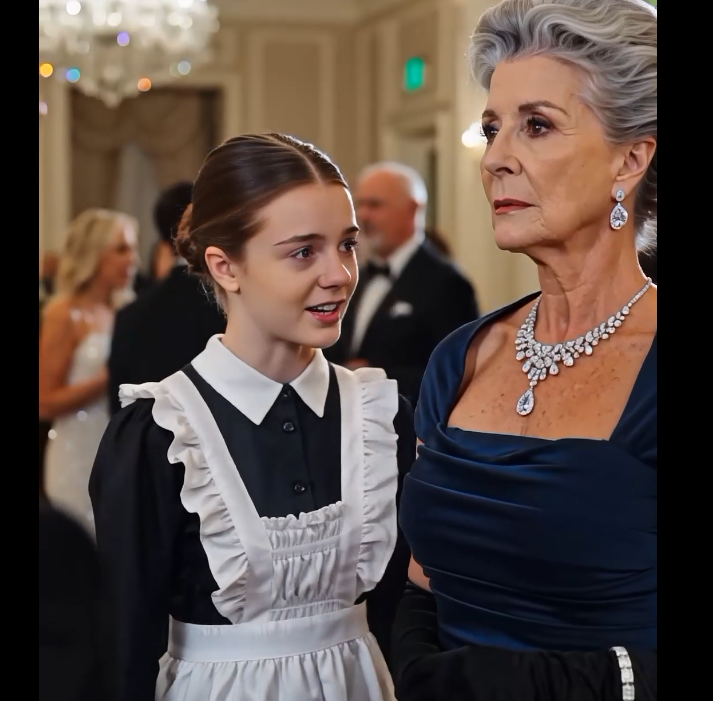
At the center of the celebration stood seventy-year-old Margaret Whitmore, one of the most respected and wealthiest women in California.
She wore a stunning black evening gown, diamond earrings, and an antique gold necklace with a small blue gemstone hanging from its center.
Everyone admired the necklace.
Everyone except an eighteen-year-old maid named Emily Carter.
Emily had been working at the mansion for only three weeks. Her mother had died when she was twelve, leaving Emily with nothing but a few photographs and memories of a woman who had loved her more than anything in the world.
But the moment Emily saw Margaret’s necklace, her entire body went cold.
She recognized it.
The tiny blue gemstone.
The delicate gold chain.
The little crescent-shaped mark on the pendant.
It was identical to the necklace her mother had worn every single day.
Emily’s mother had even told her once, “Sweetheart, this necklace is the only thing I have left from the family I lost. One day, you’ll understand why it matters.”
Emily had never understood those words.
Until tonight.
She slowly approached Margaret, her hands trembling.
“Excuse me, ma’am,” Emily whispered. “Where did you get that necklace?”
Margaret turned toward her sharply.
“What did you say?”
Emily swallowed hard, staring at the pendant.
“Your necklace, ma’am. Where did you get it?”
Margaret’s expression hardened.
“Who are you to ask me that question?”
Several guests nearby turned to look.
Emily’s eyes filled with tears.
“Because… because that was my mom’s necklace.”
The orchestra continued playing, but the people standing closest to them fell silent.
Margaret’s face suddenly lost its color.
For a fraction of a second, she looked as though she had seen a ghost.
Then she grabbed the necklace protectively.
“Stop lying!” she shouted. “And get out of my party!”
Emily flinched, but she didn’t move.
“Please,” she begged. “I know that necklace. My mother wore it every day. She told me it was connected to the family she lost.”
Margaret stepped closer, her voice trembling with anger.
“How dare you make up such a disgusting story to embarrass me in my own home?”
“I’m not lying!”
Emily’s voice cracked.
“My mother raised me alone. She worked two jobs just to feed me. Before she died, she held my hand and told me that someone had stolen our family’s happiness. She said that one day, I might discover the truth.”
Margaret’s eyes began to glisten.
For a moment, the old woman looked as though she wanted to say something.
Instead, she turned toward the security guards.
“Get this girl out of here!”
Two guards approached Emily.
But before they could touch her, Emily suddenly cried out.
“Tell me the truth!”
Her voice echoed through the ballroom.
“Why are you so afraid of a necklace? If I’m lying, look me in the eyes and tell me you have never seen my mother!”
Margaret froze.
Her lips parted, but no words came out.
A tall man in his forties stepped forward from the crowd. His name was Daniel Whitmore, Margaret’s only son.
“Mother,” he said quietly, “what is going on?”
Margaret didn’t answer.
Daniel looked at Emily, then at the necklace.
“Why does this girl think your necklace belonged to her mother?”
Margaret’s hands began to shake.
“Daniel, stay out of this.”
But Daniel had noticed something strange.
His mother was not looking at Emily with disgust anymore.
She was looking at her with fear.
And beneath that fear was something Daniel had never seen in his mother’s eyes before.
Guilt.
“Mother,” he repeated, more firmly. “Who was her mother?”
Margaret took a step backward.
“I said this is none of your concern!”
Emily wiped her tears.
“My mother’s name was Sarah Carter.”
The name struck Margaret like a physical blow.
She gripped the edge of a nearby table to steady herself.
Daniel stared at her.
“Sarah?”
Margaret’s eyes filled with tears.
“Please,” she whispered. “Not here.”
Emily shook her head.
“No. My mother spent her entire life suffering without answers. She died believing that the people who once loved her had forgotten her. I’m not leaving until you tell me why you have her necklace.”
Margaret looked around at the hundreds of guests watching her.
For decades, she had protected her reputation with money, influence, and carefully hidden secrets.
But now, in front of everyone, the past had finally found her.
She raised a trembling hand toward the orchestra.
“Stop the music.”
The musicians immediately fell silent.
Margaret turned to the guests.
“I owe this young woman the truth.”
She looked at Emily, and a tear rolled down her wrinkled cheek.
“Your mother wasn’t just someone I knew.”
Margaret’s voice broke.
“Sarah was my daughter.”
A shocked murmur swept through the ballroom.
Daniel stumbled backward.
“What?”
Margaret pressed one hand against her mouth.
“Twenty-six years ago, my husband and I had a daughter named Sarah. She was kind, stubborn, and full of life. But when she was twenty-two, she fell in love with a man we believed was beneath our family’s social standing.”
Emily stared at her.
“My mother was twenty-two when she left home.”
Margaret closed her eyes.
“Your grandfather was a powerful businessman. He believed our family name mattered more than anything. When Sarah refused to end her relationship, he gave her an ultimatum: abandon the man she loved or lose her inheritance.”
“What happened?” Daniel demanded.
Margaret’s shoulders shook.
“Sarah chose love.”
She paused, struggling to continue.
“Your grandfather was furious. He told her never to return. I was terrified of defying him. I begged Sarah to wait until he calmed down, promising that I would find a way to bring her home.”
Emily’s face crumpled.
“But you never came.”
“No,” Margaret whispered. “I didn’t.”
The admission seemed to tear something open inside her.
“Your grandfather controlled every part of my life. I convinced myself that Sarah would eventually return. I told myself she was safe. I told myself that sending her money secretly would be enough.”
Emily stared at her in disbelief.
“You sent her money?”
“Only twice,” Margaret admitted. “And when your grandfather discovered it, he threatened to disinherit Daniel and me. I was a coward. I stopped.”
Daniel looked horrified.
“You let your own daughter live without you because you were afraid of losing money?”
Margaret lowered her head.
“Yes.”
Nobody in the ballroom spoke.
Emily’s tears fell freely now.
“My mother worked in a diner. She cleaned houses. She skipped meals so I could eat. When she became sick, she couldn’t afford the treatment she needed.”
Margaret made a broken sound.
“Emily…”
“My mother never told me that she had a rich family. She never told me she had a mother who could have helped her. She only told me that she hoped one day someone would remember her.”
Margaret began to sob.
“I didn’t know she was sick.”
“You never asked!”
Emily’s scream silenced the entire room.
“You never called. You never visited. You never even tried to find her!”
Margaret sank into a chair.
For the first time in decades, the wealthy woman who could command an entire room had nothing left to hide behind.
Daniel knelt beside his mother.
“Where did you get the necklace?” Emily asked, her voice shaking. “If my mother was your daughter, why are you wearing it?”
Margaret carefully unclasped the chain.
She held the pendant in her palm.
“Because I gave it to Sarah on her twenty-first birthday. It belonged to my mother before me. I told Sarah that whoever wore this necklace would always have a home with me, no matter what happened.”
She looked up at Emily.
“After Sarah left, I kept a photograph of her wearing it. I never thought I’d see her again.”
“Then how did you get it back?”
Margaret began crying harder.
“Three years ago, a lawyer contacted me. He said Sarah had died and that some of her belongings had been found among her possessions. He sent me this necklace along with a letter.”
Emily’s knees nearly gave way.
“My mother died three years ago.”
Margaret nodded miserably.
“I know.”
Emily stared at the necklace.
“Did you read the letter?”
Margaret’s face crumpled.
“Yes.”
“What did it say?”
Margaret couldn’t answer.
Daniel stood up.
“Mother, tell her.”
Margaret slowly reached into her small evening bag and pulled out a folded piece of paper. It had been worn soft at the edges from being handled too many times.
“I have carried this with me ever since it arrived.”
She unfolded it with trembling fingers.
“It was written by Sarah.”
Margaret took a shaky breath and began reading.
‘Dear Mother,
If this letter reaches you, I am no longer here.
I spent many years being angry with you. I wondered how a mother could let her daughter disappear without looking for her.
But as I grew older, I understood that people can be afraid and still love someone. I don’t know whether you were afraid or whether you stopped caring. I suppose I’ll never know.
I have a daughter. Her name is Emily.
She has your eyes.
Sometimes, when she laughs, I see the little girl I used to be. I wanted to bring her to meet you, but I never found the courage. I was ashamed that I had nothing to offer you except my love.
If Emily ever finds you, please don’t punish her for the choices I made.
She deserves to know where she came from.
And if you have even a little love left for me, please give it to her.
Love,
Sarah.’
Margaret couldn’t finish the last line without breaking down.
Emily covered her mouth and wept.
For eighteen years, she had lived without her mother. For six of those years, she had wondered whether there was anyone left in the world who could tell her stories about the woman she had lost.
Now she was standing in front of the answer.
But the answer hurt more than she had imagined.
Margaret held out the necklace.
“This belongs to you now.”
Emily looked at it but didn’t take it.
“No.”
Margaret’s hand trembled.
“Please, sweetheart.”
“Don’t call me that.”
The words cut through Margaret more deeply than any accusation.
Emily took a step backward.
“You don’t get to put a necklace around my neck and pretend that everything is fixed. My mother needed you when she was alive. She needed someone to hold her hand when she was sick. She needed someone to tell her that she mattered.”
Margaret nodded through her tears.
“You’re right.”
“I don’t know if I can ever forgive you.”
“You don’t have to,” Margaret whispered. “I haven’t earned your forgiveness.”
That answer surprised Emily.
Margaret continued.
“I can’t bring Sarah back. I can’t undo the years she spent struggling. And I won’t insult you by pretending that money can repair what I destroyed.”
She placed the necklace on the table between them.
“But I can stop running from the truth. I can tell everyone who Sarah was. I can make sure that the world remembers my daughter, not as the girl who left our family, but as the woman who loved her child enough to give her everything she had.”
Daniel wiped his eyes.
“Emily, I never knew you existed. I was a child when Sarah left. I can’t excuse what my mother did, but I want you to know that you have family here, if you ever decide you want us.”
Emily looked at him.
For the first time that evening, someone had spoken to her without treating her like a servant.
She didn’t answer immediately.
Then she asked Margaret one question.
“Did my mother ever stop loving you?”
Margaret shook her head.
“No. I don’t think she ever did.”
Emily looked down at the necklace.
“She used to tell me that even when people hurt us, we shouldn’t let their mistakes turn our hearts cruel.”
She picked up the pendant.
“She would have wanted me to hear the truth.”
Margaret reached toward her but stopped before touching her arm.
“May I ask you something?”
Emily nodded faintly.
“Would you let me visit your mother’s grave? I want to apologize to her, even if she can no longer hear me.”
Emily swallowed hard.
“She is buried beside the old church in Pasadena. You can come tomorrow morning.”
Margaret nodded, tears running down her face.
“I’ll be there.”
Then Emily added, “But I’m not coming back here to work.”
Margaret looked up.
“I understand.”
“I want to build a life where I don’t have to beg anyone to see my worth.”
“You deserve that,” Margaret said.
“And if you want to know me, you have to know me as Emily. Not as a replacement for your daughter. Not as someone you can buy back.”
Margaret placed a hand over her heart.
“I promise.”
Emily turned to leave.
But before she reached the ballroom doors, Daniel called after her.
“Emily?”
She stopped.
He approached slowly, holding a small framed photograph he had retrieved from the mansion’s family gallery.
It showed a young woman with bright eyes, long brown hair, and a familiar smile.
Emily gasped.
It was her mother.
“I found this in our family gallery,” Daniel said. “My mother never took it down, even after all those years.”
Emily touched the glass with trembling fingers.
For the first time that night, she smiled through her tears.
“She was beautiful.”
“She still is,” Daniel whispered.
Emily carried the photograph home that night.
The following morning, Margaret arrived at the cemetery before sunrise.
She wore no diamonds, no expensive gown, and no jewelry except a simple wedding band.
She knelt beside Sarah’s grave and placed the necklace on the stone.
For nearly an hour, she spoke to the daughter she had lost.
She told Sarah how sorry she was.
She told her about Emily.
And she promised that she would never again hide from the consequences of her choices.
Emily arrived later that morning.
She found Margaret still kneeling beside the grave, holding an old photograph of Sarah as a child.
Neither woman spoke for a long time.
Finally, Margaret whispered, “I don’t expect you to call me Grandma. I don’t expect you to love me. I only hope that, someday, you might let me know you.”
Emily sat beside her.
“I can’t promise that everything will be okay.”
“I know.”
“But I can promise that I’ll give you a chance to tell the truth.”
Margaret closed her eyes in relief.
Emily picked up the necklace and placed it around her own neck.
“My mother wanted me to have this.”
Margaret nodded.
“Then it belongs exactly where it should be.”
Over the following months, Margaret began visiting Emily regularly.
At first, Emily kept her distance. She refused expensive gifts and declined offers to move into the mansion. She wanted to finish school, build her own career, and discover who she was without being defined by her family’s wealth.
Margaret respected her wishes.
She paid for Sarah’s grave to be restored, but she did not put her own name on the memorial. Instead, she arranged for a simple inscription beneath Sarah’s name:
‘A beloved daughter, a devoted mother, and a woman who never stopped loving.’
Daniel became Emily’s closest friend in the family. He helped her find opportunities to study nursing, something she had dreamed of doing because she remembered the nurses who had cared for her mother during her final weeks.
Margaret quietly funded a scholarship program for young people who had lost a parent and struggled to afford their education. She named it the Sarah Carter Foundation, making certain that her daughter’s full name would never again be hidden.
A year later, on Emily’s nineteenth birthday, Margaret invited her to a small family dinner.
There were no hundreds of guests, no orchestra, and no grand ballroom.
Just a table, a homemade cake, Daniel, and Margaret.
After dinner, Margaret brought out a small wooden box.
Inside lay a handwritten note from Sarah, one that had been found among her old belongings.
Emily unfolded it carefully.
‘My darling Emily,
If life ever brings you to the people we lost, remember this: you don’t owe anyone forgiveness, and you never have to accept love that comes with conditions.
But if someone truly changes, if they learn to be honest and humble, you may choose to open a door.
Whatever you decide, make sure your heart remains your own.
I love you more than all the stars in the sky.
Mom.’
Emily pressed the letter to her chest.
Then she looked at Margaret.
For a long moment, neither spoke.
Finally, Emily reached across the table and took the old woman’s hand.
“I’m not ready to forget what happened,” she said.
Margaret nodded.
“You shouldn’t have to.”
“But I don’t want the rest of my life to be about what you did wrong. I want to remember my mother for how much she loved me.”
Margaret’s eyes filled with tears.
“That is exactly how she deserves to be remembered.”
Emily leaned forward and gently embraced her.
Margaret held her as though she were holding something precious that she had once been too frightened to protect.
And for the first time in decades, she allowed herself to grieve without excuses.
The necklace rested against Emily’s heart.
It had once represented a broken family, a lost daughter, and a secret buried beneath years of pride.
Now it represented something different.
Not a perfect reunion.
Not a past that could be erased.
But a truth finally spoken, a young woman choosing her own future, and a family beginning to understand that love means more than blood, wealth, or a famous name.
Sometimes, the people we lose can never return.
Sometimes, forgiveness takes years.
And sometimes, the most meaningful happy ending isn’t getting back everything we lost.
It’s finding the courage to make sure the pain ends with us.
THE END.