The police cruiser didn’t slow down — it bit into the gravel shoulder and slid sideways, engine growling like an animal that had chosen a fight.
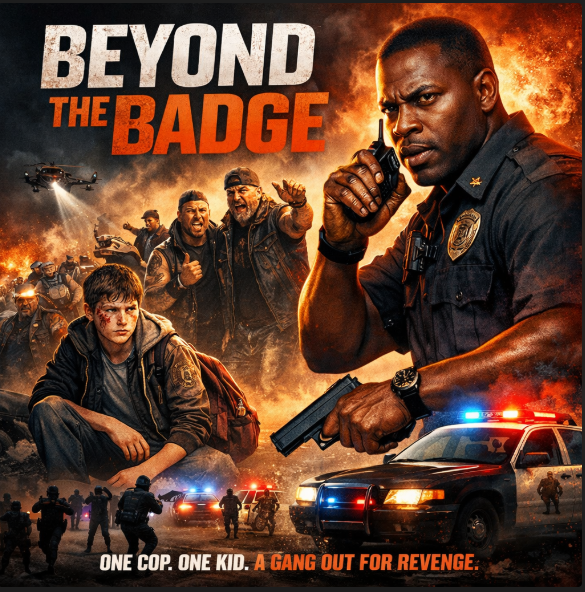
The biker holding the teenage boy by the collar barely had time to turn his head before the bumper clipped his leg and threw him rolling across the dust. The sound — metal, leather, bone — snapped through the air like a gunshot.
The boy stumbled free and fell backward, scrambling on his elbows. Six bikers. Black vests. Chrome machines idling. A torn backpack on the ground beside him.
Silence lasted half a breath.
Then engines revved.
The cruiser door opened.
The officer stepped out fast, controlled, one hand already near his sidearm, radio in the other. Tall. Solid stance. Dark uniform stretched tight across his shoulders. His voice came out sharp and trained.
“Dispatch — officer on scene. Assault in progress. Multiple suspects. Need immediate backup.”
The bikers stared at him — then at their injured friend groaning near the ditch.
One of them laughed.
“You just ran over my brother, cop.”
The officer didn’t blink. “Step away from the kid.”
The teenager — maybe sixteen — bruised cheek, split lip — looked between them like a trapped animal trying to choose which predator was slower.
The largest biker stepped forward. Beard braided with metal rings.
“You don’t know who you just hit.”
“I know exactly who I hit,” the officer replied. “A man assaulting a minor.”
The biker gang spread out slightly — a semicircle — instinctive pack behavior. They weren’t charging. Not yet. But they weren’t backing down either.
The officer keyed his radio again. “Backup priority. Possible gang presence.”
The boy tried to stand and nearly collapsed. The officer noticed without turning his head.
“You — behind the car. Now.”
The kid crawled toward the cruiser, hands shaking.
“You got a name, officer?” another biker asked.
“Yeah,” he said calmly. “The one writing your arrest report.”
That earned a few angry shouts.
The injured biker tried to rise and screamed — his leg bent wrong. Two others dragged him away from the road.
Sirens began — distant but coming fast.
That changed the math.
Biker gangs don’t fear one officer. They do consider five.
The bearded leader spat on the ground. “You made this ugly.”
“You started ugly,” the officer said.
But then something unexpected happened.
The boy behind the cruiser shouted — voice cracking — “They took my phone — they know where I live — they said they’d burn my house!”
The officer turned slightly. “Why were they after you?”
The answer came out through tears.
“My sister testified.”
The bikers went still.
That was the tell.
The officer saw it — confirmation without confession.
Witness intimidation.
Now it wasn’t a roadside bullying case. It was a felony chain.
Sirens grew louder.
The leader cursed under his breath. “Mount up.”
Two bikers rushed to their motorcycles.
“Stop right there!” the officer shouted, weapon now drawn but steady — not panicked — trained.
One biker hesitated.
The other didn’t — he kicked the ignition.
The officer fired once — not at the man — at the rear tire.
The tire exploded with a flat crack and the bike collapsed sideways, throwing its rider.
Now chaos broke open.
Backup arrived in force — three cruisers, then two more — doors flying open, officers fanning out with practiced geometry.
Orders. Shouts. Hands up. On the ground.
Most complied.
Two ran.
One was caught in thirty seconds.
The bearded leader lasted two minutes — tackled behind a storage shed by a K-9 unit.
The dust settled.
The teenager sat on the curb wrapped in a thermal blanket someone produced from a trunk kit. He kept staring at the first officer like he wasn’t sure he was real.
“What’s your name?” the officer asked, kneeling.
“Evan.”
“You’re safe now, Evan.”
But safety is complicated.
At the station, the story deepened.
Evan’s older sister had testified three weeks earlier in a weapons trafficking case tied to the biker crew. Charges were pending. Retaliation had been expected — but not this fast, not this direct.
The gang hadn’t just “found” Evan.
They tracked him from school.
That upgraded everything.
Protective watch was placed on the family within hours.
The officer — Sergeant Marcus Hale — filed a use-of-force report for the vehicle strike and tire shot. Dashcam confirmed the biker had been actively assaulting the minor. The review board cleared him within two days.
But biker networks are like hornet nests — hit one and the vibration travels.
Online chatter spiked. Patrol alerts increased. Known affiliates started disappearing from usual hangouts.
Pressure works both ways.
Evan didn’t go back to school that week.
He stayed in a safe-location apartment arranged through a witness support program. He barely slept the first nights. Every engine sound made him flinch.
Sergeant Hale visited — not as an interrogator — just to check in.
“You like mechanics?” Hale asked, noticing the engine diagrams in Evan’s notebook.
Evan nodded. “I rebuild small engines. Lawn stuff. Dirt bikes.”
“Good skill,” Hale said. “Machines make sense when people don’t.”
That got the first small smile.
Meanwhile, the arrested bikers weren’t quiet in custody. Two tried intimidation. One tried bargaining. But the injured rider — the one struck by the cruiser — broke first. Pain medication loosens pride.
He talked.
Names. Routes. Storage units. A weapons drop scheduled in four days.
Federal task force stepped in.
The roadside incident turned into a multi-agency operation.
Raid day came before sunrise.
Warehouses opened.
Guns seized.
Records taken.
Eight more arrests.
The biker crew — once loud — went suddenly thin.
Court followed fast because of the retaliation angle. Judges don’t like gangs that target witnesses’ families. Bail was denied for most.
Evan testified later — this time by protected video link.
He didn’t shake.
Sergeant Hale watched from the back row.
Afterward, outside the courthouse, Evan asked, “Why did you stop that day? There were other cars.”
Hale shrugged slightly. “Because I was there.”
“That’s it?”
“That’s enough.”
Months passed.
The biker operation fractured. Without leadership and supply routes, groups splintered or went quiet. A few smaller members took plea deals and entered monitored programs.
The bearded leader got twelve years.
The injured biker — the first one hit — received less time for cooperation but left prison with a permanent limp and no gang waiting for him.
Consequences don’t always look cinematic. Sometimes they look like empty parking spots where loud men used to stand.
Evan entered a vocational program funded through a victim assistance grant. Top of his class in engine systems. Apprenticed at a performance garage.
He kept the torn backpack — stitched now — as a reminder.
On the one-year anniversary of the incident, he brought Sergeant Hale a small gift: a restored vintage carburetor mounted on a wooden base.
“Runs perfect,” Evan said.
Hale turned it over in his hands. “You fix broken things.”
“I try to.”
“You will,” Hale said. “Just keep choosing the right machines to rebuild.”
Evan laughed. “And the right people to listen to.”
Some rescues are loud — sirens, gravel, gunshots.
What comes after is quiet — paperwork, protection, patience, rebuilding.
That’s the part most people never see.
But it’s the part that saves lives.