The Bench
The park had seen better days.
Once, it had been full of laughter—children chasing pigeons, couples sharing quiet conversations, joggers cutting through at sunrise. Now, the grass was patchy, the benches chipped and weather-worn, the trees older than most of the people who passed beneath them. But every afternoon, at exactly four o’clock, one bench was never empty.
The old man arrived like clockwork.
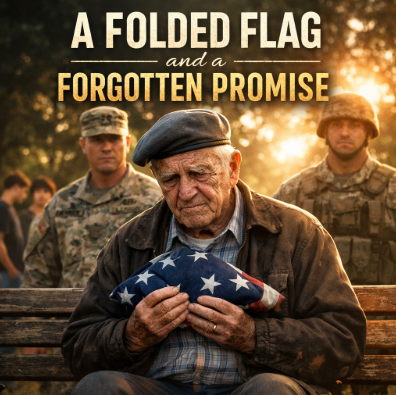
He walked slowly, his steps measured, as if the ground might shift beneath him if he moved too fast. His shoulders were slightly bent, not from weakness, but from decades of carrying things no one else could see. In his right hand, he held a neatly folded American flag. Not brand-new. Not bright. The colors were muted, softened by time, but the folds were perfect—sharp, respectful, practiced.
He lowered himself onto the bench with care.
The wood creaked beneath him, a sound that matched the ache in his knees. He didn’t complain. He never did. Instead, he rested the flag on his lap, both hands placed gently over it, as if it were something alive.
People passed by.
Most didn’t notice him. Some glanced, then looked away. A few stared longer than necessary, curiosity mixing with discomfort. A man holding a flag in silence made people uneasy these days. It reminded them of things they preferred not to think about—duty, sacrifice, loyalty, loss.
The old man didn’t look at them. His eyes stayed fixed on the lake ahead, where the water barely moved and the reflections of trees trembled like memories.
He wasn’t waiting for anyone.
Or maybe he was.
Across the park, a group of teenagers entered through the north gate. Four of them. Loud. Careless. The kind of noise that echoed even when they weren’t shouting. Their laughter cut through the calm like broken glass.
They kicked at pebbles, shoved each other, cursed freely. One of them carried a phone, filming something—nothing in particular, just the moment. Another dragged a stick along the fence, enjoying the screeching sound it made.
They noticed the old man almost immediately.
“At that guy,” one of them said, nudging his friend.
The phone camera tilted.
The flag caught their attention.
“What’s he doing?” another asked. “Is this some kind of protest?”
They slowed their steps, eyes locked on the bench.
The old man sensed them before he saw them. Years of instinct had trained him to feel shifts in the air—changes in tone, posture, intention. He didn’t turn around. He didn’t need to.
Their shadows stretched across the pavement and crept toward his feet.
“Hey,” one of the boys called out. “Nice costume.”
The old man didn’t respond.
“That thing real?” another asked, pointing at the flag.
Still nothing.
The boys laughed. Silence irritated them more than anger ever could.
One of them stepped closer, invading the space around the bench. He leaned forward, close enough for the old man to smell cheap cologne and energy drinks.
“You deaf or something?” the boy said. “I asked you a question.”
The old man’s hands tightened around the flag—not aggressively, just enough to keep it steady.
He lifted his eyes slowly.
They were pale blue, faded but sharp. Eyes that had seen deserts and snow, fire and darkness. Eyes that had learned long ago when to fight—and when not to.
“I’m just sitting,” the old man said quietly.
That only made them bolder.
“Sitting with that?” the boy scoffed. “Man, you still believe in that stuff?”
Another boy snorted. “Nobody cares about that flag anymore.”
The old man looked back toward the lake. His voice, when he spoke again, was softer. Almost tired.
“It matters to me.”
That was the wrong answer.
The boy closest to him reached out suddenly, fingers grabbing the edge of the folded fabric.
“Let me see that.”
The old man reacted on instinct, pulling the flag back toward his chest. “Don’t,” he said—not loudly, not angrily. Just a word. A plea.
But pleas only invited cruelty.
The boy yanked harder.
The flag slipped from the old man’s hands and fell to the ground.
Time slowed.
The cloth hit the pavement with a dull sound, unfolding slightly, red and white lines spreading across gray concrete. The old man stared at it, his breath catching in his chest as if something inside him had dropped with it.
The boys laughed.
“Oops,” one said.
Another stepped forward and planted his foot on the flag, grinding it into the dirt.
“There,” he said. “Now it’s where it belongs.”
Something inside the old man broke—but quietly.
He didn’t shout. He didn’t stand. He didn’t swing his cane or curse or call for help.
He closed his eyes.
A memory rushed in without permission.
A different ground. Different colors. A different flag, raised in smoke and chaos. Voices shouting orders. A friend’s hand slipping from his grasp, blood too warm, too real. The sound of helicopters. The weight of responsibility pressing down until breathing felt like work.
When he opened his eyes again, they were wet.
“Please,” he said, barely audible. “Don’t do that.”
The boys froze for half a second.
Then one of them laughed harder than the rest.
“Did you hear him?” he said. “He said please.”
The phone was still recording.
The boy on the flag looked down, then lifted his foot and slammed it down again, harder this time.
That was when the park went quiet.
Not the natural quiet of afternoon—but a heavy, unnatural silence. The kind that settles just before something changes.
Footsteps echoed behind them.
Slow. Heavy. Purposeful.
The boys turned.
Two figures were walking toward them from the tree line.
They wore dark green uniforms. Their boots hit the pavement in unison. Their posture was straight, controlled, unmistakable.
One of the boys swallowed.
“Yo… who are those guys?”
The old man didn’t look back.
He already knew.
The soldiers stopped a few feet away.
One of them spoke, his voice calm but edged with something that made the air feel colder.
“Step away from the flag.”
The boy laughed nervously. “Relax, man, it’s just a—”
He didn’t finish the sentence.
The soldier moved.
Fast. Precise. He grabbed the boy by the shoulder and shoved him aside—not violently, but firmly enough to make the point unmistakable. The boy stumbled backward, shock replacing arrogance.
The second soldier dropped to one knee.
He lifted the flag carefully, brushing dirt from the fabric with his gloved hand. He folded it slowly, deliberately, as if every movement carried weight.
“People died for this,” the soldier said quietly.
No one laughed now.
The teenagers stood frozen, faces pale, unsure whether to run or apologize or disappear entirely.
The soldier stood and turned toward the bench.
He held the flag out with both hands.
“Sir,” he said.
The old man opened his eyes.
For a moment, he didn’t move. Then, with trembling hands, he reached out and took the flag back.
The soldier saluted.
The old man’s breath hitched.
Tears slid down his cheeks, carving paths through years of restraint.
“Thank you,” he whispered.
The soldiers didn’t respond. They just stood there, solid and unmoving, as if guarding something far bigger than a piece of cloth.
The boys backed away slowly.
The park seemed to breathe again.
But something had shifted.
Because the old man knew—this wasn’t over.
Not yet.
And whatever was about to happen next…
was something none of them were ready for.
—End of Part 1
Part 2: The Weight of the Cloth
The park didn’t return to normal after that.
People pretended it did—walkers resumed their routes, a jogger slowed to stretch, a dog barked somewhere near the trees—but the air felt heavier, charged, like a storm that had paused instead of passed. The teenagers lingered at a distance, whispering among themselves, stealing glances at the soldiers as if trying to decide whether this was real or just another moment that would vanish once the camera stopped recording.
The phone was still in one boy’s hand.
The red light blinked.
Recording.
The soldier nearest him noticed.
“Turn that off,” he said—not raised, not angry. Just firm.
The boy hesitated. For the first time that afternoon, he didn’t feel untouchable. He swallowed and lowered the phone, tapping the screen until the light went dark.
“Yes, sir.”
The old man watched this quietly, his fingers tightening around the folded flag. The soldier’s words, the way authority settled so naturally in his voice—it stirred something deep inside him. A familiarity he hadn’t allowed himself to feel in years.
The second soldier stepped closer to the bench.
“You okay, sir?” he asked.
The old man nodded slowly. “I am now.”
The soldier studied him for a moment—really looked. The careful way he held the flag. The posture that didn’t quite match his age. The eyes that carried too much history to be accidental.
“Were you military?” the soldier asked.
The old man didn’t answer right away.
He looked down at the flag, then back toward the lake. The water rippled gently, as if unaware of what had just happened beside it.
“Yes,” he said finally. “A long time ago.”
The soldier nodded. He didn’t ask more. Some questions didn’t need answers.
Behind them, one of the teenagers cleared his throat. “Look, man… we were just messing around.”
The soldier turned slowly.
“This isn’t messing around,” he said. “This is disrespect.”
Another boy shifted his weight. “We didn’t know he was—”
“It doesn’t matter who he is,” the soldier interrupted. “It matters what you did.”
Silence.
The boys stared at the ground. The arrogance that had fueled them earlier had drained away, replaced by something unfamiliar—consequence.
The old man sighed.
“Let them go,” he said quietly.
The soldiers turned back toward him, surprised.
“Sir—” one began.
“I’ve seen enough punishment for one lifetime,” the old man continued. “They’ll remember this. That’s enough.”
The teenagers looked up, startled.
The soldier studied the old man again, then nodded once. “All right.”
He turned back to the boys. “You’re done here. Leave. And don’t come back today.”
They didn’t argue.
They left quickly, shoulders hunched, glancing over their backs until they disappeared beyond the trees. The park seemed wider without them, the tension draining slowly like water through cracked concrete.
For a moment, no one spoke.
Then the soldier nearest the bench extended his hand.
“My name’s Miller,” he said.
The old man took it, his grip weaker than it once had been, but steady. “Daniel.”
Miller smiled slightly. “Good to meet you, Daniel.”
The second soldier—taller, broader—shifted his stance. “We were on leave,” he said. “Didn’t expect to see something like that today.”
Daniel gave a dry chuckle. “Life has a way of surprising you.”
Miller glanced at the flag. “Is that…?”
“My son’s,” Daniel said.
The words came out before he could stop them.
The soldiers didn’t react outwardly, but something in their expressions softened.
“He carried it overseas,” Daniel continued. “Brought it home folded just like this. He said it reminded him why he went.”
Daniel’s voice wavered, but he pushed through.
“He didn’t come back the second time.”
The park felt quiet again—but this time, the silence carried respect.
“I sit here every day,” Daniel said. “Same bench. Same time. Just to remember.”
Miller nodded slowly. “I’m sorry, sir.”
“So am I,” Daniel replied.
A breeze passed through the trees, rustling leaves, lifting the edge of the flag just slightly. Daniel adjusted it instinctively, smoothing the fabric with his thumb.
“You didn’t have to step in,” he said to the soldiers. “But I’m grateful you did.”
Miller hesitated, then spoke carefully. “We were nearby. Saw the whole thing start.”
Daniel looked at him. “Then you saw me do nothing.”
“That’s not what I saw,” Miller said.
Daniel raised an eyebrow.
“I saw restraint,” Miller continued. “That’s harder than fighting.”
Daniel considered that, then smiled faintly.
They stood there for another moment, three men bound by something invisible yet undeniable. Different generations. Different wars. The same understanding.
Then Miller’s radio crackled.
“Unit Four, status?”
Miller lifted it. “All clear.”
“Copy. Resume patrol.”
Miller clipped the radio back to his vest and looked at Daniel. “We should go.”
Daniel nodded. “Of course.”
The soldiers took a few steps away, then Miller stopped.
He turned back.
“Sir,” he said, “with your permission… I’d like to walk you home.”
Daniel blinked, surprised. “That’s not necessary.”
“I know,” Miller replied. “But I’d still like to.”
Daniel hesitated, then slowly stood. His knees protested, but he ignored the pain. He tucked the flag securely under his arm.
“All right,” he said.
They walked side by side along the path, boots and worn shoes moving in quiet rhythm.
As they reached the edge of the park, Daniel paused.
“This flag,” he said softly, “has seen a lot of hands.”
Miller glanced at it. “It’s in the right ones now.”
Daniel nodded.
Across the street, a small crowd had gathered—people who had seen just enough of what happened to feel curious, unsettled, emotional. Someone whispered. Someone else pointed.
A woman stepped forward. “Sir… thank you,” she said, eyes shining.
Daniel didn’t know how to respond. He wasn’t used to being thanked.
He just nodded.
As they continued walking, Daniel felt something unfamiliar stirring in his chest. Not pride. Not anger.
Hope.
But somewhere behind them—unseen, unnoticed—the phone that had been turned off earlier flickered back to life.
The video had already been uploaded.
And across the country, people were starting to watch.
—End of Part 2