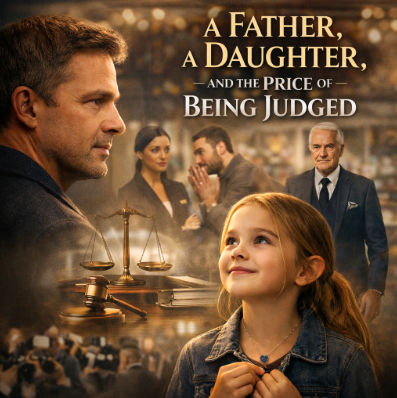
The girl’s fingers tightened around her father’s hand the moment they stepped inside the jewelry store.
It wasn’t fear—at least not at first.
It was awe.
The showroom looked like something from a movie set. Soft golden lights reflected off glass counters. Diamonds sparkled under spotlights like frozen stars. The air smelled faintly of polished wood and expensive perfume. Somewhere in the background, a slow instrumental track played, calm and confident, as if the store itself knew it didn’t need to impress anyone.
The man noticed everything.
Not because he was overwhelmed—but because he was careful.
He wore clean but simple clothes: dark jeans, a plain button-down shirt, slightly faded at the cuffs. His shoes were well-kept, though not designer. No watch flashed on his wrist. No visible signs of wealth. Just a calm posture, straight back, and eyes that observed more than they revealed.
His daughter, Lily, was turning eight today.
And she had never been inside a place like this.
“Daddy,” she whispered, eyes wide, “everything here looks like a princess movie.”
He smiled. “Just look, okay? No touching.”
She nodded quickly, already pressed against the glass, her breath fogging it slightly as she stared at a delicate gold necklace with a tiny sapphire in the center.
Behind the counter, the store staff noticed them immediately.
Two associates exchanged a glance. One raised an eyebrow. The other subtly sighed.
They had seen this type before—or at least, they thought they had.
A man with no visible status symbols. A child dressed neatly but plainly. No shopping bags from nearby luxury stores. No personal assistant. No confident stride that screamed money.
Just another “browser.”
One of the associates, a woman in her early thirties with flawless makeup and a sharp black blazer, stepped forward. Her smile was technically polite—but it didn’t reach her eyes.
“Can I help you?” she asked, her tone edged with impatience, like the question itself was an inconvenience.
The man turned to her calmly.
“We’re just looking for something for my daughter’s birthday.”
Lily looked up at the woman, smiling shyly.
The associate glanced at the girl, then back at the man. Her eyes flicked down—quickly, but not subtly—to his shoes, his shirt, his empty wrists.
A second staff member leaned closer and whispered something. They both smirked.
“I see,” the associate said. “Well…” She paused, letting the silence stretch just long enough to sting. “We really don’t have anything here for your price range.”
A quiet laugh followed. Not loud. Not dramatic. Just enough.
Lily didn’t fully understand the words—but she understood the tone.
Her smile faded.
She tugged on her father’s sleeve. “Daddy… It’s okay. We can go.”
He felt it then.
That familiar pressure in his chest—not anger, not embarrassment—but something colder. Something older.
The associate mistook his silence for defeat.
“Across the street there’s a nice costume jewelry place,” she added, almost helpfully. “Much more affordable.”
Another soft laugh.
The man looked down at his daughter and knelt beside her.
“Hey,” he said quietly. “Did I tell you why birthdays matter?”
She shook her head.
“They’re not about how much something costs,” he said. “They’re about remembering who you are.”
She nodded, not fully understanding, but trusting him completely.
He stood back up and turned to the counter.
“Thank you for your time,” he said calmly.
The associate had already turned away.
That’s when the room changed.
The soft music stopped abruptly.
Footsteps echoed from the back office—slow, deliberate, authoritative.
An older man emerged.
Silver hair, neatly combed. A tailored gray suit that didn’t scream luxury—but whispered it to those who knew. His posture alone commanded attention. Conversations died instantly. Staff straightened. One associate swallowed hard.
The owner had arrived.
He scanned the room once. Took in the staff. The counters. Then his gaze landed on the man and the little girl standing near the display.
His expression shifted.
Recognition.
Not surprise—but confirmation.
He walked forward, each step measured.
“Sir,” the old man said, his voice calm but firm, carrying effortlessly across the showroom.
The associates froze.
“I apologize,” the owner continued. “They don’t know who you really are.”
The room went silent.
Lily looked up at her father, confused.
The associate’s face drained of color. “Mr. Caldwell—I—”
The owner raised a hand without looking at her.
“Not now.”
He turned back to the man.
“I was told you might come in person,” the owner said. “I just didn’t expect it to be today.”
The man nodded slightly. “Timing is funny like that.”
The owner smiled, but there was tension behind it.
“Please,” he said, gesturing toward the private viewing area. “Allow me.”
The associates stood frozen, their earlier laughter now a distant memory.
As the man and his daughter walked past the counter, Lily glanced back once—curious, not smug.
Behind them, the staff whispered urgently.
“Who is he?”
“I don’t know—did you hear the way Mr. Caldwell spoke to him?”
“That wasn’t a normal apology…”
Inside the private room, the owner poured water into crystal glasses.
“I heard about the pending acquisition,” the owner said carefully. “And the insurance dispute.”
The man took a sip.
“It’s not a dispute anymore,” he replied. “My attorney filed this morning.”
The owner exhaled slowly. “A lawsuit?”
“A necessary one,” the man said. “When a company denies a legitimate insurance claim, the settlement usually comes after the headlines.”
The owner nodded. “And the valuation?”
“Tripled,” the man replied calmly. “Once the court order comes through.”
The owner leaned back, stunned.
Outside, the associates stared through the glass, their earlier judgments echoing painfully in their minds.
Inside the room, Lily swung her legs gently.
“Daddy,” she whispered, “are we in trouble?”
He smiled and brushed her hair back.
“No, sweetheart,” he said softly. “Sometimes people just don’t recognize value until it speaks.”
The owner cleared his throat.
“For what it’s worth,” he said, “I’ll be reviewing staff conduct personally.”
The man nodded once. “That won’t be necessary.”
The owner blinked. “It won’t?”
“No,” the man said calmly. “They already learned something today.”
Outside the glass, the associate who had laughed earlier stared at the floor, her career suddenly feeling far less secure.
And as Lily reached toward a simple sapphire necklace—the one she’d admired earlier—the owner gently slid it closer.
“A fine choice,” he said.
The man looked at the price tag.
He didn’t blink.
Because the truth was, this visit had never been about money.
It was about timing.
And soon, everyone would understand exactly who he really was.
The store did not feel the same anymore.
What had once been filled with soft music and quiet arrogance now carried tension—thick, invisible, pressing against the glass walls of the private room.
The associates outside moved carefully, like people walking on thin ice, whispering less, smiling less, suddenly aware that every move might be remembered.
The owner, Mr. Caldwell, folded his hands neatly on the table.
“I want to be clear,” he said. “Nothing that happened here today reflects how this store is supposed to operate.”
The man nodded but said nothing.
Silence, when controlled, had power.
Lily sat quietly beside her father, her feet swinging, eyes fixed on the sapphire necklace now resting on black velvet in front of her. She touched it gently, as if afraid it might disappear.
“Can I really have this?” she asked.
“Yes,” her father said softly. “If you still want it.”
She smiled—small, genuine, unbothered by status or revenge. Just happy.
Mr. Caldwell cleared his throat. “I understand you’re in the middle of… significant corporate activity.”
The man looked up. “That’s one way to put it.”
“The lawsuit,” the owner continued carefully, “it’s already being discussed in private circles.”
The man smiled faintly. “It tends to happen when insurance companies try to avoid large payouts.”
Mr. Caldwell nodded slowly. “Denying that claim was… shortsighted.”
“Illegal,” the man corrected gently.
Another pause.
“My attorney thinks the settlement will set a precedent,” the man continued. “Once discovery is complete, the valuation shifts dramatically.”
Mr. Caldwell exhaled. “Then the acquisition—”
“Is inevitable,” the man said. “Whether they like it or not.”
Outside the room, one of the associates dropped a receipt pad. It hit the floor loudly.
Everyone froze.
Mr. Caldwell didn’t look away from the man. “You didn’t come here to buy jewelry, did you?”
The man smiled again. This time, it reached his eyes.
“No,” he said. “I came because my daughter wanted to.”
Lily looked up at him proudly.
“And because,” he added, “it’s good to see how people behave when they think nothing is at stake.”
Mr. Caldwell’s expression tightened.
“I assume,” he said carefully, “you won’t be mentioning today publicly.”
“That depends,” the man replied. “On what happens next.”
Across town, in a glass-walled conference room overlooking the city, a very different conversation was happening.
A group of executives sat around a polished table. Ties loosened. Phones buzzing nonstop. A large screen displayed a single subject line:
PENDING LITIGATION – URGENT
“This is bad,” one executive said. “Really bad.”
“Our legal exposure just doubled,” another added. “If the court order goes through, the insurance denial becomes indefensible.”
“And the media?” someone asked.
A pause.
“They haven’t picked it up yet,” the general counsel said. “But when they do—”
The room went quiet.
One executive leaned back. “Who exactly is this guy again?”
The general counsel swallowed. “The majority shareholder… who’s been silent for years.”
Someone cursed under their breath.
“He’s not silent anymore,” another said.
Back at the jewelry store, Mr. Caldwell stood.
“If you’ll allow me,” he said, “I’d like to make something right.”
The man raised an eyebrow. “I’m listening.”
“I will personally ensure that every employee here receives additional training,” the owner said. “Not scripted apologies. Real accountability.”
The man considered this.
“And?” he asked.
“And,” Mr. Caldwell added, “I’ll make a public donation—under your daughter’s name—to a children’s legal aid fund.”
Lily’s eyes widened. “What’s that?”
Her father smiled. “It helps kids who don’t get treated fairly.”
She nodded seriously. “That’s good.”
The man looked back at Mr. Caldwell.
“Do that,” he said. “And we’re done here.”
The owner let out a breath he didn’t realize he’d been holding.
As they left the store, the associate who had laughed earlier stepped forward, trembling.
“I—I’m sorry,” she said quietly. “I shouldn’t have said what I did.”
The man stopped.
He looked at her—not with anger, not with satisfaction—but with calm clarity.
“You weren’t wrong,” he said. “You just assumed.”
Her eyes filled with tears.
He took Lily’s hand and walked away.
No lecture. No threats.
That was worse.
The story broke two days later.
Not about the jewelry store.
About the lawsuit.
INSURANCE GIANT FACES MASSIVE LEGAL CHALLENGE AFTER CLAIM DENIAL
INTERNAL DOCUMENTS SUGGEST SYSTEMIC MISCONDUCT
VALUATION OF HOLDING COMPANY SURGES AMID COURT ORDER
Financial analysts began dissecting numbers. Attorneys gave interviews. Shareholders panicked.
And somewhere deep in the article, almost as an aside, a single line appeared:
The plaintiff, who has remained largely out of the public eye, is known for his refusal to engage in performative displays of wealth.
People shared the article anyway.
They always did.
That evening, Lily sat on her bed, the sapphire necklace resting gently against her collarbone.
“Daddy,” she asked, “why did they laugh at us?”
He thought for a moment.
“Because,” he said, “some people only understand numbers they can see.”
“And you?” she asked.
“I understand people,” he replied.
She smiled sleepily. “I like that better.”
He kissed her forehead and turned off the light.
In a corner office miles away, a CEO stared out over the city skyline, phone pressed to his ear.
“Yes,” he said quietly. “I know who he is now.”
A pause.
“No,” he added. “We shouldn’t have underestimated him.”
Another pause.
“Yes,” he said finally. “Prepare the settlement.”
Because the truth was simple.
They hadn’t laughed at his price range.
They had laughed at their own ignorance.
And the cost of that mistake?
Would be far higher than any necklace.