The hospital room smelled of antiseptic and fresh linen. Outside the large glass window, the city lights flickered against the dark American sky. Machines beeped steadily, marking the rhythm of a new life that had just entered the world.
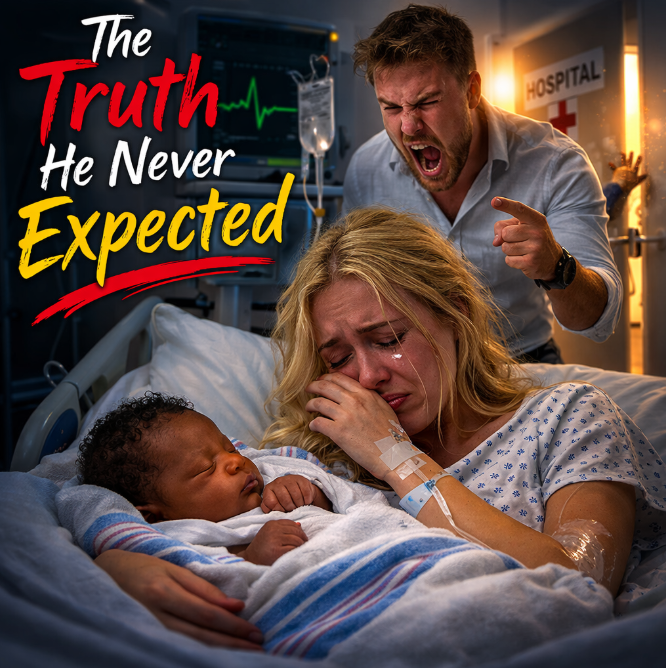
Julie lay back against her pillows, exhausted but glowing. Her blond hair clung to her forehead, damp from hours of labor. In her arms rested her newborn son, wrapped snugly in a soft white blanket with blue stripes. She traced his tiny fingers with trembling hands, tears sliding quietly down her cheeks—not from pain, but from overwhelming love.
He was beautiful.
A nurse adjusted the IV line gently and smiled. “He’s healthy. Strong heartbeat. You did great, Julie.”
Julie nodded, her eyes fixed on her baby’s face. He had dark skin, delicate features, and a quiet strength in his tiny movements. To her, he was nothing short of a miracle.
The door creaked open.
Mark stepped in, breathless and excited. His blond hair was slightly messy, and his shirt was wrinkled from pacing the hospital corridors for hours. His face carried the nervous joy of a man about to meet his child.
“Julie?” he called softly, stepping closer. “How are you? Is he—”
He stopped mid-sentence.
Mark’s eyes fell on the baby.
The smile on his face froze.
His body stiffened. The room suddenly felt smaller, the beeping of the monitor louder.
He stared.
The baby’s skin tone. The contrast between the infant’s features and his own.
His expression slowly shifted from confusion to disbelief.
Then anger.
“Whose baby is this?” Mark’s voice cracked, but it quickly grew sharp. “He is not mine. You cheated on me!”
The words cut through the room like shattered glass.
Julie’s eyes widened in shock. “Mark, no—”
“Don’t lie to me!” he shouted, his face red. “Don’t you dare lie to me while I’m standing here!”
The nurse froze near the door, unsure whether to intervene.
Julie’s breathing quickened. “Mark, please listen to me. I can explain.”
“Explain?” he laughed bitterly. “Explain how my child looks nothing like me? Explain how I’ve been made a fool?”
Tears streamed down Julie’s cheeks. She clutched the baby protectively. “I swear to you, I never cheated. I would never do that to you.”
Mark’s hands trembled. Years of trust, memories, promises—everything seemed to collapse in seconds.
“You will pay for what you did,” he said coldly.
Without another word, he turned, walked out of the room, and slammed the door so hard the walls shook.
Silence filled the space.
Julie broke down completely.
Mark stormed down the hospital corridor, ignoring the curious glances of passing staff. His chest felt tight. His mind replayed the image again and again.
It didn’t make sense.
He had trusted Julie completely. They had been married for three years. They had planned this pregnancy together. He had attended doctor appointments. Held her hair when morning sickness overwhelmed her. Painted the nursery himself.
And now—
He felt betrayed.
Outside, he leaned against a wall, breathing heavily. His phone buzzed. It was his mother.
“Well?” she asked eagerly when he answered. “Is my grandson here?”
Mark hesitated.
“Mom… something’s wrong.”
“What do you mean?”
“He’s… he’s not mine.”
There was silence on the other end.
“What are you saying?” she whispered.
Mark’s voice hardened. “The baby doesn’t look like me. Not even close.”
His mother inhaled sharply. “Mark… don’t jump to conclusions.”
“I know what I saw.”
But deep down, doubt flickered. Not doubt about Julie’s loyalty—he had never questioned her before—but doubt about what he thought he understood.
Inside the room, Julie held her baby close as tears fell onto the blanket.
She had known this moment might come.
Not because she had done anything wrong—but because of something she had kept hidden. Not out of deception, but fear.
When Julie was younger, she had discovered something about her biological history. She had been adopted as a baby. Her adoptive parents, both white, had raised her lovingly in a quiet suburban neighborhood. She had grown up believing she was fully of European descent.
It wasn’t until college that she learned the truth.
A medical test revealed genetic markers that didn’t match her adoptive parents. After searching through old documents, she discovered that her biological father had been African American.
The knowledge had shaken her identity.
But she had never thought it would matter.
When she married Mark, she didn’t bring it up. It felt distant. Irrelevant. She looked white. She had lived her whole life as white.
And now, staring at her newborn son, she knew genetics had written a different story.
The door opened gently again. This time, it was Dr. Harris, the obstetrician who had delivered the baby.
“I heard shouting,” she said calmly. “Is everything alright?”
Julie wiped her tears. “No. My husband thinks I cheated.”
Dr. Harris studied her face carefully. “Did you?”
“No,” Julie said firmly. “Never.”
The doctor nodded. “Then we can clear this up.”
Julie looked confused.
“Genetics can be complicated,” Dr. Harris explained. “Traits can skip generations. Skin tone, features—sometimes they reflect ancestry you didn’t even know was there.”
Julie swallowed. “I… I do know. My biological father was Black. I found out years ago.”
Dr. Harris’s expression softened. “Then that may explain everything.”
“But Mark doesn’t know.”
“Then maybe it’s time he does.”
The next morning, Mark returned to the hospital, quieter but still distant. He avoided looking at Julie directly.
She spoke first.
“I never cheated on you.”
He didn’t respond.
“I was adopted,” she continued. “My biological father was Black. I found out when I was in college. I didn’t tell you because I didn’t think it mattered.”
Mark’s jaw tightened. “That’s convenient.”
“Let’s do a DNA test,” she said. “Today.”
He hesitated. Pride battled with reason. Finally, he nodded.
“Fine.”
The test was arranged quickly. A simple swab. A few anxious hours.
They sat on opposite sides of the room, silence heavy between them.
The baby slept peacefully, unaware of the storm around him.
When the nurse returned with preliminary confirmation, her voice was steady.
“The DNA test confirms,” she said. “Mark, you are the biological father.”
The room went still.
Mark stared at the paper in his hands. The words blurred for a moment.
Probability of paternity: 99.99%.
His breath caught.
He looked at Julie. Really looked at her.
The exhaustion. The pain. The heartbreak in her eyes.
And suddenly, shame flooded him.
“I’m… I’m his father?” he whispered.
Julie nodded, tears forming again. “I told you.”
Mark sank into a chair.
“I accused you,” he said, voice breaking. “I didn’t even give you a chance.”
Julie held the baby closer but didn’t pull away when Mark slowly stood and approached the bed.
He looked at his son differently now.
Not as a symbol of betrayal—but as a reflection of something deeper.
“Hi,” he whispered softly, touching the baby’s tiny hand.
The infant’s fingers wrapped instinctively around his.
Mark’s eyes filled with tears.
“I’m so sorry,” he said to Julie. “I let anger speak before trust.”
She studied him carefully. “You hurt me, Mark.”
“I know. And I’ll spend the rest of my life making that right.”
Days later, when they finally brought their son home, the nursery felt warmer than before.
Mark stood beside the crib, watching his child sleep.
He thought about how quickly he had judged. How easily fear had turned into accusation. How fragile trust could be in moments of shock.
He realized something important.
Love requires patience.
And sometimes, the truth isn’t what shocks you most—it’s how you react before you know it.
He turned to Julie, who stood quietly at the doorway.
“Thank you,” he said.
“For what?”
“For fighting for us.”
She gave a small, tired smile.
Their son stirred softly, and Mark gently placed a hand on his chest.
“Welcome home, little man,” he whispered.
Outside, the evening sun painted the sky in warm colors.
The real truth hadn’t destroyed their marriage.
It had revealed its strength.