I’ve never believed that karma works fast — until the night snow covered Maple Street like a white courtroom.
The wind was sharp enough to sting skin. Porch lights glowed through the snowfall, and the neighborhood sat wrapped in winter silence. Inside one of the houses, silence was broken by shouting.
“Get out!” the woman screamed.
The front door flew open.
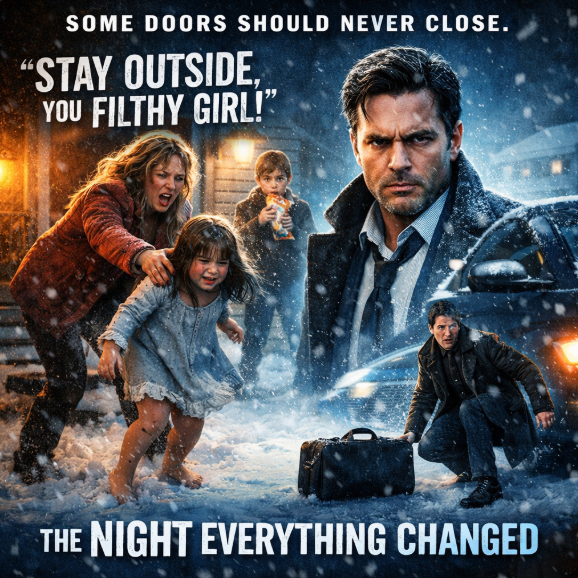
Little Meera — six years old, thin sweater, no shoes — stumbled forward as her mother shoved her hard onto the porch. She slipped on the icy wood and fell to her knees.
“Stay outside, you filthy girl!” her mother spat. “Maybe the cold will teach you not to lie!”
The door slammed like a gunshot.
Snowflakes settled in the child’s hair. Her small fingers trembled. She didn’t even cry loudly — just quiet, broken breaths.
On the side steps, a boy around nine sat with a packet of chips. He had been watching cartoons on a tablet. Now he just stared, chewing stopped halfway. Crunch. Silence. He didn’t know what to do. He’d seen shouting before — but never this.
“Should… should I call someone?” he whispered to himself.
Before he could decide, headlights cut through the snowfall.
A dark sedan braked hard in front of the house.
The driver’s door opened. A well-dressed man stepped out — long coat, leather shoes already gathering snow. He looked irritated at first — then confused — then frozen.
He saw the child.
His briefcase slipped from his hand and hit the road with a dull thud.
He walked forward quickly, crouched down, voice controlled but urgent.
“Hey… hey, sweetheart… where are your shoes?”
The girl tried to speak but her teeth were chattering too hard.
The porch boy spoke instead. “Her mom threw her out.”
The man’s jaw tightened.
He removed his coat and wrapped it around the girl, lifting her gently. She weighed almost nothing.
“What’s your name?” he asked softly.
“M… Meera.”
“I’m Daniel,” he said. “You’re safe now.”
He walked straight to the door and rang the bell. Once. Twice. Then knocked — not loud — but firm.
The door opened violently.
The mother appeared — irritated — then defensive — then suddenly nervous when she saw the man, the coat around the girl, the car.
“Who are you?” she snapped.
“I could ask you the same,” Daniel said calmly. “Why is your daughter barefoot in the snow?”
“She lies. She steals. She needs discipline.”
“She needs warmth,” he replied.
“Mind your business.”
“I am,” he said quietly. “Child endangerment is everyone’s business.”
She scoffed. “You people always interfere. You don’t know what she did.”
Daniel took out his phone. “Good. You can explain it to the police.”
Her confidence cracked for half a second — then pride rebuilt it.
“Go ahead. Call.”
He did.
The porch boy’s chip bag crinkled loudly again in the silence.
Within minutes, red and blue lights painted the snow. Officers stepped out. Questions were asked. Temperatures checked. Statements recorded. The little girl was placed in a heated vehicle with blankets.
The mother kept talking — too much talking — angry talking — the kind that sounds like guilt wearing a mask.
Then a neighbor spoke up. Then another. Stories surfaced. Shouting. Lockouts. Bruises explained away as “clumsy.”
The officers’ tone changed.
By the time the cars left, the mother was in the back seat of one of them.
She shouted threats through the window. No one answered.
Daniel stood in the snow, watching quietly.
The porch boy came closer. “Are you her dad?”
Daniel shook his head. “No. Just someone who stopped the car.”
“Good,” the boy said seriously. “Because dads aren’t supposed to be late.”
Daniel swallowed that sentence like a stone.
Weeks passed.
Meera entered temporary foster care. Quiet. Watchful. Too polite. The kind of politeness children learn when love is unpredictable.
Daniel couldn’t forget her eyes in the snow.
He made calls. He attended hearings. He signed forms. He rearranged his work life. People told him it was complicated — expensive — emotionally risky.
He did it anyway.
Three months later, she walked into his home holding a small backpack and a stuffed rabbit someone from the shelter gave her.
“This is your room,” he said gently.
She stood at the doorway like it might disappear.
“Can I really sleep here?”
“Every night,” he said.
She tested the bed with one careful hand — like touching a cloud.
Children don’t always smile when they’re saved. Sometimes they just breathe differently.
Karma, however, was still writing the other half of the story.
The mother — Rhea — was charged with neglect and abuse. She expected it to blow over. It didn’t. Old reports surfaced. School complaints. Medical inconsistencies. A recorded voicemail full of threats she forgot she sent.
Court didn’t go her way.
She lost custody permanently.
Fines followed. Then probation violations. Then job termination when background checks updated.
Friends stopped answering. Neighbors stopped nodding. Reputation — once sharp — turned brittle.
She said everyone betrayed her.
But karma rarely needs help.
Years moved.
Meera grew.
Therapy helped. School helped. Stability helped most. She discovered she loved drawing — especially winter scenes with bright warm windows.
At age sixteen, she won a state art competition. At eighteen, she earned a scholarship.
At twenty-two, she stood on a stage receiving an award for a children’s book she illustrated — a story about a girl rescued from the snow by a stranger who stopped his car.
Interviewers asked what inspired it.
She answered simply:
“Someone chose to stop.”
One afternoon after the ceremony, as she stepped outside with Daniel — older now, grayer, proud but pretending not to be — a woman approached hesitantly.
Thin. Tired. Eyes carrying years badly.
It was Rhea.
Life had not been kind — but it had been fair.
“I just wanted to say…” the woman began, voice dry, “…I see you did well.”
Meera looked at her for a long moment — not with anger — not with fear — just clarity.
“Yes,” she said gently. “I did.”
“I was going through things back then—”
“I know,” Meera replied. “But I was six.”
Silence.
No shouting. No revenge speech. No cruelty returned.
Just truth — which is heavier than punishment.
Rhea nodded slowly. Words failed. She walked away smaller than she arrived.
Daniel exhaled. “You okay?”
Meera smiled — warm, steady.
“Yeah,” she said. “Winter ended.”
That night, snow began falling again — soft, peaceful, harmless.
Somewhere on Maple Street, a porch light glowed.
But no child stood outside anymore.