I’ve never believed in destiny — not until the day black cars rolled into our village and stopped in front of my broken door.
Our village didn’t even have a proper name on most maps. People just called it “the last stop before nowhere.” Tin roofs, cracked mud walls, open drains, and wind that carried more dust than hope. Nothing important ever happened here. No one important ever came here.
That evening, I was standing outside our small house, rinsing rice in a dented steel bowl. The sky was orange with sunset smoke, and the air smelled like burnt wood and diesel. Kids were chasing a torn football nearby. Old women sat on charpoys gossiping. Normal poverty. Normal silence.
Then the birds flew away all at once.
Not scattered — fled.
I heard engines before I saw them. Smooth engines. Not tractors. Not bikes. Something heavy and controlled.
People turned.
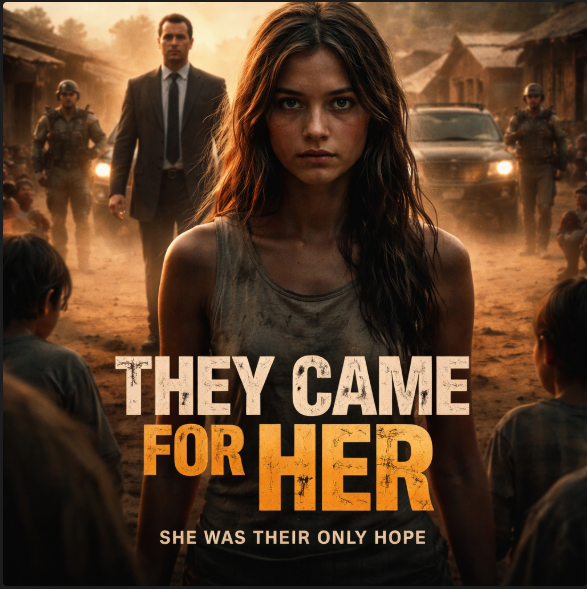
Three vehicles entered the narrow dirt road — one long black luxury sedan and two matte-green military SUVs behind it. No sirens. No horns. Just authority. The kind that doesn’t need to announce itself.
Dust rose like a curtain behind them.
The football stopped rolling. Conversations died mid-sentence. Even the dogs went quiet.
The vehicles halted directly in front of my house.
My first thought was simple: Wrong address.
The sedan door opened slowly.
A polished black shoe stepped into our dirt.
Then he emerged — tall, clean, composed. Dark suit, crisp white shirt, no tie. Not flashy — powerful. The kind of man who looked like he belonged in command rooms and crisis meetings. His face was calm, but not soft. Measured. Like he already knew how this moment would go.
Two armed soldiers exited the SUVs behind him and remained ten steps back — alert, scanning, hands near weapons.
He walked straight toward me.
Not asking. Not checking. Straight.
My fingers tightened around the steel bowl. Water spilled onto my feet.
He stopped at arm’s length and studied my face like he was confirming a photograph in his memory.
When he spoke, his voice was low and certain.
“It’s time,” he said. “We need you. Come with us.”
For a moment, I thought he was joking — or mad — or talking to someone behind me. I even glanced back.
No one.
“Me?” I asked quietly.
“Yes,” he said. No hesitation. “You.”
The villagers had gathered in a half-circle now. Fear and curiosity mixed in their eyes. My neighbor whispered, “What did she do?” Another said, “Government case.” Someone else murmured, “Witness protection.”
I had done nothing. I had been nothing.
“I think you have the wrong person,” I said.
The man reached into his coat slowly — the soldiers tensed — and pulled out an old photograph.
He held it up.
My breath stopped.
It was me.
But not me now.
Me — at age six — standing in a hospital hallway, staring directly into the camera with those same steady eyes I’ve been told are “too serious for a child.”
I dropped the bowl. It clanged loud enough to hurt.
“Where did you get that?” I whispered.
“You saved a man’s life on Highway 47,” he said. “Seventeen years ago. Massive crash. You were first to respond.”
Memory hit like lightning.
Smoke. Glass. Blood. A man trapped. People screaming but not acting. My hands moving without thinking. Pressure on a wound. Tearing cloth. Keeping him breathing until the ambulance came.
“I was just a kid,” I said.
He shook his head slightly. “No. You were precise. Efficient. Untrained — yet exact.”
My chest felt tight. “Lots of kids help.”
“Not like that.”
Behind him, one soldier spoke quietly into his radio: “Confirmation visual. Subject matches.”
Subject.
Not girl.
Subject.
“What is this about?” I asked.
The man studied the village around us — like a doctor looking at symptoms — then leaned slightly closer.
“You’ve had instincts your whole life,” he said softly. “You know things before they happen. You read people too quickly. You react too accurately. Yes?”
I said nothing — which was answer enough.
He continued: “You avoid crowded roads because you sense accidents before they occur. You choose people to trust within seconds — and you’re never wrong. You wake up before storms. Before earthquakes. Before deaths.”
My stomach dropped.
I had never told anyone that.
Not even my mother.
“Who are you?” I asked.
“Director Armaan Rao,” he replied. “Strategic Threat Response Division.”
That sounded invented — or classified.
“I’m not joining the army,” I said automatically.
A faint smile. “This is not the army.”
The villagers leaned closer. Fear had turned into awe now.
My mother pushed through the crowd, breathless. “What’s happening? Why are soldiers here?”
The director turned to her with surprising respect. “Ma’am, your daughter is required for national service.”
My mother grabbed my arm. “She’s done nothing wrong.”
“I know,” he said gently. “That’s why we’re here.”
I pulled my arm free. “Required for what?”
He looked directly into my eyes — and for the first time, I saw urgency behind his calm.
“Because,” he said quietly, “you predicted three disasters — and didn’t know you did.”
My head shook. “I never—”
“Two years ago you told your teacher not to take the river bridge. It collapsed that afternoon. Last winter you warned the clinic nurse to move the oxygen tanks. The building caught fire that night. Last month you told a bus driver to delay departure. Brake failure occurred on the highway.”
My knees felt weak.
I remembered all of it.
Small warnings. Casual words. Gut feelings.
“You’re tracking me?” I said.
“We’re tracking outcomes,” he corrected.
“Why me?”
“Because,” he said, “you are one of the rare Predictive Cognition carriers.”
That sounded like science fiction.
“It means,” he continued, “your brain processes micro-patterns faster than conscious thought — environmental signals, behavioral cues, probability shifts. You don’t guess. You calculate — subconsciously.”
I laughed nervously. “I failed math twice.”
“School math,” he said. “Not survival math.”
The soldiers shifted position. The air felt heavier now — like time was limited.
“What happens if I say no?” I asked.
He answered honestly. “We ask again. Then we protect you anyway.”
“From what?”
He paused.
That pause told me everything.
“From those who already know you exist.”
Cold ran through my spine.
As if on cue, a distant motorcycle engine screamed from the far road — too fast — approaching hard.
One soldier snapped his rifle up. “Incoming.”
Director Rao didn’t turn. “We’re out of time.”
My mother’s grip tightened. “She’s not going anywhere.”
I looked at her — really looked — and realized something strange:
I had seen this moment before.
Not as a dream — as a feeling.
A fork in a path.
“If I go,” I asked quietly, “do people live?”
He held my gaze. No drama. Just truth.
“Yes.”
That was enough.
I stepped forward.
My mother started crying. “You don’t even know them!”
I hugged her fast. “I know me.”
The motorcycle roar grew louder.
The director opened the sedan door. “Get in.”
Villagers watched like history was happening in front of a broken house.
As I sat inside, he spoke one last line — low enough only I could hear:
“By tomorrow morning, you’ll prevent something that would have killed 312 people.”
My heart hammered. “How do you know that number?”
He closed the door gently.
“Because,” he said through the glass, “you already told us — six months ago — during a sleep interview you don’t remember.”
The convoy moved.
Through the rear window, my village shrank into dust and sunset.
I wasn’t being taken.
I was being activated.
And somewhere ahead — something terrible was waiting to be stopped.
By me.