People notice silence more than noise.
The airport was full of it that night. Not the peaceful kind, but the uncomfortable kind—the kind that sits between strangers when no one wants to make eye contact.
It was past midnight at the international terminal, the hour when flights blur together, and exhaustion sharpens people’s judgments. Screens flickered with delays.
Coffee cups littered the floor. Somewhere, a baby cried, and no one bothered to hush it.
Evan Walker felt the silence settle the moment he stepped into the security corridor.
He wasn’t doing anything unusual. Hoodie zipped halfway. Backpack slung over one shoulder. Phone in his hand, boarding pass already pulled up. He had done this routine hundreds of times. Fly. Land. Fix what was broken.
Leave before anyone learned his name. Tonight was no different. Or at least, it wasn’t supposed to be.
“Sir. Step aside.”
The voice was firm. Practiced. Cold enough to slice through the fatigue.
Evan stopped. Two security officers stood in front of him. One was already reaching for his bag.
“Is there a problem?” Evan asked calmly.
The taller guard didn’t answer. His eyes flicked to Evan’s hoodie, then to the backpack, then back to Evan’s face. “Random check.”
Behind them, the line slowed. People sighed. Someone tutted loudly. Evan felt the weight of attention press into his back.
“I’m going to miss my connection,” Evan said. “Boarding closes in eight minutes.”
The guard shrugged. “Should’ve arrived earlier.”
A woman behind Evan leaned toward her companion and whispered, not quietly enough, “Of course they stopped him.”
Evan heard it. He always did.
The bag was placed on the metal table. Zippers opened. Clothes shifted. A few passengers craned their necks, curiosity blooming where empathy should have been.
Evan kept his hands visible, his posture relaxed. Years of training had taught him that stillness was safer than protest.
Then it happened.
A sharp thud echoed across the terminal.
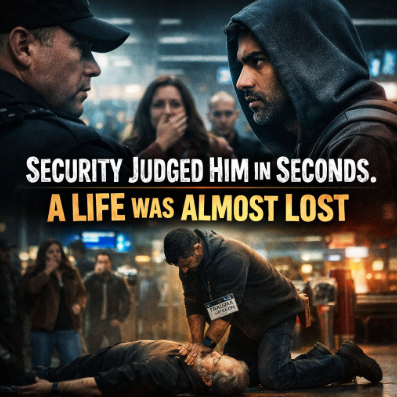
At first, no one understood what they were hearing. Then came the gasp. A suitcase tipped over. A man collapsed near Gate 47, his body hitting the floor with a sound too heavy to ignore. His legs twitched once. Then nothing.
“Sir?” someone called.
No response.
The silence shattered into panic.
“Oh my God!”
“Is he okay?”
“He just fell!”
A woman knelt beside the man, shaking his shoulder. “Can you hear me?” Her voice rose, cracking. “Please—someone help!”
The security guards froze, attention torn between procedure and chaos. Evan’s head snapped toward the sound. His eyes locked onto the man’s face—ashen, lips tinged blue, chest frighteningly still.
“Call for medical!” someone shouted.
A teenager backed away, hands over her mouth. An older couple stared, frozen. The woman kneeling began to cry. “He’s not breathing. Someone do something!”
Evan moved.
“Let me through,” he said, voice sharp now.
The guard stepped in front of him instinctively. “Stay back.”
“I can help,” Evan said.
The guard scoffed. “Sir, step away.”
Evan’s pulse pounded. Seconds mattered. He could see it. The angle of the man’s jaw. The stillness that screamed cardiac arrest.
“Please,” Evan said, louder. “He’s in arrest.”
The guard hesitated. “Medical is on the way.”
“You don’t have time,” Evan snapped. “Move.”
Around them, people watched. Some nodded urgently. Others crossed their arms. The whispering returned.
“Why is he yelling?”
“Who does he think he is?”
“Security should handle this.”
The man on the floor jerked once, then went limp again.
Evan didn’t wait.
He dropped his backpack and pushed past the guard. Someone grabbed his sleeve, but he tore free. He slid to his knees beside the collapsed man, fingers already checking the carotid pulse.
Nothing.
“Sir,” Evan said softly, though he knew the man couldn’t hear him. “Stay with me.”
He tilted the man’s head, cleared the airway, and began compressions. Hard. Fast. Precise. His hands moved with muscle memory carved by years of trauma rooms and sirens and lives balanced on seconds.
“One, two, three—”
“Sir! You can’t—” a guard started.
“Call it in,” Evan barked without looking up. “Adult male, cardiac arrest. I need an AED now.”
The authority in his voice cut through the noise. The guard stopped mid-sentence.
A woman nearby whispered, “How does he know that?”
Evan kept counting. Sweat beaded at his temple. His hoodie slipped open with the movement. A plastic badge slid from the neckline and landed against his chest.
TRAUMA SURGEON.
Someone gasped.
“Oh,” the woman behind them breathed.
The guards saw it at the same time. The taller one’s face drained of color. “Sir—doctor—we didn’t—”
“Not now,” Evan said, never breaking rhythm.
The AED arrived. Evan guided shaking hands through the process. Clear. Shock delivered. He resumed compressions immediately.
The man coughed.
It was small. Weak. But real.
A sound ripped through the terminal—relief, disbelief, hope colliding all at once. The man’s chest rose. Color crept back into his face.
Evan leaned back, breathing hard. “You’re okay,” he murmured. “You’re still here.”
Medical staff rushed in seconds later, taking over. Questions flew. Times were called. Vitals stabilized.
Someone pulled Evan to his feet.
“I’m so sorry,” the guard said, voice low. “We didn’t know.”
Evan wiped his hands on his jeans. “You didn’t ask.”
The guard had no answer.
Passengers stared at Evan differently now. Some smiled. Some avoided his gaze. The woman who whispered earlier wouldn’t meet his eyes at all.
An announcement crackled overhead. Evan’s flight number followed by the words he expected.
Final boarding call.
Evan glanced toward the gate. He knew he’d missed it.
A flight attendant approached, breathless. “Sir, are you the doctor?”
Evan nodded.
“We held the door,” she said quickly. “They told us what you did.”
Evan hesitated. Then he picked up his bag.
As he walked toward the jet bridge, the silence returned—but it had changed. It wasn’t uncomfortable anymore. It was heavy with reflection.
Because everyone there understood something they hadn’t before.
Judgment happens fast. Faster than emergencies. Faster than truth.
And sometimes, it almost costs a life.