She Thought She Was Doing the Right Thing. She Was Wrong.
The woman stopped so suddenly that the heel of her shoe dug into the gravel path. Her heart kicked hard, the kind of jolt that convinces you something important—something dangerous—is happening right in front of you.
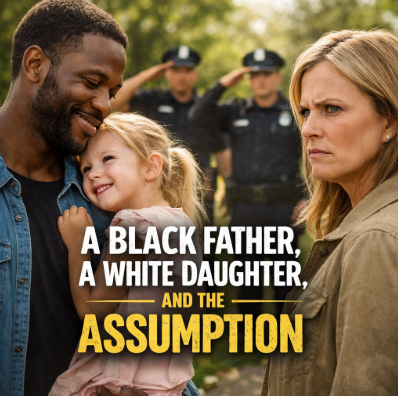
Across the park, a tall Black man walked hand in hand with a little white girl.
The girl laughed, swinging their arms like a pendulum. The man smiled down at her, listening, patient, protective. They looked ordinary. Too ordinary.
And somehow, that made the woman uneasy.
She watched for a few seconds longer than she meant to. The way he leaned closer when the child spoke. The way the child trusted him without question. The way his grip tightened—not possessive, just careful—when a cyclist passed too close.
The woman’s chest tightened. Her mind filled the silence with questions that felt, to her, like concern.
Is that really his child?
Where’s the mother?
Should someone say something?
She told herself she wasn’t judging. She was being responsible. People were always told to “see something, say something.” This was her moment to do the right thing.
She squared her shoulders and stepped forward.
“Hey,” she said sharply, loud enough to cut through the birdsong.
The man stopped. The little girl looked up at him, then at the woman, confused.
“Yes?” he replied, calm but alert.
The woman crossed her arms. “Whose child is that with you?”
The question landed like a slap.
For a split second, the park seemed to hold its breath.
The man looked down at the girl, then back at the woman. His expression didn’t harden. It didn’t flare. Instead, he smiled—a soft, patient smile, the kind parents use when answering a question they’ve answered too many times before.
“She’s my daughter,” he said. “Of course.”
The little girl nodded proudly and squeezed his hand.
The woman felt heat rise in her face. That wasn’t the response she’d expected. He wasn’t defensive. He wasn’t angry. He wasn’t nervous.
He was comfortable.
Still, the doubt didn’t leave her.
She leaned in slightly, eyes scanning the man’s face, his clothes, the child again—as if something might give itself away under closer inspection.
“I don’t believe you,” she said. “This doesn’t look right.”
The smile faded—not into anger, but into something heavier. Tired.
“Ma’am,” the man said evenly, “you’re making a mistake.”
That should have been her cue to stop.
Instead, she reached into her purse.
“I’m calling the police,” she announced. “Stay right here.”
The girl’s fingers tightened around his.
“Daddy?” she whispered.
He knelt so they were eye level. “It’s okay,” he said softly. “I’ve got you.”
The woman stepped back, phone to her ear, voice loud enough for nearby walkers to hear. Words like suspicious, doesn’t add up, public safety floated through the air. A few people slowed. Some stared. No one intervened.
The man stood, shoulders squared now—not in defiance, but in readiness. He had done this dance before. Not here, not today, but enough times to recognize the rhythm.
Minutes stretched. The park no longer felt peaceful.
The woman watched him carefully, waiting for the crack—for fear, for anger, for guilt. None came. He stood there, one hand resting gently on his daughter’s shoulder, eyes forward, breathing steady.
Sirens broke the tension.
Two patrol cars rolled up near the path. Doors opened. Two officers stepped out.
The woman exhaled, relief washing over her face. Good, she thought. Now this will be sorted.
She pointed immediately. “That’s him.”
The officers followed her gesture.
The man met their eyes.
And everything changed.
Both officers froze.
Not in surprise. In recognition.
They walked forward, boots crunching on gravel, posture shifting. As they reached him, they stopped—straightened—and raised their hands in a crisp, unmistakable salute.
“Good afternoon, sir,” one of them said. “Didn’t expect to see you here.”
The park went silent.
The woman’s mouth fell open.
The man returned the salute casually. “Afternoon, officers. Just enjoying the day with my daughter.”
The younger officer glanced at the little girl and smiled. “Lucky kid.”
The woman’s phone slipped slightly in her hand.
“I—I called because—” she stammered.
One officer turned to her, his tone professional but firm. “Ma’am, what seems to be the problem?”
She swallowed. “I was concerned. I didn’t think… I mean, I wasn’t sure if that was really his child.”
The officer’s eyebrows lifted. “Based on what?”
She opened her mouth. Closed it. Opened it again.
“Well… it just looked unusual.”
The older officer’s jaw tightened. “Unusual how?”
Silence.
The man looked at her then—not angry, not smug. Just disappointed.
“This is my daughter,” he said again, quietly. “Her name is Lily.”
The little girl peeked out from behind him and waved.
The officer nodded. “Everything checks out, ma’am. There’s no issue here.”
The woman felt the ground tilt beneath her. “But you saluted him—”
“He’s earned our respect,” the officer replied. “And yours would be appropriate too.”
Heat burned behind her eyes. People were watching now. The joggers. The families. The quiet witnesses who hadn’t stepped in before but hadn’t missed this moment either.
“I was just trying to help,” she said weakly.
The man crouched again, meeting his daughter’s gaze. “Sweetheart, why don’t you go look at the ducks with Officer Mike?”
The officer smiled and walked with the girl a few steps away.
Then the man stood and faced the woman fully.
“Helping starts with asking yourself why you’re afraid,” he said. “And who pays the price for it.”
She couldn’t meet his eyes.
The officers returned Lily to his side. “Sorry for the interruption, sir,” one said.
“No harm done,” the man replied. “But maybe some lessons learned.”
They nodded and walked back to their cars.
The woman stood frozen as the man and his daughter turned and continued down the path, hand in hand, their laughter slowly returning.
Only now, the park felt different.
He hadn’t raised his voice. He hadn’t needed to.
As they disappeared into the trees, a thought hit her harder than any accusation ever could:
She hadn’t messed up because she was wrong.
She messed up because she never questioned herself.
And the realization followed her long after the sirens were gone—heavy, unavoidable, and impossible to ignore.